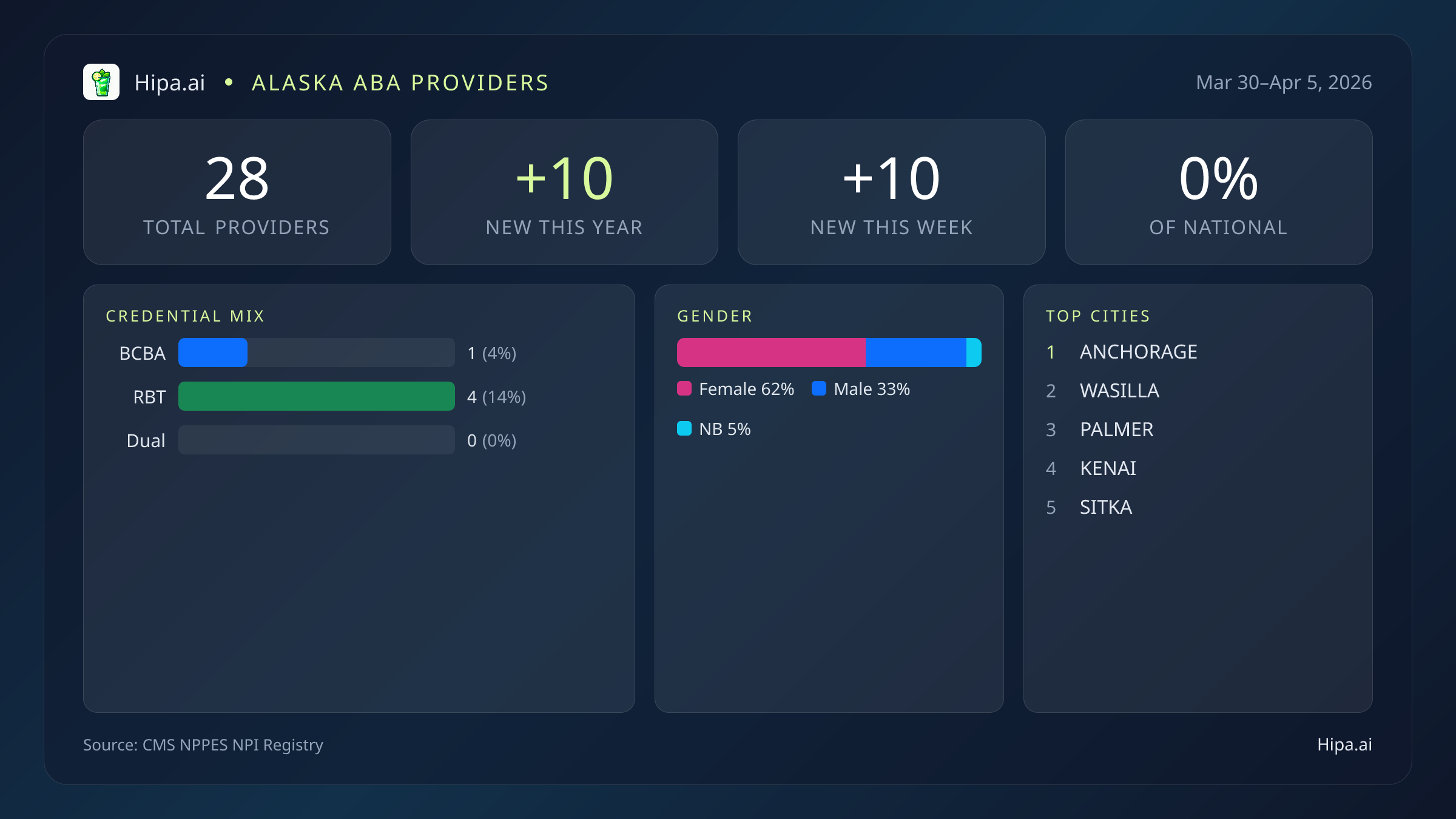
Alaska's behavioral health sector saw minimal expansion in the latest CMS NPI registry update, with a total of 28 behavioral health providers. This represents 0% of the national weekly total, signaling a very limited contribution to the overall U.S. workforce. Notably, all 10 providers new to the registry this year were added in this past week, indicating a recent, albeit small, influx of practitioners to the state's NPI records.
Credential Mix and Supervision Capacity
Within the reported credentials, the state shows a modest ABA workforce. The data identifies 1 BCBA and 4 RBTs. There were no providers holding dual BCBA and RBT credentials in this update. This results in a 4:1 RBT-to-BCBA ratio among the new and updated providers. From an industry perspective, this ratio is considerably lower than the often-cited ideal of 8-10 RBTs per BCBA, which suggests potential challenges for scaling direct ABA services under adequate supervision. Beyond ABA-specific roles, the data also includes one provider with an "MS,LPCS, CDCS" credential and another with a "CDC1" credential, highlighting a broader behavioral health landscape.
Workforce Demographics and Organizational Presence
Of the 21 individual providers, the gender distribution shows 13 female providers, accounting for 62%. There are 7 male providers, making up 33%, and 1 provider identifying as nonbinary, representing 5%. The registry also lists 7 organizations. The Southeast Alaska Regional Health Consortium appeared twice in the provider list, indicating its role as a multi-faceted healthcare entity in the region. This snapshot suggests that Alaska's behavioral health workforce, particularly for ABA services, remains small and may face significant hurdles in meeting demand due to limited BCBA capacity for supervision.