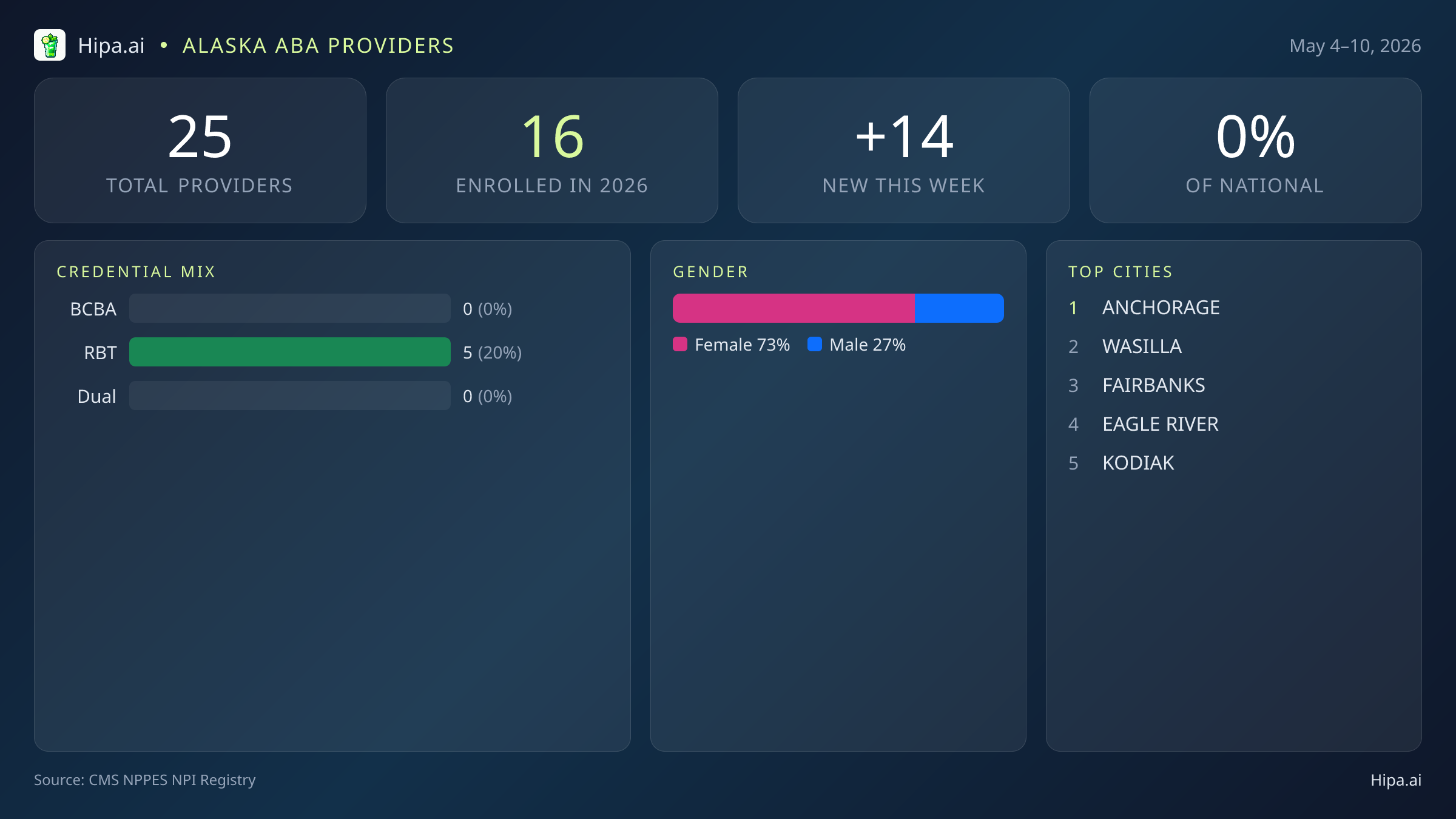
Alaska added 25 behavioral health providers in the latest CMS NPI registry weekly update. While this represents 0% of the national weekly total, indicating a very small fraction of overall new provider activity, it reflects the state's unique challenges for healthcare workforce growth, with 14 new providers joining just this week.
ABA Workforce Composition
The data reveals a critical imbalance within the applied behavior analysis workforce. There are 5 Registered Behavior Technicians (RBTs) listed, but notably, 0 Board Certified Behavior Analysts (BCBAs) and 0 dual BCBA+RBT credentials. This complete absence of BCBAs in the new entries is a significant concern for ABA service delivery, as RBTs require direct supervision. Without local BCBAs, RBTs cannot ethically or legally provide ABA therapy, potentially necessitating reliance on out-of-state supervisors or indicating a very limited local ABA infrastructure. Beyond ABA, the update also includes other behavioral health professionals such as 2 Licensed Professional Counselors (LPCs), 1 Licensed Clinical Social Worker (LCSW), 1 Mental Health Professional Counselor (MHPC), and 1 Certified Drug and Alcohol Counselor (CDC I).
Provider Demographics and Distribution
Of the 22 individual providers, the workforce shows a clear gender distribution: 16 (73%) are female and 6 (27%) are male. The majority of these new providers are concentrated in Alaska's larger population centers, with Anchorage, Wasilla, and Fairbanks being the top cities for new registrations. No specific organizations appeared multiple times in this week's update, suggesting a fragmented or independent provider landscape.
The current data suggests that while there is some growth in the RBT workforce, the lack of BCBA supervisors presents a substantial barrier to expanding access to quality ABA services across Alaska, pointing to a dire need for investment in BCBA training and recruitment.