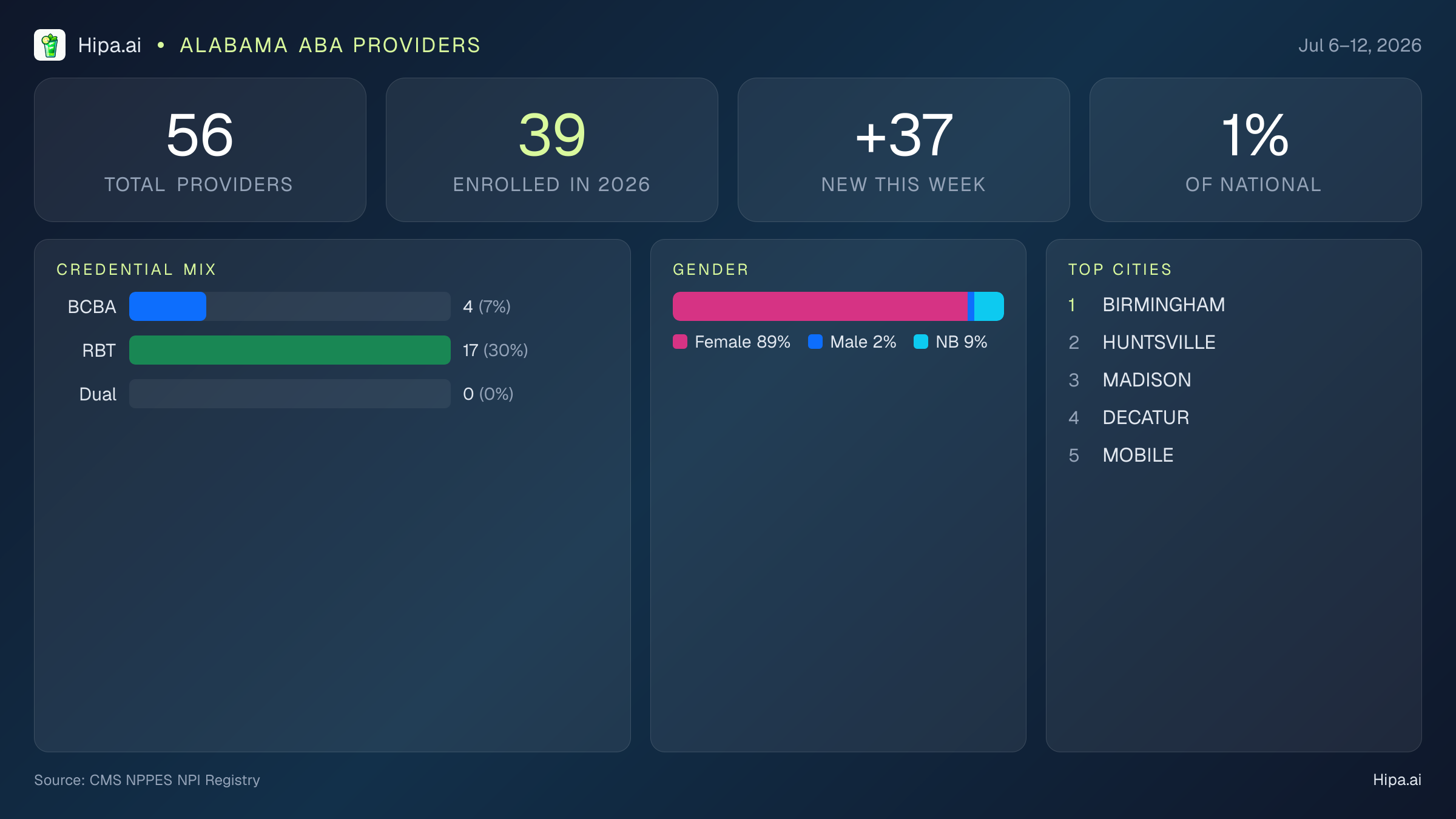
Alabama saw 56 behavioral health providers added in the latest CMS NPI registry update, contributing 1% of the national total. This modest share suggests a steady but not rapidly expanding behavioral health market in the state. Notably, 37 of these providers were new this week, indicating recent growth in the workforce.
ABA Workforce Composition
Within the applied behavior analysis (ABA) sector, the data shows 4 BCBA credentials and 17 RBT credentials. This dataset indicates no individuals holding both BCBA and RBT credentials. The ratio of RBTs to BCBAs, at over four RBTs per BCBA, highlights the critical need for sufficient BCBA supervision to support the direct service RBT workforce and maintain quality ABA therapy delivery. This balance is crucial for scaling services effectively across the state.
Provider Demographics and Organizational Presence
Among the 45 individual providers, the workforce is predominantly female, with 40 (89%) identifying as female. Additionally, 1 (2%) is male, and 4 (9%) identify as nonbinary. No specific organizations appeared multiple times in this update, suggesting that recent growth is distributed across various smaller practices or individual providers rather than being driven by a few dominant multi-state chains.
The continued addition of behavioral health professionals, particularly RBTs, is vital for enhancing access to critical services in Alabama, though the state will need to ensure a proportional increase in BCBAs to meet supervision demands and support a growing ABA workforce.