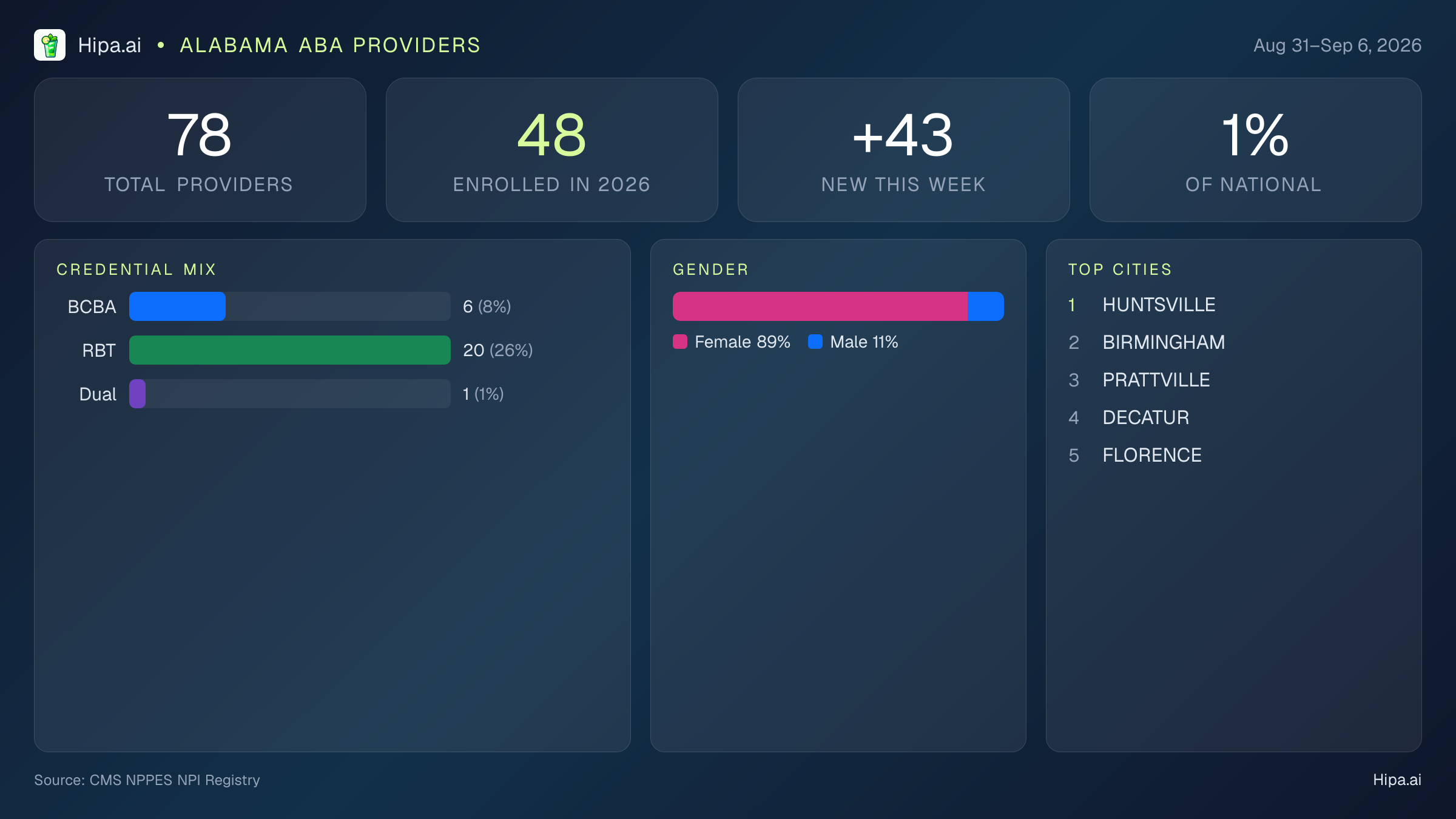
Alabama recorded 78 providers in the latest CMS NPI registry weekly update, representing 1% of the national weekly total. The registry added 43 new providers this week, bringing the year-to-date count to 48. The update includes 61 individuals and 17 organizations. Alabama’s share places it among the more active state markets in this weekly snapshot, although NPI activity reflects registrations rather than confirmed hiring, caseloads, service capacity or appointment availability. The concentration of new records may signal ongoing workforce entry and organizational formation, particularly across Huntsville, Birmingham, Prattville, Decatur and Florence.
ABA Workforce Mix
The credential summary lists 6 BCBAs, 20 RBTs and 1 provider with dual BCBA-RBT credentials. These categories overlap: the dual credential is included in the BCBA and RBT counts, so they are not mutually exclusive shares of Alabama’s 78 providers. The separate credential-text field lists 6 RBTs, illustrating why credential and taxonomy fields should be read as different registry signals rather than combined into one workforce total. Even with that limitation, the registry shows a technician-heavy ABA profile relative to documented BCBA capacity. Because BCBAs supervise RBTs, a small supervisor pool can constrain how quickly technician growth becomes expanded treatment access. The broader mix includes LICSW, LPC and LCSW credentials, along with speech-language and counseling professionals, indicating that the update covers behavioral health beyond ABA.
Demographics and Organizations
Gender data identifies 54 female providers, 7 male providers and no nonbinary providers, corresponding to 89%, 11% and 0%. No notable organization appears multiple times in the update. Seventeen providers carry multiple taxonomies; that overlap may reflect broader service roles and does not represent 17 additional providers.
Alabama’s update suggests expanding registry activity but limited documented BCBA depth, making supervisor recruitment and cross-disciplinary coordination central to improving ABA access.