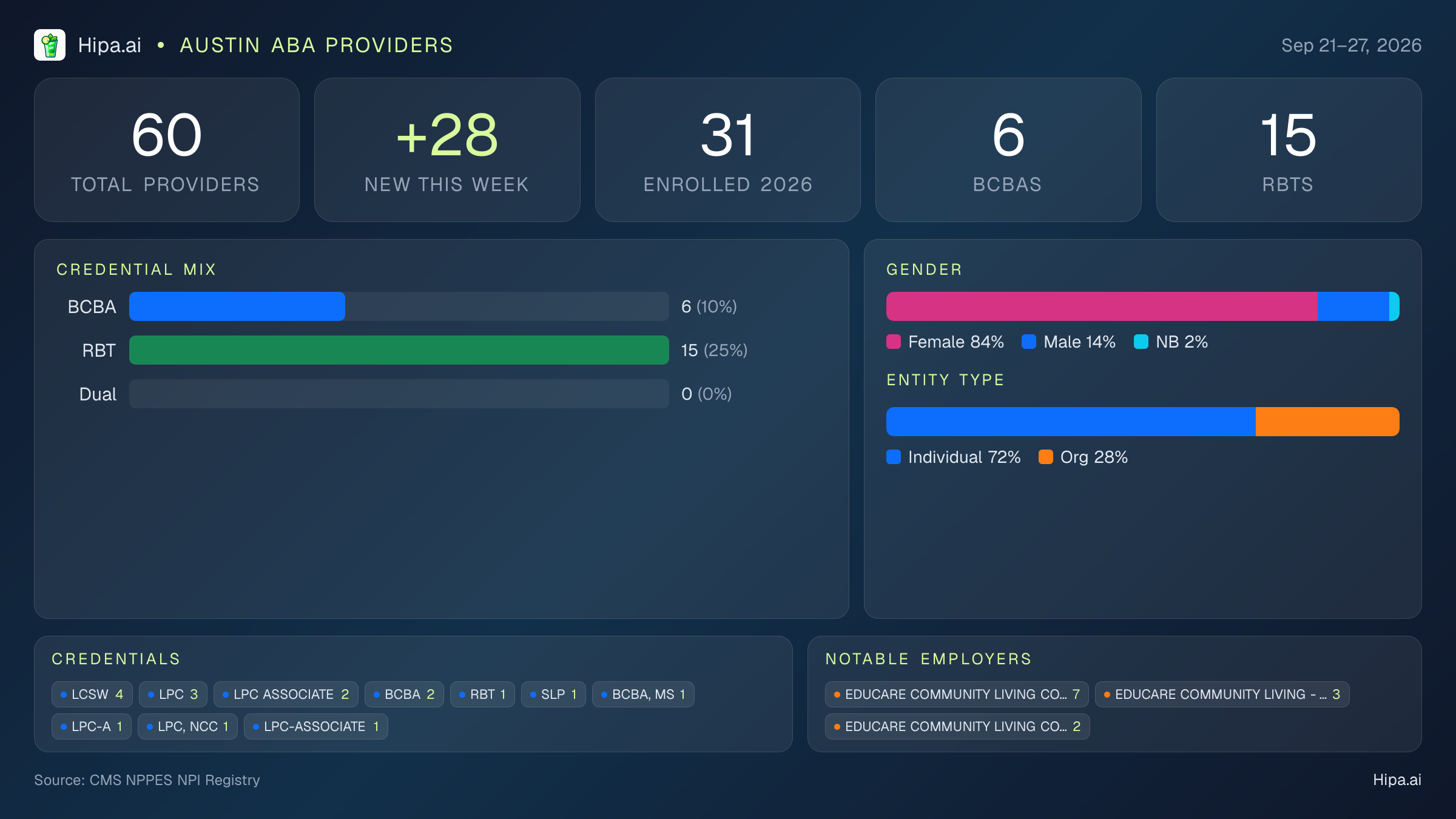
Austin has 60 providers in the latest CMS NPI registry weekly update, accounting for 1% of the national weekly total. The listing includes 28 new providers this week and 31 this year, with 43 individuals and 17 organizations. That activity points to a notable concentration of registered behavioral health providers, but NPI records do not establish who is actively practicing, accepting patients or providing ABA services.
ABA Credential Mix
The registry reports 6 BCBA providers and 15 RBT providers, with no dual BCBA-and-RBT credentials listed. The larger RBT count suggests more listed direct-care personnel than BCBA-level supervisors, a gap that may constrain supervision capacity if the credentials reflect current local staffing. These counts are not a complete ABA workforce measure: the registry includes other behavioral health professions, and taxonomy and credential classifications can overlap. In fact, 19 providers have multiple taxonomies, so those classifications should not be read as mutually exclusive groups. The data also lists one provider with an assistant behavior analyst taxonomy, but that does not change the reported BCBA or RBT totals.
Workforce Demographics
Among individuals, the registry lists 36 women, or 84%; six men, or 14%; and one nonbinary provider, or 2%. The organization appearing most often is EDUCARE COMMUNITY LIVING CORPORATION - TEXAS, with seven records; EDUCARE COMMUNITY LIVING - NORMAL LIFE, INC. appears three times, and EDUCARE COMMUNITY LIVING CORPORATION - GULF COAST appears twice. These are organization records, not counts of individual clinicians. Austin’s registered workforce therefore shows a larger RBT than BCBA pool alongside multiple behavioral health organizations, suggesting that expanding ABA access may depend not only on adding direct-care staff but also on ensuring sufficient BCBA supervision.