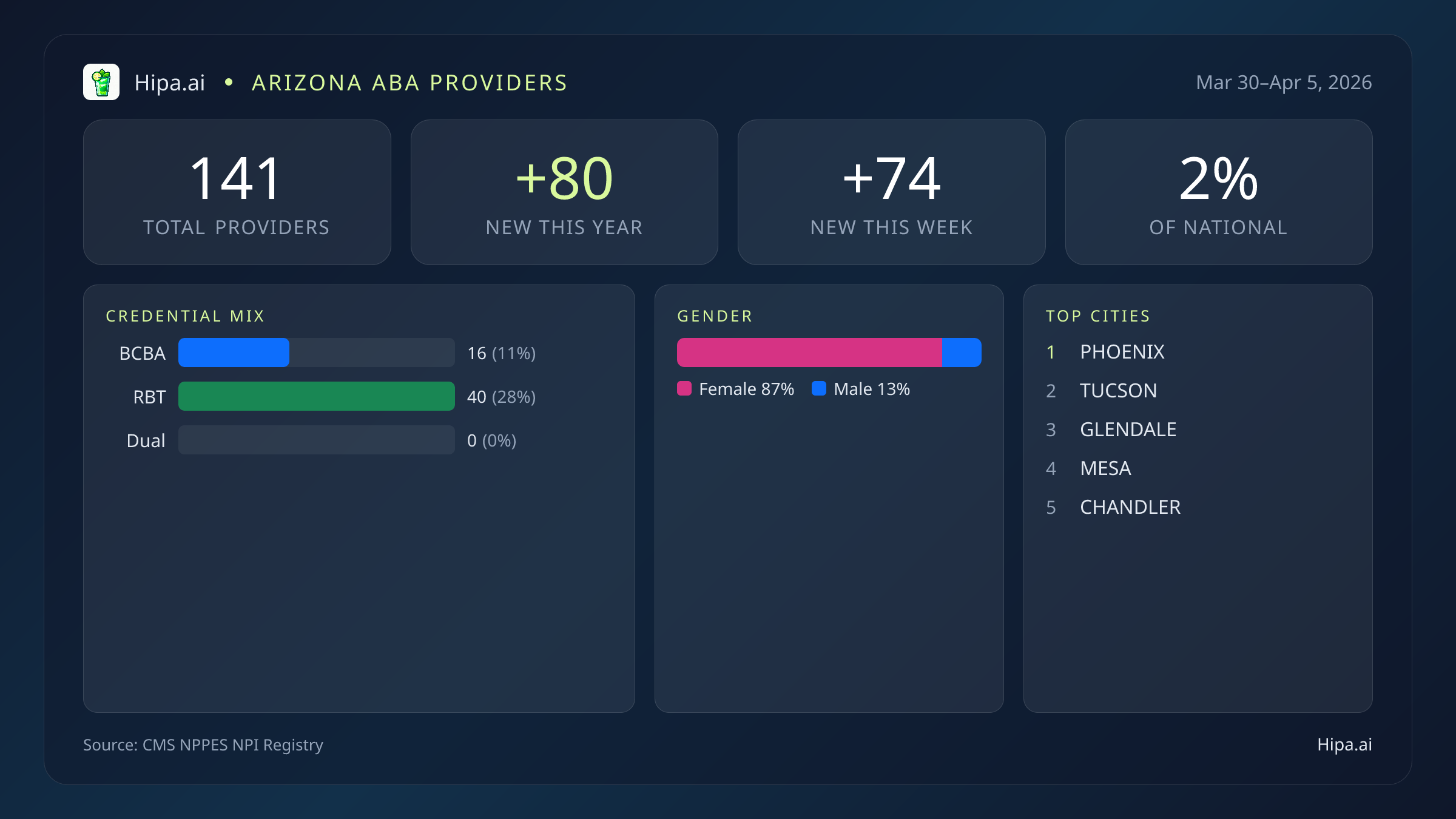
Arizona's behavioral health sector saw a notable influx in the latest CMS NPI registry weekly update, with a total of 141 providers. This represents 2% of the national weekly total, indicating steady, albeit moderate, growth in the state's behavioral health workforce. A significant 74 providers were newly added this week, nearly matching the year-to-date total of 80 new providers, suggesting a concentrated period of recent enrollments. The majority of these additions were individuals, accounting for 110 entries, alongside 31 organizational providers.
Credential Mix and Supervision Capacity
Among individual providers, the data shows 16 professionals holding BCBA credentials and 40 individuals with RBT credentials. This yields an RBT-to-BCBA ratio of 2.5:1, which is a favorable ratio compared to many states, suggesting a relatively healthy capacity for BCBAs to provide adequate supervision for RBTs delivering direct ABA services. Notably, there were no providers explicitly listed with dual BCBA and RBT credentials in this update. Beyond ABA-specific credentials, the data also includes 7 Licensed Professional Counselors (LPC) and 5 Licensed Clinical Social Workers (LCSW), reflecting a broader behavioral health landscape.
Workforce Demographics and Geographic Concentration
The workforce demographics in Arizona continue to show a strong female representation, with 96 female providers making up 87% of individual enrollees, while 14 male providers account for 13%. No nonbinary providers were recorded in this update. Major urban centers like Phoenix, Tucson, Glendale, Mesa, and Chandler are identified as top cities for provider activity, indicating where behavioral health services are most concentrated. Furthermore, 30 providers hold multiple taxonomies, highlighting a diverse skill set and broader scope of practice within the state's behavioral health community, rather than a single specialization.
This data points to a growing and predominantly female behavioral health workforce in Arizona, with a good supervisory foundation for ABA services, suggesting a positive trend for increasing access to care in key urban areas.