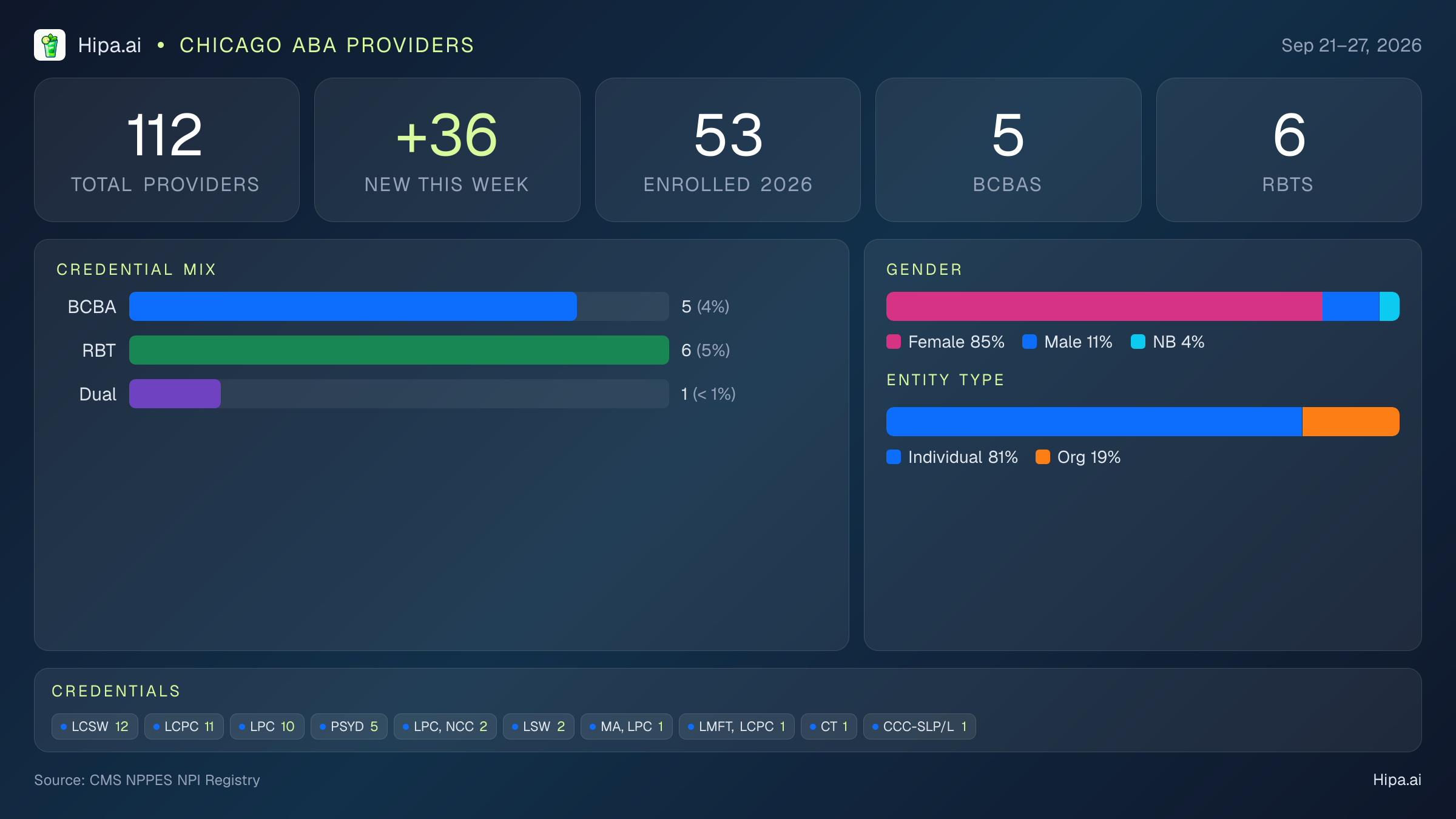
Chicago recorded 112 providers in the latest CMS NPI registry weekly update, accounting for 1% of the national weekly total. The registry lists 36 new providers this week and 53 this year; 91 are individuals and 21 are organizations. The city’s share signals a substantial concentration of behavioral health registrations, though NPI records do not confirm current practice, patient availability or ABA service delivery.
ABA Credential Mix
The registry reports 5 BCBA credentials, 6 RBT credentials and 1 dual credential. The dual BCBA-and-RBT credential overlaps both categories, so these counts are not mutually exclusive. Taken at face value, the listed RBT count is slightly higher than the BCBA count, but the small reported groups do not establish the city’s full ABA workforce or actual supervision capacity. BCBAs supervise RBTs, making the availability and distribution of supervisors important to service access. The update also reports 27 providers with multiple taxonomies, another classification overlap that should not be read as separate provider groups.
Workforce Demographics
Women account for 77 listed providers, or 85%; men account for 10, or 11%, and nonbinary providers account for 4, or 4%. The data identifies no notable organizations appearing multiple times, and it provides no basis for attributing registrations to a multi-state ABA chain. The registry’s broader credential mix includes social workers, counselors and psychologists, reflecting behavioral health activity beyond ABA-specific roles. Because the NPI update counts registrations rather than verified active clinicians or treatment capacity, its figures describe provider activity in the registry, not the number of people able to receive services. Overall, Chicago’s registrations show broad behavioral health activity, while the comparatively small reported BCBA count points to supervision capacity as a consideration for ABA access.