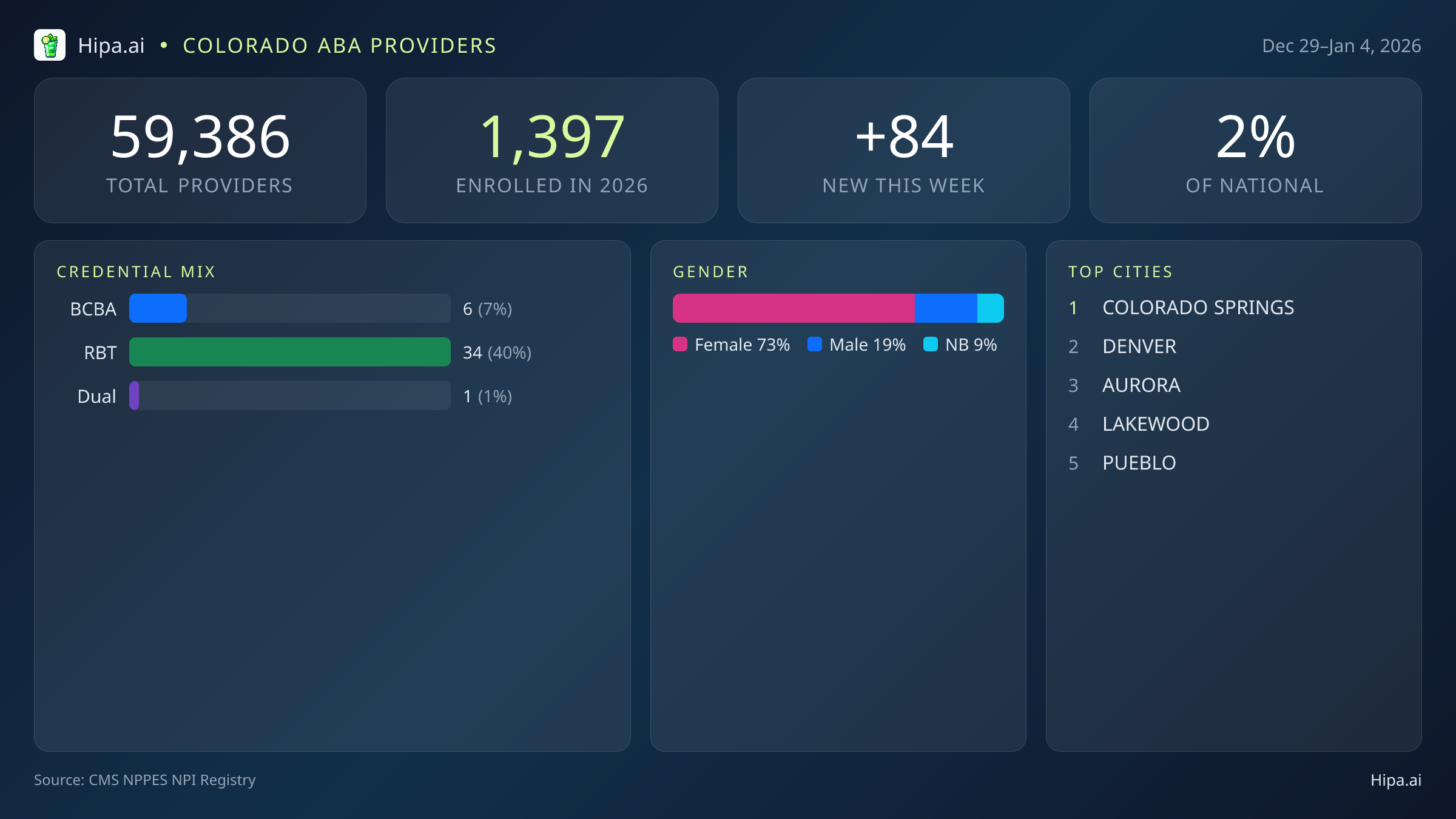
Colorado added 84 behavioral health providers in the latest CMS NPI registry weekly update, accounting for 3% of the national total. This consistent influx of new professionals signals a healthy, if not rapidly accelerating, expansion within the state's behavioral health sector, suggesting ongoing demand for services and a stable pipeline of new practitioners.
ABA Workforce Composition
Focusing on applied behavior analysis, the data reveals 6 Board Certified Behavior Analysts (BCBAs) and 34 Registered Behavior Technicians (RBTs). It's important to note that these credential counts can overlap, as evidenced by 1 provider holding both BCBA and RBT credentials, a common career progression. The ratio of RBTs to BCBAs, approximately 5.67 to 1, indicates a robust foundation for delivering direct ABA services. However, the relatively modest number of new BCBAs compared to RBTs suggests that increasing supervisory capacity will be critical to support the growing RBT workforce and ensure quality care.
Provider Demographics
Among the 70 individual providers, women represent the majority, accounting for 51 individuals or 73%. Male providers total 13 individuals (19%), and 6 individuals (9%) identify as nonbinary. The data did not highlight any specific organizations appearing multiple times in this week's update, suggesting a diverse entry of smaller practices or individual practitioners rather than dominant multi-state chains. The top cities for new providers include Colorado Springs, Denver, and Aurora.
Overall, Colorado's steady growth in behavioral health providers, particularly its RBT workforce, indicates an expanding capacity for direct ABA service delivery, which is vital for improving access to care for individuals with autism and other developmental needs across the state.