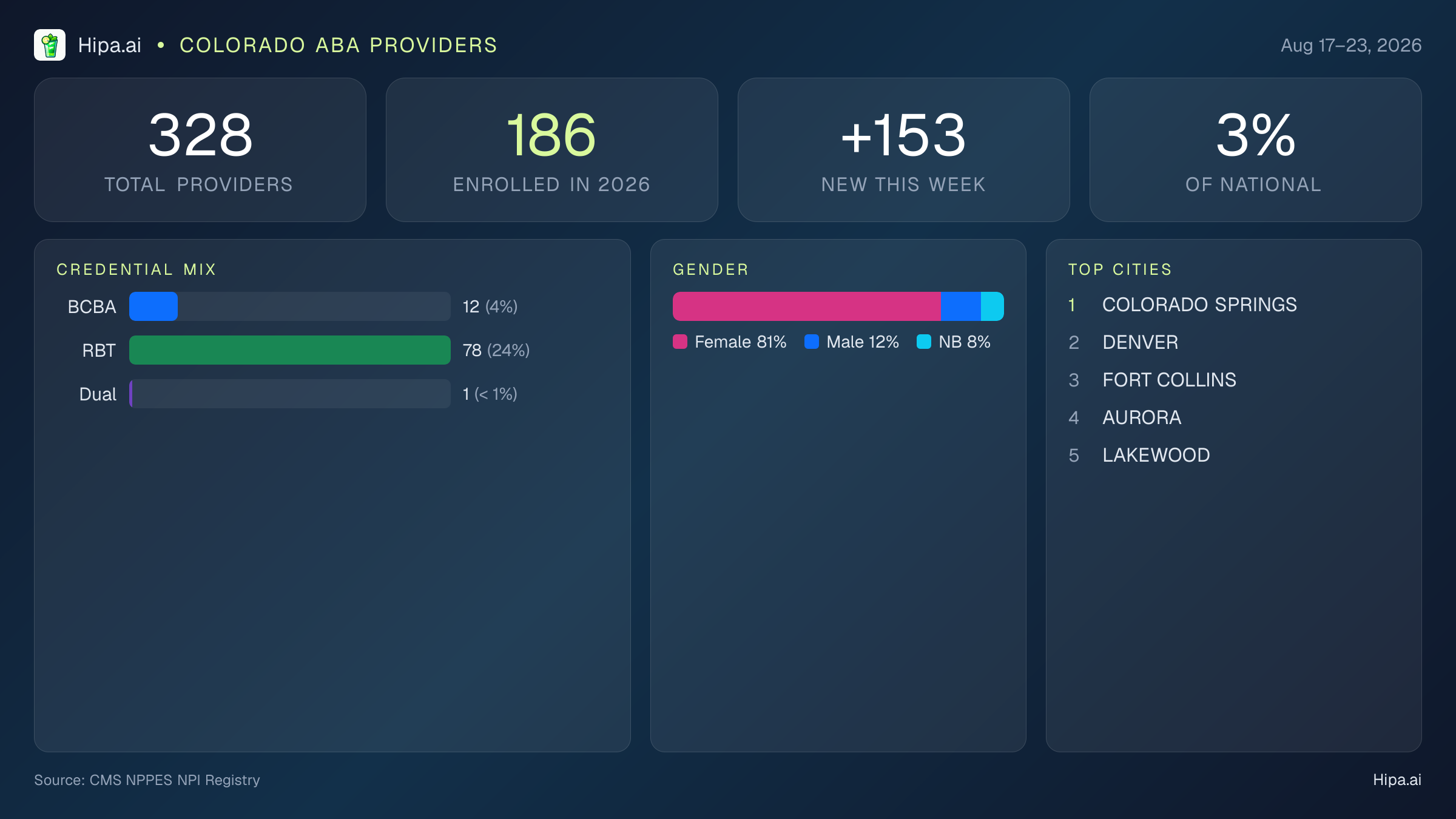
| ABA UP AND UP CO LLCORG | DENVER, CO | - | BCBA | 08/19/2026 |
| ABDULRAHMAAN, TAJMAH | DENVER, CO | - | Addiction (Substance Use Disorder) Counselor | 01/03/2024 |
| ABDULSATTAR, AYA | COLORADO SPRINGS, CO | - | RBT | 08/17/2026 |
| ACKE, AMANDA | COLORADO SPRINGS, CO | BCBA | BCBA | 02/03/2022 |
| ACTION RECOVERY COUNSELING LLCORG | DENVER, CO | - | Addiction (Substance Use Disorder) Counselor | 11/10/2025 |
| ADAMS, DENNIS | ARVADA, CO | - | Case Manager/Care Coordinator | 01/05/2017 |
| ADRIA RIGG, LLCORG | FORT COLLINS, CO | - | Mental Health Counselor | 08/19/2026 |
| ALEXANDER, NICOLE | FORT COLLINS, CO | MSW, LCSW | Clinical Social Worker | 02/19/2009 |
| ALFIERI, KIRSTEN | FORT COLLINS, CO | - | RBT | 08/17/2026 |
| ALKALAY, SHARON | LAFAYETTE, CO | M.S., CCC-SLP | Speech-Language Pathologist | 02/18/2009 |
| ALMEIDA, JEFFREY | COLORADO SPRINGS, CO | - | RBT | 08/18/2026 |
| ALVIS, KENDALL | COLORADO SPRINGS, CO | M.A. LPC | Mental Health Counselor | 02/27/2007 |
| ANDRIS, JAMIE | LITTLETON, CO | - | RBT | 08/17/2026 |
| ARDENT GROVEORG | DENVER, CO | - | Mental Health Counselor | 01/05/2022 |
| ARDOIN, SAMANTHA | FORT COLLINS, CO | - | Mental Health Counselor | 08/03/2020 |
| ARIEL TRANSITION AGENCY LLCORG | AURORA, CO | - | Case Management Agency | 08/20/2026 |
| ARMSTRONG, SHYLA | COLORADO SPRINGS, CO | - | RBT | 08/17/2026 |
| ARNOLD, MEGAN | ARVADA, CO | - | Counselor | 08/17/2026 |
| ASPENRIDGE RECOVERYORG | DENVER, CO | - | Clinic/Center | 08/17/2026 |
| ASSESSING ALTERNATIVES COUNSELINGORG | LAKEWOOD, CO | - | Mental Health Counselor | 08/17/2026 |
| AUTHENTIC SELF LLCORG | BOULDER, CO | - | Mental Health Counselor | 08/21/2026 |
| BABION, MELISSA | FORT COLLINS, CO | MA, LPCC | Mental Health Counselor | 12/19/2023 |
| BAKER HEALTH SERVICES LLCORG | MONUMENT, CO | - | Speech-Language Pathologist | 08/18/2026 |
| BAKER, NATALIE | DENVER, CO | - | BCBA | 03/10/2022 |
| BAKERSKY, KYLIE | GOLDEN, CO | MS, LPCC | Mental Health Counselor | 08/30/2022 |
| BAMONTI, MAKAELA | GOLDEN, CO | LPC | Mental Health Counselor | 07/13/2026 |
| BANCROFT, KRISTINLYN | ALAMOSA, CO | RBT | RBT | 03/24/2026 |
| BEALL, LONI | FORT COLLINS, CO | M.A., LPC | Mental Health Counselor | 09/22/2017 |
| BECKMAN, ALLYSSA | FORT COLLINS, CO | LCSW | Mental Health Counselor | 10/28/2024 |
| BEEYOND COUNSELING LLCORG | FORT COLLINS, CO | - | Mental Health Counselor | 08/20/2026 |
| BELLAROSA, CHEYENNE | DENVER, CO | MSW, LCSW | Clinical Social Worker | 09/28/2020 |
| BELLINI, MORGAN | BOULDER, CO | - | Mental Health Counselor | 01/02/2020 |
| BIRMINGHAM, BRENNA | LAKEWOOD, CO | CAT | RBT | 08/20/2026 |
| BJORNSTAD, JONATHAN | NORTHGLENN, CO | - | Addiction (Substance Use Disorder) Counselor | 08/18/2026 |
| BLAIR, MEGAN | COLORADO SPRINGS, CO | PHD | Mental Health Counselor | 06/04/2016 |
| BLAIR, MICHAEL | COLORADO SPRINGS, CO | LPC | Mental Health Counselor | 01/02/2024 |
| BLUE SPRIG PEDIATRICSORG | AURORA, CO | - | RBT | 07/28/2026 |
| BOHL, KATELYN | DENVER, CO | - | RBT | 08/20/2026 |
| BOOTSMILLER, JACKSON | AURORA, CO | - | Case Manager/Care Coordinator | 08/18/2026 |
| BOWER, KATHRYN | DENVER, CO | - | Speech-Language Pathologist | 06/23/2022 |
| BOWES-BACA, BRIANNA | COLORADO SPRINGS, CO | - | RBT | 08/17/2026 |
| BOWMAN, NATALIE | DENVER, CO | CCC-SLP | Speech-Language Pathologist | 05/22/2018 |
| BRAINARD, REBECCA | LAKEWOOD, CO | - | Case Manager/Care Coordinator | 08/19/2026 |
| BREATH & BONE LLCORG | LITTLETON, CO | - | Mental Health Counselor | 08/19/2026 |
| BRIDGE CARE CONNECTIONSORG | DENVER, CO | - | Case Management Agency | 06/08/2026 |
| BRIGGS, NICOLE | PUEBLO, CO | - | Mental Health Counselor | 08/20/2026 |
| BROWN, HOLLY | DENVER, CO | - | Speech-Language Pathologist | 09/17/2024 |
| BROWN, SARA | ARVADA, CO | MA, LPCC | Mental Health Counselor | 08/17/2026 |
| BUCK JACK, LLCORG | PUEBLO, CO | - | BCBA | 07/23/2025 |
| BURK, ASHLEY | COLORADO SPRINGS, CO | - | Clinical Social Worker | 08/26/2022 |
| BURNING SAGE LLCORG | COLORADO SPRINGS, CO | - | Professional Counselor | 04/13/2021 |
| BUSKARD, JESSICA | DENVER, CO | - | BCBA | 05/06/2019 |
| BYRNE, CLAUDIA | LAKEWOOD, CO | - | Psychologist | 05/23/2005 |
| CAPPELLUCCI, LANI | PUEBLO, CO | - | Mental Health Counselor | 06/09/2021 |
| CARDENAS, JULIA | LOVELAND, CO | - | Speech-Language Pathologist | 08/20/2026 |
| CARDENAS, MOLLY | DENVER, CO | - | Mental Health Counselor | 07/21/2023 |
| CARRASQUILLO DOMENA, JEREMY | COLORADO SPRINGS, CO | - | RBT | 07/07/2026 |
| CARROLL, JULIE-ANNE | PUEBLO, CO | - | RBT | 08/18/2026 |
| CARROLL, RACHEL | CASTLE ROCK, CO | M.S. CCC-SLP | Speech-Language Pathologist | 08/19/2026 |
| CARTER, TEAGAN | LAKEWOOD, CO | - | Professional Counselor | 08/20/2026 |
| CASIMIRO, MICHAEL | DENVER, CO | LPC | Counselor | 04/05/2023 |
| CASTILLO, JAIME | LAKEWOOD, CO | LPC | Professional Counselor | 09/21/2021 |
| CCJK, PLLCORG | ENGLEWOOD, CO | - | Clinical Social Worker | 08/21/2026 |
| CHAMBERLIN, ZACHARY | DENVER, CO | - | RBT | 08/19/2026 |
| CHARRON, JULIA | GREENWOOD VILLAGE, CO | SWC | Clinical Social Worker | 05/16/2024 |
| CISNEROS, VALERIA | PARKER, CO | - | RBT | 08/18/2026 |
| CLARK, AIMEE | THORNTON, CO | LCSW | Clinical Social Worker | 11/12/2006 |
| COATES, EMILY | COMMERCE CITY, CO | MA, BCBA | BCBA | 12/10/2019 |
| COGSWELL, DEVON | DENVER, CO | - | Mental Health Counselor | 08/12/2026 |
| COLE, DARCY | CANON CITY, CO | DSW, LCSW, LAC | Addiction (Substance Use Disorder) Counselor | 07/11/2019 |
| COLLECTIVE CO LLCORG | GLENDALE, CO | - | Counselor | 08/28/2019 |
| COLORADO TELETHERAPY SERVICESORG | COLORADO SPRINGS, CO | - | Mental Health Counselor | 08/21/2026 |
| CONNOR, CODY | FORT COLLINS, CO | - | Addiction (Substance Use Disorder) Counselor | 08/19/2026 |
| CORRIERI, DANIELLE | FORT COLLINS, CO | - | BCBA | 02/03/2025 |
| COWART, MACI | THORNTON, CO | - | Professional Counselor | 01/18/2022 |
| CREWS, DELICIA | DENVER, CO | RBT | RBT | 08/18/2026 |
| CRISP, MELISSA | COLORADO SPRINGS, CO | LCSW | Clinical Social Worker | 06/19/2020 |
| CUEBAS, CRISARA | FORT COLLINS, CO | - | Professional Counselor | 08/22/2026 |
| DANAES SPEECH THERAPYORG | EVERGREEN, CO | - | Speech-Language Pathologist | 08/10/2026 |
| DASPIT, EMILY | DENVER, CO | LPC | Professional Counselor | 03/15/2024 |
| DAVENPORT, MCKENZIE | CENTENNIAL, CO | LAC | Mental Health Counselor | 04/11/2022 |
| DAVIDSON, LAUREN | DENVER, CO | - | RBT | 08/19/2026 |
| DAVIS, KIERSTEN | FORT COLLINS, CO | M.S., CCC-SLP | Speech-Language Pathologist | 08/20/2026 |
| DE'ANDA, JAYDA | PUEBLO, CO | - | Mental Health Counselor | 08/20/2026 |
| DEL ALMA COUNSELING & HOLISTIC WELLNESS PLCCORG | DENVER, CO | - | Professional Counselor | 07/08/2026 |
| DELEWSKI, KATHERINE | LITTLETON, CO | LCSW | Clinical Social Worker | 07/05/2018 |
| DIALECTICAL PATHWAYS TO WELLNESSORG | COLORADO SPRINGS, CO | - | Mental Health Counselor | 12/17/2024 |
| DICKMAN, SEAN | LAKEWOOD, CO | EMT, QBHA | Addiction (Substance Use Disorder) Counselor | 08/21/2026 |
| DICKSON, JULIE | LONGMONT, CO | - | Mental Health Counselor | 08/20/2026 |
| DOMLOVIL, ALLISON | GRAND JUNCTION, CO | - | Speech-Language Pathologist | 05/28/2019 |
| DRAKE, MORGAN | COLORADO SPRINGS, CO | - | RBT | 06/12/2026 |
| DURBIN, BAILEY | COLORADO SPRINGS, CO | RBT | RBT | 11/25/2019 |
| DURTSCHI, MELISSA | PARKER, CO | - | Mental Health Counselor | 08/21/2026 |
| DWYER, DANIEL | DENVER, CO | ADDC, LPCC | Addiction (Substance Use Disorder) Counselor | 08/17/2026 |
| EAGER, ELSA | COLORADO SPRINGS, CO | - | RBT | 06/15/2026 |
| EDGAR, ELISA | BUENA VISTA, CO | MSCCC/SLP | Speech-Language Pathologist | 12/05/2008 |
| EDWARDS, AMANDA | LAKEWOOD, CO | - | Clinical Social Worker | 11/13/2025 |
| FARRIS, MYKENZIE | COLORADO SPRINGS, CO | - | BCBA | 08/20/2026 |
| FIRMIN, EMILY | WINDSOR, CO | QASP-S | BCBA | 08/19/2026 |
| FLATIRONS RELATIONSHIP CENTER, PLLCORG | BOULDER, CO | - | Mental Health Counselor | 08/19/2026 |
| FLAUM, IZABELA | COLORADO SPRINGS, CO | - | RBT | 08/17/2026 |
| FLICK, MORGAN | DENVER, CO | M.S. CCC-SLP | Speech-Language Pathologist | 08/21/2026 |
| FORREST, CASSIDY | COLORADO SPRINGS, CO | - | RBT | 08/19/2026 |
| FUSION FUNCTIONAL WELLNESSORG | STERLING, CO | - | Addiction (Substance Use Disorder) Counselor | 12/19/2025 |
| FUSION FUNCTIONAL WELLNESSORG | CANON CITY, CO | - | Addiction (Substance Use Disorder) Counselor | 02/24/2020 |
| GAINES, CINDY | FLORENCE, CO | - | RBT | 08/18/2026 |
| GALLEGOS, AMELIE | FORT COLLINS, CO | LSW | Clinical Social Worker | 09/23/2024 |
| GARCIA, LEAH | COLORADO SPRINGS, CO | - | RBT | 08/18/2026 |
| GESTAL, DEAN | BOULDER, CO | - | Mental Health Counselor | 08/18/2026 |
| GLASPEY, BRIDGET | WESTMINSTER, CO | - | RBT | 08/18/2026 |
| GLASS, JACQUELINE | COLORADO SPRINGS, CO | MS, LPC, NCC | Professional Counselor | 05/12/2020 |
| GONZALEZ, WENDI | COLORADO SPRINGS, CO | - | RBT | 08/18/2026 |
| GOULET, DEBORAH | DENVER, CO | LCSW | Clinical Social Worker | 10/15/2015 |
| GRANT, MIRANDA | CANON CITY, CO | - | Mental Health Counselor | 08/19/2026 |
| GRAVA HEALTH LLCORG | PARKER, CO | - | Addiction (Substance Use Disorder) Counselor | 08/13/2026 |
| GRAY, SARAH | LITTLETON, CO | LPC | Counselor | 06/11/2009 |
| GREGORY, BRIANNA | COLORADO SPRINGS, CO | - | RBT | 08/17/2026 |
| GUNS, KRISTENE | ENGLEWOOD, CO | LCSW | Clinical Social Worker | 12/03/2024 |
| HALFERTY, MARGARET | DENVER, CO | - | Speech-Language Pathologist | 08/20/2026 |
| HALL, ERIN | LAKEWOOD, CO | - | Professional Counselor | 08/17/2026 |
| HAMDAN, INSAF | CENTENNIAL, CO | - | Mental Health Counselor | 08/20/2026 |
| HANSON, ELIZABETH | GREELEY, CO | - | RBT | 08/17/2026 |
| HARDING, TONI | LOVELAND, CO | MA | Speech-Language Pathologist | 06/05/2024 |
| HARE, RACHEL | COLORADO SPRINGS, CO | - | RBT | 12/11/2025 |
| HARKER, KIMBERLY | DENVER, CO | MS, LPC, LAC | Professional Counselor | 01/17/2022 |
| HARMONY THERAPY GROUP, PLLCORG | AURORA, CO | - | Professional Counselor | 02/26/2018 |
| HARROLLE, LILLIAN | GREELEY, CO | - | RBT | 08/20/2026 |
| HARTMAN, LEAH | LAKEWOOD, CO | LPC, LAC | Mental Health Counselor | 09/13/2023 |
| HAVENER, DEVIN | BOULDER, CO | - | Mental Health Counselor | 07/19/2021 |
| HEARTS OF THE ROCKIES HOME HEALTH CARE LLCORG | PUEBLO, CO | - | Community/Behavioral Health Agency | 08/21/2026 |
| HELM, KATHERINE | BROOMFIELD, CO | LCSW | Clinical Social Worker | 04/21/2020 |
| HENDERSON, SONIA | COLORADO SPRINGS, CO | - | RBT | 08/17/2026 |
| HENDRICK, JEVON | COLORADO SPRINGS, CO | - | RBT | 08/17/2026 |
| HERNANDEZ, DENISE | WHEAT RIDGE, CO | M.D. | Specialist | 08/08/2006 |
| HJORT, COURTNEY | DENVER, CO | LCSW | Clinical Social Worker | 02/07/2017 |
| HOFF, RACHEL | MILLIKEN, CO | - | Speech-Language Pathologist | 08/08/2017 |
| HOLLAND, KRISTEN | LOVELAND, CO | MS, CCC-SLP, MA | Speech-Language Pathologist | 08/21/2026 |
| HORST, MCKENNA | LOVELAND, CO | - | RBT | 08/17/2026 |
| HORTON, TOMMY | COLORADO SPRINGS, CO | - | RBT | 08/18/2026 |
| HOUSING AUTHORITY OF THE CITY OF AURORAORG | AURORA, CO | - | Clinical Social Worker | 05/12/2026 |
| HOVEY, ADDLER | COLORADO SPRINGS, CO | - | RBT | 08/18/2026 |
| ITULE, DENISE | FORT COLLINS, CO | - | Mental Health Counselor | 08/21/2026 |
| JACKSON, LANETTE | COLORADO SPRINGS, CO | LPC | Professional Counselor | 01/24/2021 |
| JANE L. JOHNSON, LLCORG | FORT COLLINS, CO | - | Clinical Social Worker | 01/09/2017 |
| JENNINGS, FITA | COLORADO SPRINGS, CO | - | RBT | 07/15/2026 |
| JOHNSON, SHATARIE | FOUNTAIN, CO | - | RBT | 08/20/2026 |
| JOHNSON, TESSA | BUENA VISTA, CO | - | RBT | 08/19/2026 |
| JONES, NAOMI | DENVER, CO | - | Addiction (Substance Use Disorder) Counselor | 08/19/2026 |
| JONI HANDRAN LLCORG | DENVER, CO | - | Mental Health Counselor | 08/18/2026 |
| JORDAN-HERNANDEZ, ANGELICA | WHEAT RIDGE, CO | QBHP, LCSW | Clinical Social Worker | 03/11/2021 |
| JORDAN, ERIKA | GRAND JUNCTION, CO | - | Professional Counselor | 08/19/2026 |
| KAHN, SARAH | DURANGO, CO | MA, LPCC | Counselor | 08/21/2026 |
| KARGBO, ZURI | DENVER, CO | SLP | Speech-Language Pathologist | 12/05/2024 |
| KELLER, RETTA | AURORA, CO | - | Mental Health Counselor | 08/18/2026 |
| KELLUM, LAURIE | LOVELAND, CO | MA, LPC | Professional Counselor | 08/09/2010 |
| KIDSTUFF CHILD AND FAMILY COUNSELING, P.C.ORG | GREELEY, CO | - | Addiction (Substance Use Disorder) Counselor | 04/03/2020 |
| KIND MINDS SUPPORT SERVICES LLCORG | BOULDER, CO | - | Speech-Language Pathologist | 08/05/2026 |
| KING, COLE | COLORADO SPRINGS, CO | - | RBT | 08/20/2026 |
| KIRKPATRICK, ALYSSA | BROOMFIELD, CO | - | Clinical Social Worker | 08/16/2023 |
| KITSON, CATHERINE | LOUISVILLE, CO | - | Mental Health Counselor | 08/17/2026 |
| KLINK, MAI | DENVER, CO | - | Speech-Language Pathologist | 08/20/2026 |
| KOEN, CYNTHIA | PUEBLO, CO | - | Case Manager/Care Coordinator | 07/27/2026 |
| KOPEL-THEOPHANIS, ELENA | DENVER, CO | MA, LPC | Mental Health Counselor | 04/17/2024 |
| KRAFT, BETHANY | DENVER, CO | MA, LPC | Mental Health Counselor | 03/29/2014 |
| LANTZY, KARINA | CANON CITY, CO | LCSW | Clinical Social Worker | 11/05/2021 |
| LAWS, CAROLYN | BROOMFIELD, CO | - | Mental Health Counselor | 08/18/2026 |
| LECLAIRE, JULIE | GRAND JUNCTION, CO | NP | Mental Health Counselor | 01/16/2013 |
| LEGACY PROJECT LLC DBA THERAPY MATTERS LLCORG | LOUISVILLE, CO | - | Counselor | 10/27/2017 |
| LEMMON, AFTON | COLORADO SPRINGS, CO | - | RBT | 08/19/2026 |
| LIEBERMAN, PHILLIP | AURORA, CO | - | RBT | 11/05/2024 |
| LINDSAY BROUGH LLCORG | PALMER LAKE, CO | - | Speech-Language Pathologist | 08/17/2026 |
| LIVE WELL VENTURESORG | WHEAT RIDGE, CO | - | Specialist | 02/06/2008 |
| LONGO, KRISTEN | DENVER, CO | MSW | Clinical Social Worker | 12/24/2025 |
| LONI K BEALL LPC LLCORG | FORT COLLINS, CO | - | Mental Health Counselor | 12/30/2020 |
| LOPEZ, ANTONIA | GREELEY, CO | - | Addiction (Substance Use Disorder) Counselor | 08/22/2026 |
| LOPEZ, PAVANI | LAKEWOOD, CO | - | RBT | 08/19/2026 |
| LOVE, DAKOTA | COLORADO SPRINGS, CO | - | BCBA | 08/20/2026 |
| LOVE, KRISTEN | SALIDA, CO | - | Clinical Social Worker | 10/08/2010 |
| LOVE, ROBIN | FORT COLLINS, CO | MA, LPCC | Mental Health Counselor | 08/21/2026 |
| LOVETT, BRIDGETTE | DENVER, CO | LPC | Professional Counselor | 07/30/2024 |
| MAINARD, DONALD | COLORADO SPRINGS, CO | - | Clinical Social Worker | 08/21/2026 |
| MALDONADO, AUTUMN | GRAND JUNCTION, CO | - | Mental Health Counselor | 07/25/2023 |
| MARECKI, KAROLINA | BOULDER, CO | - | Counselor | 06/01/2018 |
| MARIN, ERIC | COLORADO SPRINGS, CO | - | RBT | 08/19/2026 |
| MARSHALL, TYLER | LAKEWOOD, CO | MA, LPCC | Professional Counselor | 01/16/2026 |
| MARTIN, CHASE | DENVER, CO | - | Case Manager/Care Coordinator | 01/22/2024 |
| MARTINEZ, ASHLEY | FORT CARSON, CO | - | Clinical Social Worker | 08/21/2026 |
| MATEJKO, PAYTON | FORT COLLINS, CO | , BA, MASTERS INTERN | Addiction (Substance Use Disorder) Counselor | 08/17/2026 |
| MAY, SARAH | COLORADO SPRINGS, CO | LCSW | Clinical Social Worker | 10/04/2016 |
| MAZZOLA, LISANNE | THORNTON, CO | LPC | Professional Counselor | 12/17/2009 |
| MCHUGH, JOYCE | FIRESTONE, CO | LCSW | Clinical Social Worker | 08/20/2026 |
| MCINTYRE, MADISON | COLORADO SPRINGS, CO | - | RBT | 08/03/2026 |
| MCMAHON, MADISON | DENVER, CO | M.A., CCC-SLP | Speech-Language Pathologist | 05/13/2025 |
| MCNEEL, MORGAN | DENVER, CO | - | Psychologist | 09/13/2023 |
| MEDICAL CENTER CORPORG | DENVER, CO | - | Clinic/Center | 06/12/2019 |
| MICHELE MORTENSEN, LLCORG | BAILEY, CO | - | Addiction (Substance Use Disorder) Counselor | 01/02/2024 |
| MILLER, GREGORY | COLORADO SPRINGS, CO | - | RBT | 02/19/2026 |
| MILLER, MEGAN | COLORADO SPRINGS, CO | SLP | Speech-Language Pathologist | 08/17/2026 |
| MILLER, MIAH | COLORADO SPRINGS, CO | - | RBT | 01/16/2026 |
| MILLS, CHARITY | COLORADO SPRINGS, CO | LPC | Counselor | 07/27/2020 |
| MOLINA, AIYANA | COLORADO SPRINGS, CO | - | RBT | 08/17/2026 |
| MONCADA, SAMANTHA | DENVER, CO | - | RBT | 08/18/2026 |
| MONEY, ANDREA | CASTLE ROCK, CO | LPC | Professional Counselor | 08/17/2026 |
| MOODY, JORDYN | ARVADA, CO | LPC | Professional Counselor | 08/17/2026 |
| MORGAN, TAYLOR | LAKEWOOD, CO | - | RBT | 08/18/2026 |
| MORSCH, ELIZABETH | DENVER, CO | - | Speech-Language Pathologist | 08/13/2025 |
| MULKEY, TANIA | COLORADO SPRINGS, CO | LPCC | Professional Counselor | 08/20/2026 |
| NEHLS, CARLI | DENVER, CO | - | Speech-Language Pathologist | 09/04/2025 |
| NEILSEN, EMILY | DENVER, CO | LPC | Mental Health Counselor | 09/20/2019 |
| NEW JOURNEY COUNSELING, LLCORG | COLORADO SPRINGS, CO | - | Professional Counselor | 05/13/2026 |
| NICOLETTI, AMBER | ARVADA, CO | - | Professional Counselor | 02/07/2018 |
| NIXON, LACI | FORT COLLINS, CO | - | RBT | 08/11/2026 |
| NORTHPOINT COLORADO LLCORG | LOVELAND, CO | - | Community/Behavioral Health Agency | 11/10/2020 |
| NUCLEAR CARE PARTNERS, LLCORG | GRAND JUNCTION, CO | - | Case Management Agency | 04/21/2011 |
| OAKLEY, CAROLINE | BOULDER, CO | MA, LPCC | Mental Health Counselor | 08/18/2026 |
| OGGEL, HAYLEY | FORT COLLINS, CO | ATR, LPCC | Mental Health Counselor | 02/01/2023 |
| OLIVE'S HEALTH & HOPE PROFESSIONAL COMPANYORG | PARKER, CO | - | Clinic/Center | 05/12/2025 |
| ORTEGA, DIANA | GREENWOOD VILLAGE, CO | MA | Psychologist | 08/21/2026 |
| ORTEGA, SARAH | PUEBLO, CO | - | Professional Counselor | 05/03/2019 |
| OSINSKI, TRENTON | COLORADO SPRINGS, CO | LPCC | Mental Health Counselor | 08/18/2026 |
| OSTRANDER LOPEZ, ARIANA | MONUMENT, CO | - | RBT | 10/09/2025 |
| OTERO-VILLAFANE, JESLY | AURORA, CO | - | Mental Health Counselor | 08/19/2026 |
| PACE, TIA | LITTLETON, CO | - | RBT | 05/12/2026 |
| PADGETT, ALISON | GREELEY, CO | - | RBT | 08/19/2026 |
| PAPINI, AUSTIN | DENVER, CO | LPC | Mental Health Counselor | 08/21/2026 |
| PARLOW, TELEIA | WESTMINSTER, CO | LCSW | Clinical Social Worker | 03/21/2026 |
| PEDIATRIC SPEECH THERAPY ASSOCIATESORG | GRAND JUNCTION, CO | - | Speech-Language Pathologist | 08/18/2026 |
| PETERSON, DARAH | COLORADO SPRINGS, CO | - | RBT | 08/20/2026 |
| PHILLIPS, MADISON | AURORA, CO | LSW | RBT | 05/09/2022 |
| PIDTERGERYA, TANYA | DENVER, CO | NONE | Mental Health Counselor | 05/26/2021 |
| PIKES PEAK PEER SUPPORT LLCORG | COLORADO SPRINGS, CO | - | Community/Behavioral Health Agency | 08/18/2026 |
| POLARIS PARTNERS COUNSELING AND CONSULTING LLCORG | DENVER, CO | - | Counselor | 06/25/2014 |
| POLARIS PARTNERS COUNSELING AND CONSULTING LLCORG | DENVER, CO | - | Mental Health Counselor | 08/18/2026 |
| PONTEJOS, SASHA | DENVER, CO | - | Clinical Social Worker | 11/14/2023 |
| POPELKA, BRITTANY | THORNTON, CO | LPC | Mental Health Counselor | 03/14/2022 |
| PORTERFIELD, KELLY | COLORADO SPRINGS, CO | LPC | Mental Health Counselor | 11/26/2009 |
| PRESTON COUNSELING & PSYCHOLOGICAL SERVICES LLCORG | FORT COLLINS, CO | - | Mental Health Counselor | 08/19/2026 |
| PULL, KOEN | GREELEY, CO | MA, LPCC | Professional Counselor | 03/25/2019 |
| PURPOSE PILLARS, LLCORG | FORT COLLINS, CO | - | Community/Behavioral Health Agency | 08/20/2026 |
| QUIST, SARIAH | LOVELAND, CO | MA,LAC | Addiction (Substance Use Disorder) Counselor | 07/20/2022 |
| RAMIREZ, YESENIA | COMMERCE CITY, CO | - | Psychologist | 08/21/2026 |
| RAPP, CAROLINE | GLENDALE, CO | CSW | Clinical Social Worker | 01/17/2017 |
| RAYMOND L. MIZERORG | PUEBLO, CO | - | Mental Health Counselor | 08/17/2026 |
| RED ROCK COUNSELING, LLCORG | COLORADO SPRINGS, CO | - | Counselor | 07/29/2026 |
| REED, STEVEN | AURORA, CO | - | Addiction (Substance Use Disorder) Counselor | 08/20/2026 |
| REIB, MARISSA | COLORADO SPRINGS, CO | - | Case Manager/Care Coordinator | 05/04/2020 |
| REID, NICOLE | AURORA, CO | CCC-SLP | Speech-Language Pathologist | 09/06/2022 |
| REPLOGLE, CECILE | DENVER, CO | LSW | Clinical Social Worker | 08/21/2026 |
| REYNOLDS, KELLEY | WINDSOR, CO | LCSW | Clinical Social Worker | 10/11/2011 |
| RICE, ANGELENA | GREENWOOD VILLAGE, CO | LPC | Professional Counselor | 03/27/2018 |
| ROBE, MAISAH | COLORADO SPRINGS, CO | - | RBT | 08/18/2026 |
| ROBERTS, DEBRA | CENTENNIAL, CO | - | RBT | 08/17/2026 |
| ROBINSON, KATRINA | COLORADO SPRINGS, CO | LPC | Professional Counselor | 03/08/2019 |
| ROCKY MOUNTAIN THERAPEUTIC SERVICESORG | WESTMINSTER, CO | - | Clinical Social Worker | 08/25/2025 |
| ROCKY VISTA HEALTH CENTER LLCORG | ENGLEWOOD, CO | - | Clinic/Center | 07/15/2008 |
| RODRIGUEZ, COLLEEN | COLORADO SPRINGS, CO | - | RBT | 08/16/2021 |
| ROHLFS, JENNIFER | COLORADO SPRINGS, CO | - | BCBA | 01/18/2018 |
| ROMERO, EMELY | DENVER, CO | LCSW | Clinical Social Worker | 08/22/2017 |
| ROOSEVELT, HELEN | DENVER, CO | - | Mental Health Counselor | 10/28/2025 |
| ROOT, ALEXIS | COLORADO SPRINGS, CO | - | Mental Health Counselor | 12/10/2020 |
| ROVIG, CASSANDRA | STEAMBOAT SPRINGS, CO | - | Clinical Social Worker | 08/20/2026 |
| RUEHLE, CYNTHIA | DENVER, CO | - | RBT | 08/18/2026 |
| RUIZ, ANDREA | COLORADO SPRINGS, CO | - | RBT | 08/21/2026 |
| RUSNAK, ALLISON | DENVER, CO | - | Speech-Language Pathologist | 08/20/2026 |
| SABOL, ABIGAIL | COLORADO SPRINGS, CO | - | RBT | 08/18/2026 |
| SAFAVI, MARAL | AURORA, CO | PSYD | Psychologist | 08/08/2023 |
| SALAZAR, NEVAEH | BOULDER, CO | - | RBT | 08/21/2026 |
| SAMOUR, JOSEPH | FORT COLLINS, CO | LPC | Professional Counselor | 02/16/2024 |
| SAUNDERS, REBECCA | GREENWOOD VILLAGE, CO | - | Counselor | 05/18/2022 |
| SCHOENHARDT, DYLAN | DENVER, CO | - | Case Manager/Care Coordinator | 08/18/2026 |
| SCHONAUER, JOANNA | LAKEWOOD, CO | - | Case Manager/Care Coordinator | 08/22/2026 |
| SCHUBERT, HALEY | DENVER, CO | M.A., CCC-SLP | Speech-Language Pathologist | 05/07/2025 |
| SCOTT, HALEY | COLORADO SPRINGS, CO | - | Assistant Behavior Analyst | 10/18/2023 |
| SCRUGGS, EMILY | AURORA, CO | LPCC | Mental Health Counselor | 08/18/2026 |
| SEVART, KENDALL | ARVADA, CO | - | Mental Health Counselor | 08/17/2026 |
| SHAHEEN, MADI | NEDERLAND, CO | LPC | Professional Counselor | 09/10/2019 |
| SHIRAZI, ERSHAD | COLORADO SPRINGS, CO | - | RBT | 06/03/2026 |
| SHOEMAKER, HANNAH | GOLDEN, CO | M.S. CCC-SLP | Speech-Language Pathologist | 08/13/2025 |
| SILER, BRITTNEY | ALAMOSA, CO | - | Mental Health Counselor | 06/07/2018 |
| SISENSTEIN-WARMAN, HEATHER | LAMAR, CO | - | RBT | 08/17/2026 |
| SMITH, DANAE | EVERGREEN, CO | MS, CCC-SLP | Speech-Language Pathologist | 03/19/2007 |
| SMITH, HAYDEN | GRAND JUNCTION, CO | - | Professional Counselor | 08/21/2026 |
| SMOCK, SHENEL | AURORA, CO | - | Mental Health Counselor | 04/02/2024 |
| SOLAR BARGE PSYCHOTHERAPYORG | ARVADA, CO | - | Mental Health Counselor | 08/21/2024 |
| SOSA, ARIANA | DENVER, CO | - | Speech-Language Pathologist | 08/20/2026 |
| SOSKE, GRACE | FORT COLLINS, CO | - | Professional Counselor | 06/02/2026 |
| SPANIER, ELLI | COLORADO SPRINGS, CO | LPCC | Mental Health Counselor | 08/21/2026 |
| STABLER, DANA | GRAND JUNCTION, CO | LPC, NCC | Professional Counselor | 07/03/2026 |
| STALNAKER, JENNY | COLORADO SPRINGS, CO | LCSW | Clinical Social Worker | 08/19/2026 |
| STEVENS, CAROLINE | PARKER, CO | - | Addiction (Substance Use Disorder) Counselor | 08/07/2026 |
| STONE, SIERRA | GRAND JUNCTION, CO | - | Mental Health Counselor | 08/20/2026 |
| STONEY RIDGE COUNSELING LLCORG | GREENWOOD VILLAGE, CO | - | Clinical Social Worker | 08/18/2026 |
| STROHAUER, APRIL | LOVELAND, CO | MA | Professional Counselor | 06/26/2023 |
| STROOMER, THEODORE | DENVER, CO | - | Addiction (Substance Use Disorder) Counselor | 08/21/2026 |
| STURDIVANT, ANASIA | LOVELAND, CO | LCSW | Clinical Social Worker | 09/24/2024 |
| SZYMCZAK, BLAKE | GRAND JUNCTION, CO | - | Mental Health Counselor | 02/12/2021 |
| TAPIA GARCIA, EBELYN | DENVER, CO | - | Speech-Language Pathologist | 08/20/2026 |
| TERRY, LUCA | COLORADO SPRINGS, CO | - | RBT | 08/19/2026 |
| THERAPY SERVICES OF THE ROCKIES LLCORG | FORT COLLINS, CO | - | Mental Health Counselor | 08/20/2026 |
| THOMAS, LEILANI | COLORADO SPRINGS, CO | - | RBT | 08/22/2026 |
| THRIVEWELL LLCORG | DOLORES, CO | - | Clinical Social Worker | 08/17/2026 |
| TIERSON, MOLLY | BOULDER, CO | LCSW | Clinical Social Worker | 07/08/2025 |
| TODD, JENNA | COLORADO SPRINGS, CO | - | RBT | 08/18/2026 |
| TOWER, KATHRYN | DENVER, CO | MA CCC-SLP | Speech-Language Pathologist | 06/17/2013 |
| TREMBLY, ROGER | MONTROSE, CO | - | Clinical Social Worker | 07/01/2026 |
| VALENZUELA, JENA | COLORADO SPRINGS, CO | - | RBT | 07/20/2026 |
| VAN DYKE, NATALIE | LITTLETON, CO | BS | Mental Health Counselor | 08/13/2020 |
| VANG, MARY | DENVER, CO | - | Speech-Language Pathologist | 08/18/2026 |
| VOGT, MEGHAN | COLORADO SPRINGS, CO | LAC | Addiction (Substance Use Disorder) Counselor | 12/29/2025 |
| VOORHIS, ANNABEL | BOULDER, CO | - | RBT | 08/18/2026 |
| WALCOTT, ELIZABETH | AURORA, CO | CLINICAL SOCIAL WORK | Clinical Social Worker | 08/18/2026 |
| WALDROOP, CAYLEE | COLORADO SPRINGS, CO | - | RBT | 08/17/2026 |
| WALK THE TALK THERAPY PLLCORG | DENVER, CO | - | Mental Health Counselor | 08/21/2026 |
| WASHINGTON, JENNIFER | COLORADO SPRINGS, CO | - | RBT | 08/20/2026 |
| WATSON-GRANT, ANNEMARIE | COLORADO SPRINGS, CO | - | RBT | 05/05/2026 |
| WATSON, DARRIUS | COLORADO SPRINGS, CO | - | RBT | 06/01/2026 |
| WEHUMANORG | DENVER, CO | - | Case Management Agency | 07/14/2026 |
| WEITFLE, KATIE | COLORADO SPRINGS, CO | - | RBT | 08/20/2026 |
| WEST, HANNAH | LAKEWOOD, CO | - | RBT | 08/20/2026 |
| WET MOUNTAIN COUNSELING SERVICES P.L.L.C.ORG | COLORADO SPRINGS, CO | - | Mental Health Counselor | 01/01/2024 |
| WIEGAND, TERESE | ARVADA, CO | LPC | Mental Health Counselor | 08/21/2026 |
| WILLETT, AMANDA | DENVER, CO | LCSW, MPH | Clinical Social Worker | 01/25/2022 |
| WILSON, JULIA | AURORA, CO | - | Case Manager/Care Coordinator | 08/21/2026 |
| WIMBLEY, DASIA | COLORADO SPRINGS, CO | - | RBT | 08/17/2026 |
| WIND-WALKER, BRITTNEY | LAKEWOOD, CO | - | RBT | 08/21/2026 |
| WINKLER, SARAH | DENVER, CO | - | Speech-Language Pathologist | 08/20/2026 |
| YANER, RICHARD | COLORADO SPRINGS, CO | - | Professional Counselor | 08/18/2026 |
| ZUPKOFSKA, TANYA | COLORADO SPRINGS, CO | BT | BCBA | 08/20/2026 |