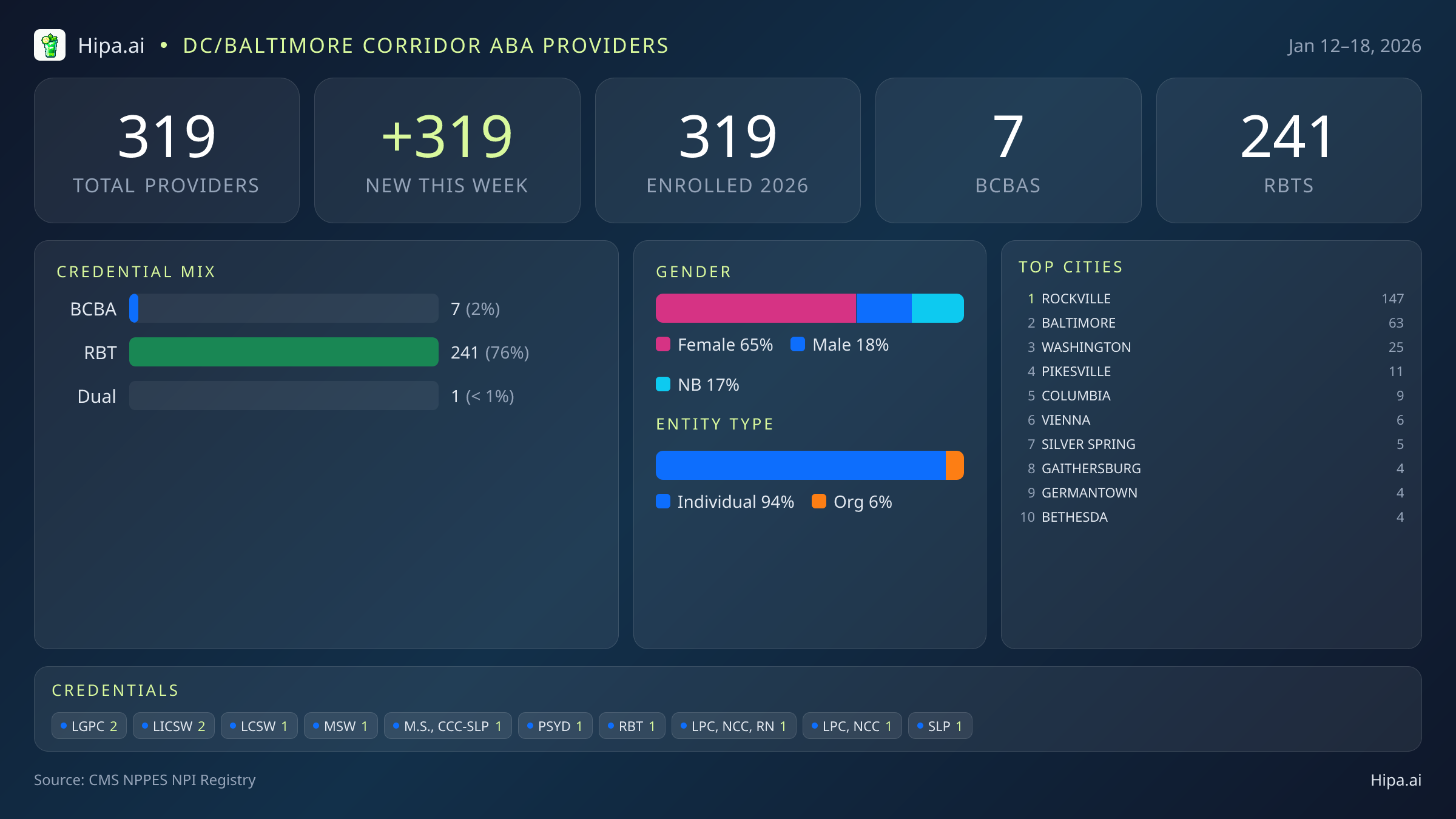
The DC/Baltimore Corridor's behavioral health sector now includes 319 providers, all newly registered this week, representing 6% of the national total. This significant concentration underscores the region's growing demand for behavioral health services. Of these, 301 are individual practitioners and 18 are organizations, indicating a diverse mix of practice structures entering the market.
ABA Credential Landscape
Within the individual providers, the data reveals a strong emphasis on Applied Behavior Analysis. There are 7 BCBAs and 241 RBTs. These credential counts are not mutually exclusive, as 1 provider holds dual BCBA and RBT credentials, a common career progression. The high ratio of approximately 34 RBTs per BCBA suggests a potential strain on supervision capacity, a critical factor for quality ABA service delivery.
Workforce Demographics and Local Hotspots
The individual provider workforce in the corridor is predominantly female, with 197 female providers making up 65% of the total. Male providers number 53 (18%), while 51 providers (17%) identify as nonbinary. No single organization appeared multiple times in this update. Geographically, Rockville leads with 147 providers, followed by Baltimore with 63, and Washington with 25.
This concentrated influx of RBTs, particularly in urban centers like Rockville and Baltimore, signals a robust expansion of direct ABA service capacity. However, the notable imbalance in the BCBA-to-RBT ratio suggests an ongoing and critical need for more certified supervisors to ensure adequate oversight and support for the growing RBT workforce across the DC/Baltimore Corridor.