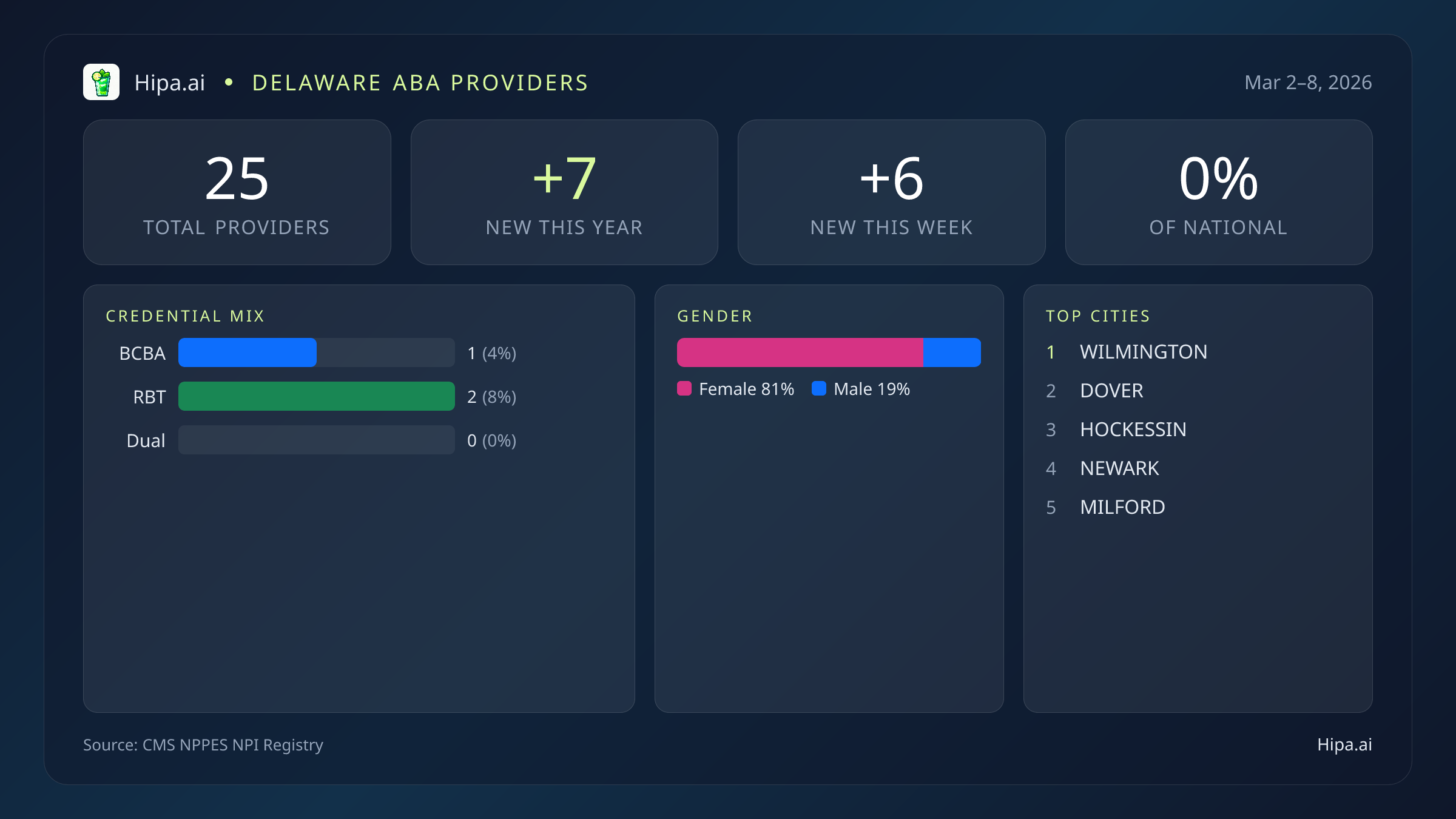
Delaware saw a total of 25 providers added to the CMS NPI registry this past week, with 21 individuals and 4 organizations contributing to the state's behavioral health landscape. This represents a negligible portion of the national weekly total at 0%, with only 1 new provider added this week. Over the course of the year, Delaware has added 7 new providers, indicating a slow but steady growth in its behavioral health workforce.
Credential Mix and Supervision Capacity
Within this cohort, the ABA-specific workforce shows a limited presence. The state gained 1 BCBA (Board Certified Behavior Analyst) and 2 RBTs (Registered Behavior Technicians) this week. There were no dual-credentialed BCBA+RBT professionals recorded, which can be a key indicator of career progression and workforce stability in ABA. The ratio of BCBAs to RBTs, while small, points to a potential bottleneck in supervision capacity, as RBTs require supervision from BCBAs to deliver services. Other prominent credentials among the individual providers include 4 LPCMH (Licensed Professional Counselor of Mental Health) and 3 LCSW (Licensed Clinical Social Worker), indicating a broader focus on mental health counseling and social work services in this week's additions.
Workforce Demographics and Organizational Presence
The individual provider demographic data shows a strong female majority, with 17 female providers making up 81% of the individual additions, compared to 4 male providers at 19%. No nonbinary providers were reported. No large, multi-state ABA chains or other notable organizations appeared multiple times in this week's data. The presence of 8 providers with multiple taxonomies suggests a diverse range of specializations within the new additions. The top cities for these new providers include Wilmington, Dover, Hockessin, Newark, and Milford.
This snapshot suggests that Delaware's ABA workforce additions are currently very modest, potentially impacting the availability and access to ABA services across the state due to limited practitioner numbers and the critical BCBA-to-RBT supervision ratio.