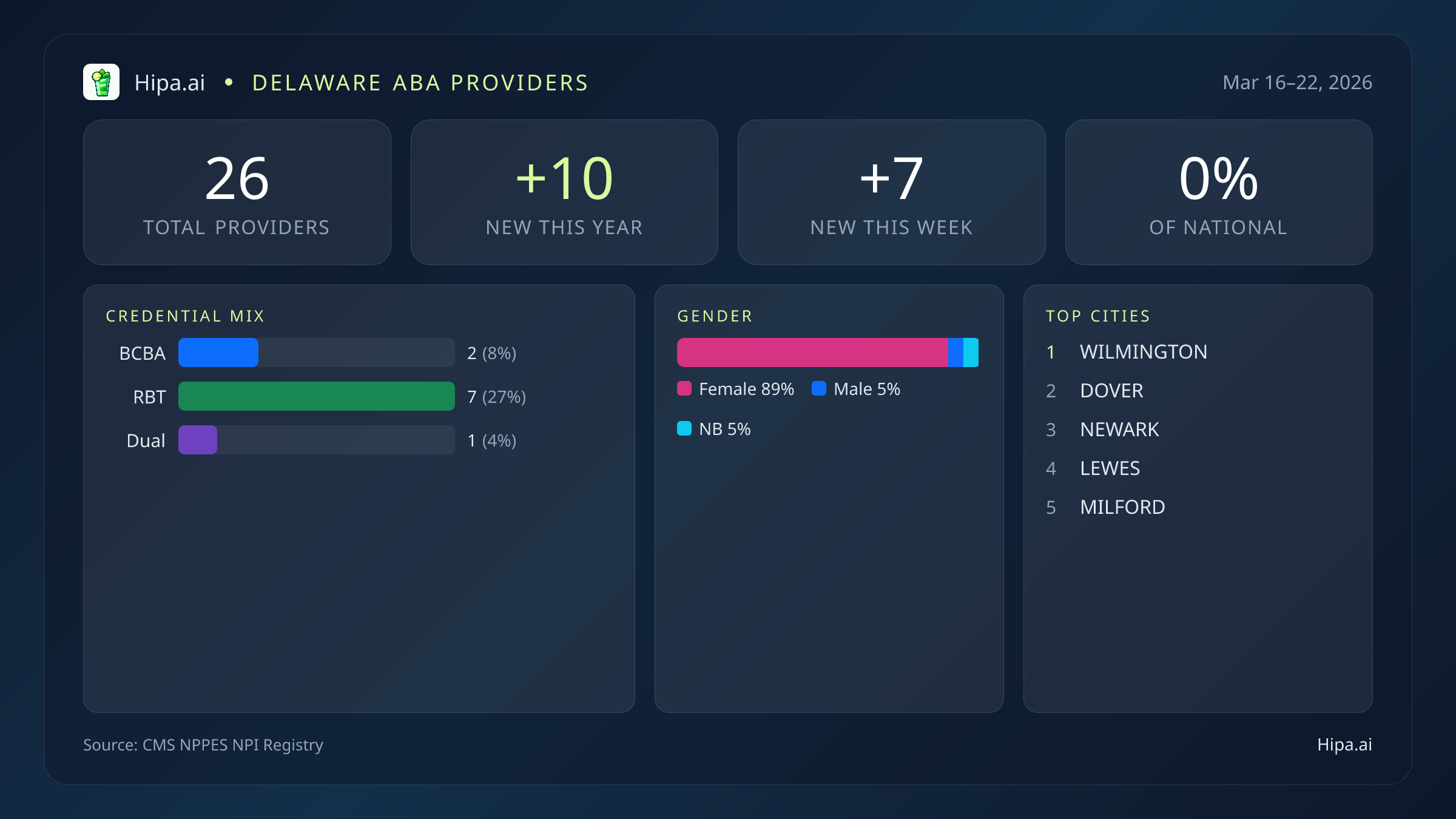
Delaware's behavioral health sector saw modest activity in the latest CMS NPI registry weekly update, with a total of 26 providers recorded. The state contributed 0% to the national weekly total, reflecting its smaller size and population compared to larger states. This week alone, 7 new providers were added to the registry, contributing to a total of 10 new providers for the year to date. Of the total, 19 were individuals and 7 were organizations, indicating a mix of independent practitioners and structured service entities.
ABA Workforce Credentials and Supervision Capacity
Focusing on the ABA workforce, the data shows 2 BCBA credentials and 7 RBT credentials. Notably, one individual holds both a BCBA and an RBT credential, signifying career progression and diversified skill sets within the field. This credential overlap means there are effectively 6 distinct RBTs and 2 distinct BCBAs (one of whom is also an RBT). The ratio of RBT credentials to BCBA credentials is 7:2, or 3.5 RBTs per BCBA. This is a significantly lower ratio than the typical 8-10 RBTs per BCBA often seen in the industry, suggesting that Delaware may have a relatively strong supervision capacity for its current RBT workforce. However, it also indicates a smaller overall pool of ABA-specific professionals compared to states with higher RBT counts. Beyond ABA, the registry also included other behavioral health professionals such as LPCMH, Clinical Social Workers, and Psychologists, reflecting a broader mental health support system.
Demographics and Organizational Presence
The individual provider data reveals a strong female representation, with 17 female providers making up 89% of the recorded individuals. There was 1 male provider, accounting for 5%, and 1 nonbinary provider, also representing 5%. No specific organizations appeared multiple times in this update, but the presence of organizations like "CHILDREN & FAMILIES FIRST" and "BAYADA HOME HEALTH CARE, INC." highlights the involvement of established entities in the state's behavioral health landscape. The providers are distributed across key cities including WILMINGTON, DOVER, NEWARK, LEWES, and MILFORD, indicating a spread of services across the state.
This data suggests that Delaware's ABA sector, while small, possesses a potentially robust supervisory structure, which could support quality service delivery for its population, even as the overall workforce continues to grow.