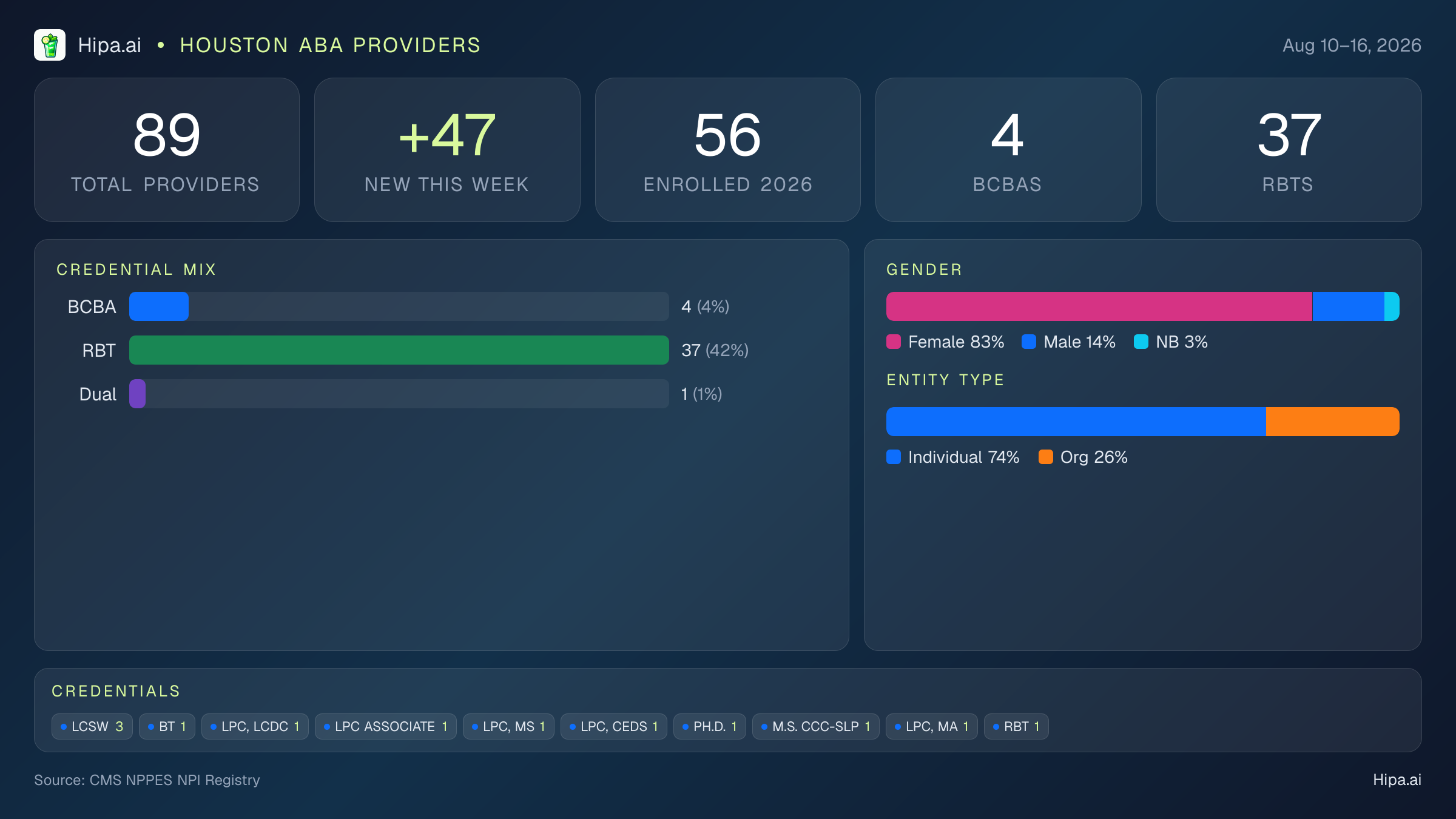
Houston recorded 89 providers in the latest CMS NPI registry weekly update, representing 1% of the national weekly total. The registry count includes 66 individuals and 23 organizations, indicating a substantial mix of direct-care professionals, clinicians and service entities in the city. A 1% national share signals that Houston is an active regional behavioral health market, although NPI registrations do not show whether providers are accepting referrals, serving local clients or operating at full capacity.
ABA Credential Mix
The update lists 4 BCBA providers and 37 RBT providers, including 1 dual credential holder with both BCBA and RBT credentials. These categories overlap, so the dual-credentialed provider is counted in both totals and the figures should not be treated as mutually exclusive. The resulting credential mix is heavily weighted toward RBTs, the direct-care workforce that delivers much of day-to-day ABA treatment, while the smaller BCBA count points to a more limited supervisory pool. That imbalance can support service growth only if BCBAs have capacity to oversee RBT teams. The registry also reports 22 multi-taxonomy providers, further underscoring that NPI classifications may overlap and do not represent distinct workforce segments.
Workforce Demographics
Women account for 55 providers, or 83% of the reported workforce. Men account for 9 providers, or 14%, and nonbinary providers account for 2 providers, or 3%. No notable organizations appear multiple times in the update, so the data does not identify a dominant employer or chain. Houston’s large RBT presence alongside a smaller BCBA base suggests expanding direct-care capacity, but access growth may depend on strengthening the city’s supervisory pipeline.