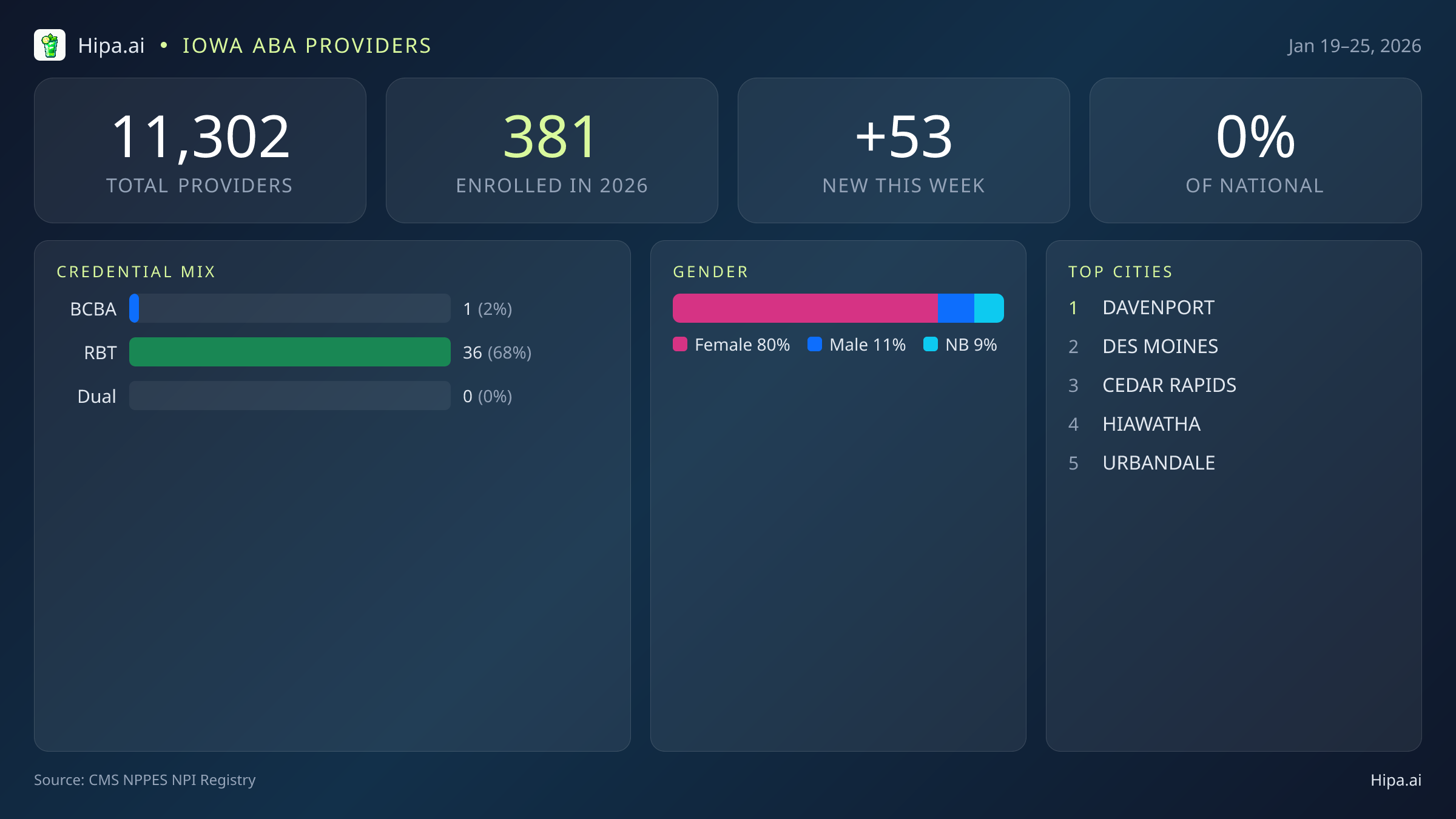
Iowa added 53 behavioral health providers in the latest weekly CMS update, representing 1% of the national total. This modest share indicates a steady, albeit smaller, growth trajectory for the state's behavioral health workforce compared to more populous regions. The concentration of new providers across cities like Davenport, Des Moines, and Cedar Rapids suggests localized efforts to meet increasing demand for services.
ABA Workforce Composition
Within the applied behavior analysis sector, the update includes 36 Registered Behavior Technicians (RBTs) and 1 Board Certified Behavior Analyst (BCBA). The data shows no individuals with dual BCBA and RBT credentials this week, which typically signals career progression. The significant imbalance, with 36 RBTs to only 1 BCBA, highlights a critical need for more BCBAs to provide the necessary supervision for RBTs. This ratio suggests potential bottlenecks in expanding direct ABA service capacity, as RBTs require consistent and qualified oversight from BCBAs for ethical and effective practice.
Provider Demographics
Among the 45 individual providers, the workforce is predominantly female, with women accounting for 80%. Male providers make up 11%, and 9% identify as nonbinary. The update also includes 8 organizations, though no single entity appeared multiple times in this week's data, suggesting a mix of independent practices and smaller clinics rather than large multi-state chains. The top cities for new providers include Davenport, Des Moines, and Cedar Rapids.
This data suggests that while Iowa is successfully attracting new RBTs to deliver direct services, the limited number of new BCBAs could constrain the growth and accessibility of supervised ABA services across the state.