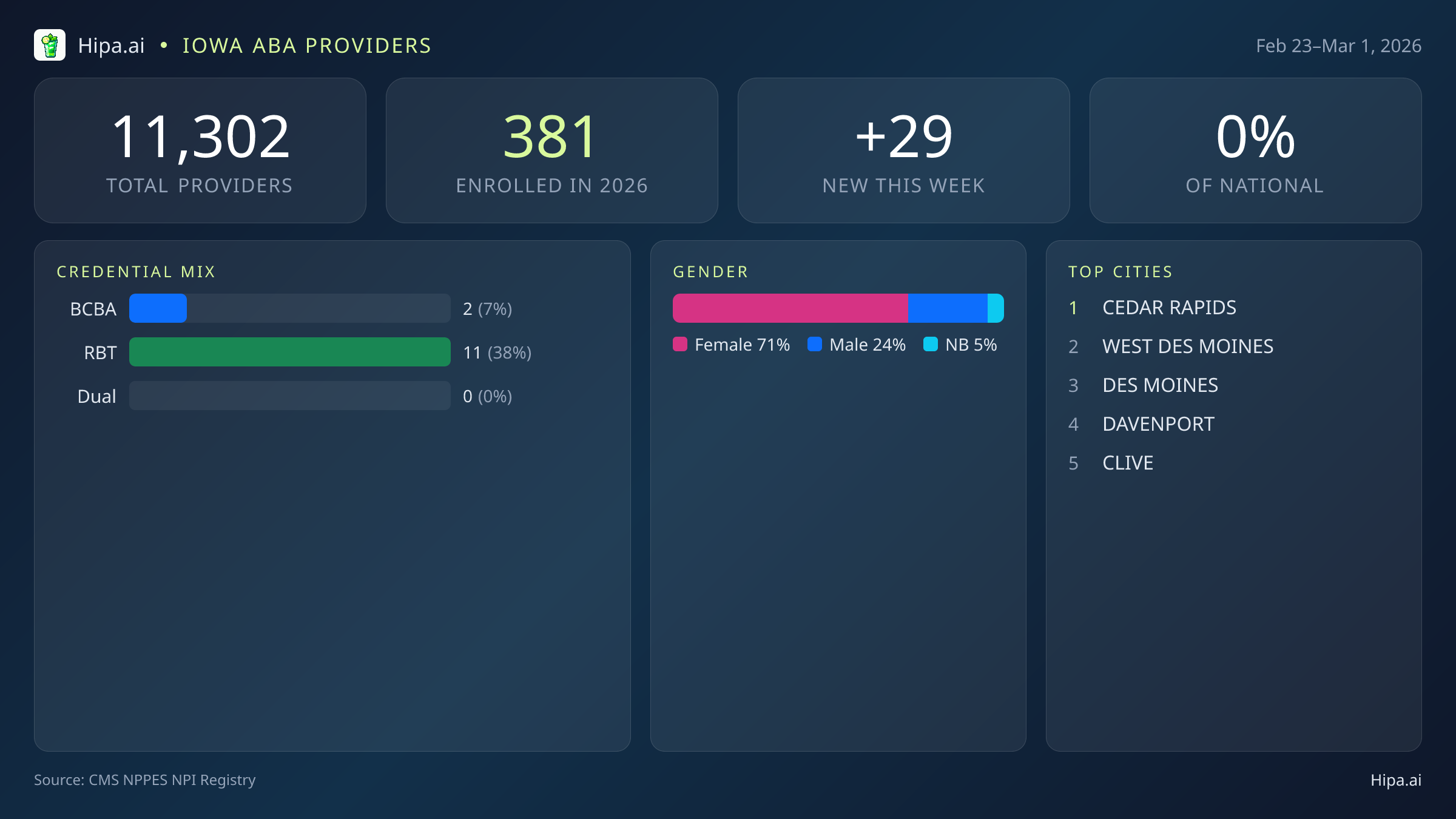
Iowa added 29 new behavioral health providers to the CMS NPI registry this week, representing 1% of the national total. All 29 providers are new this week, signaling a steady, localized expansion within the state's behavioral health sector. This includes 21 individual practitioners and 8 organizational entities, indicating a mix of independent professionals and new practice groups.
ABA Workforce Composition
Within the applied behavior analysis field, the data reveals 2 providers with a BCBA taxonomy and 11 providers with an RBT taxonomy. These counts reflect primary taxonomies and credentials; no providers in this update held dual BCBA and RBT credentials. The observed ratio of RBTs to BCBAs, approximately 5.5 to 1, suggests a workforce heavily weighted towards direct service delivery. While a robust RBT workforce is crucial, this ratio highlights the ongoing need for sufficient BCBA-level supervision to ensure quality and expand service capacity.
Provider Demographics and Trends
Among the individual providers, the gender distribution shows a clear pattern: 15 providers, or 71%, are female. Male providers account for 5 individuals (24%), and one provider (5%) identified as nonbinary. The top cities for new enrollments include Cedar Rapids, West Des Moines, and Des Moines, indicating growth in key urban areas. Notably, no organizations appeared multiple times in this week's data, suggesting that the growth is driven by a variety of smaller, independent practices rather than the expansion of larger, multi-state chains.
This week's NPI data for Iowa points to incremental growth in its behavioral health workforce, particularly in ABA, with a strong foundation of RBTs. However, continued focus on increasing the BCBA supervisory pool will be essential to support these direct service providers and enhance overall access to care in the state.