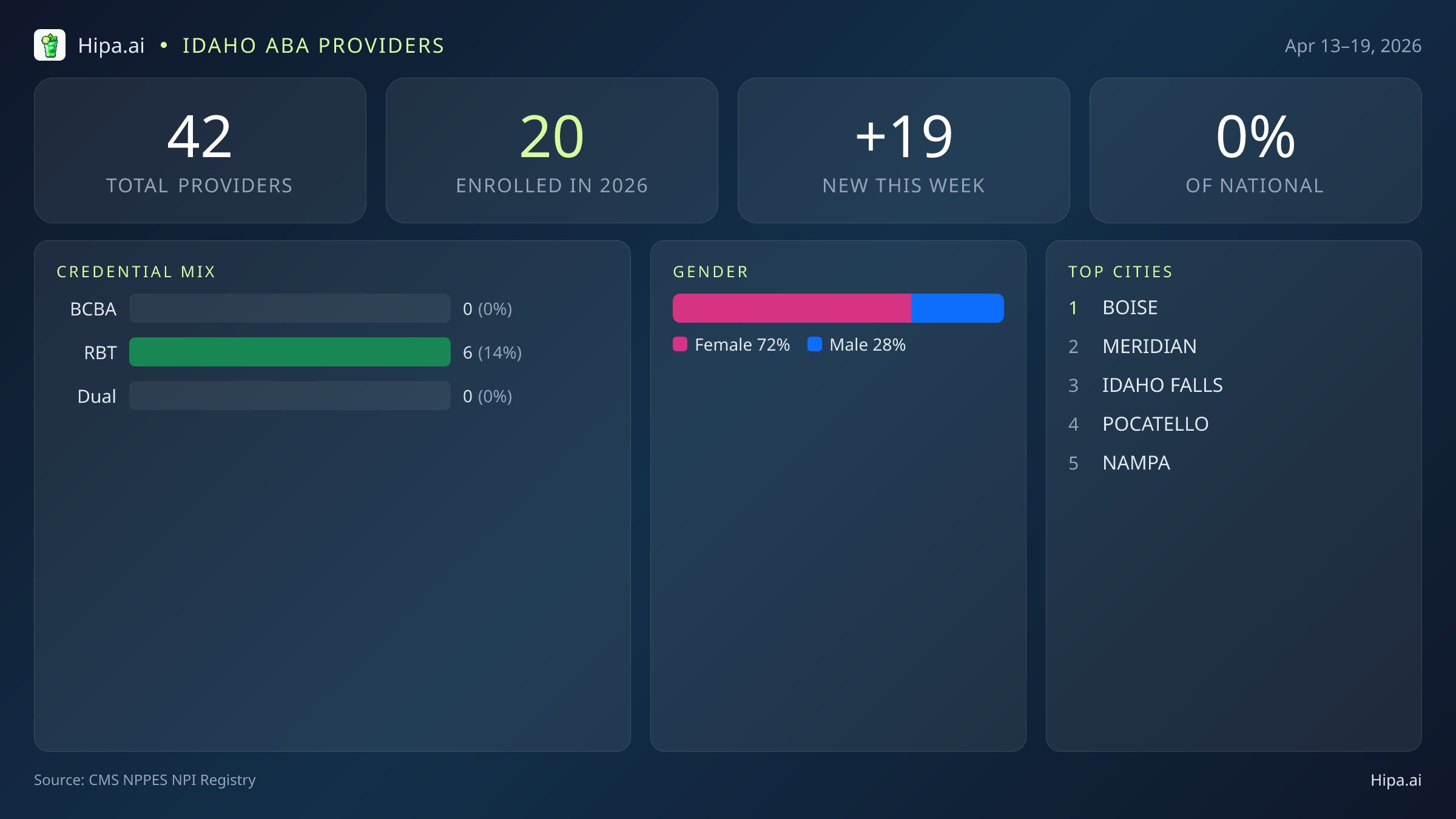
Idaho saw a total of 42 behavioral health providers in the latest CMS NPI registry update. While this represents a negligible share of the national weekly total, 19 new providers were added this week, signaling recent growth in the state's behavioral health sector. Of these, 32 were individuals and 10 were organizations, reflecting a mix of private practitioners and clinic expansions.
Credential Mix and Supervision Capacity
The ABA workforce data for Idaho reveals a specific challenge: there are 0 Board Certified Behavior Analysts (BCBAs) listed by credential in this update. In contrast, 6 Registered Behavior Technicians (RBTs) were identified. This absence of BCBAs, who are essential for supervising RBTs and designing ABA programs, indicates a significant bottleneck for ABA service delivery and expansion within the state. It's important to note that these credential counts reflect primary listings; providers may hold multiple certifications or different taxonomies. For instance, 11 providers reported multiple taxonomies. Beyond ABA, the update also includes 7 Licensed Clinical Social Workers (LCSW) and 5 Licensed Professional Counselors (LPC), among other mental health professionals.
Workforce Demographics and Organizational Landscape
Among the 32 individual providers, the workforce is predominantly female, with 23 women comprising 72%. Male providers account for 9 individuals, making up 28%. No nonbinary providers were reported. The top cities for new provider activity include Boise, Meridian, and Idaho Falls. No specific organizations appeared multiple times in this week's update, suggesting a landscape of smaller practices or new entries rather than significant expansion by dominant multi-state chains.
Overall, this data suggests that while Idaho is seeing some growth in its general behavioral health workforce, the critical shortage of BCBAs poses a significant barrier to expanding access to quality ABA services for individuals in the state.