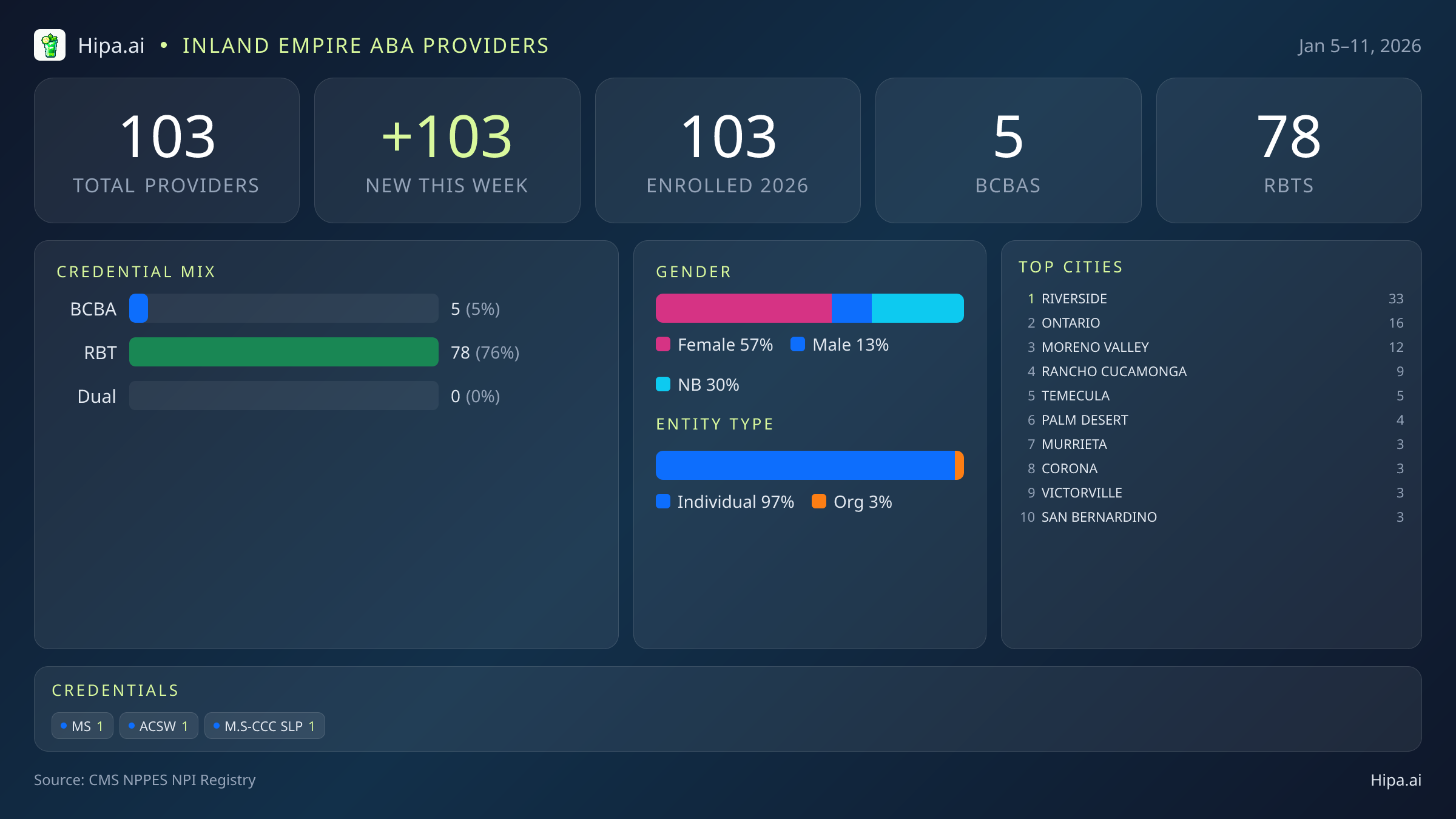
The Inland Empire area has seen a significant influx of behavioral health providers, with 103 new registrations in the latest CMS NPI registry update. This represents 2% of the national weekly total, signaling a growing focus on expanding access to care in this California region. Of these, 100 are individual practitioners and 3 are organizations, indicating a mix of independent professionals and clinic-based services entering the market.
ABA Credential Breakdown
Focusing on Applied Behavior Analysis, the update reveals 5 new BCBAs and 78 new RBTs. The absence of dual BCBA+RBT credentials among these new registrants suggests these are distinct additions to either the supervisory or direct-service workforce. The ratio of BCBAs to RBTs is approximately 1:15.6, which is lower than ideal for direct supervision capacity, potentially indicating a high demand for BCBA-level supervision for the growing RBT workforce. Other new individual credentials include one MS, one ACSW, and one M.S-CCC SLP, reflecting a broader scope of behavioral health professionals.
Workforce Demographics and Local Concentration
The individual workforce in the Inland Empire shows a diverse gender distribution, with 57 female providers (57%), 13 male providers (13%), and 30 nonbinary providers (30%). No single organization appeared multiple times in this week's update. Provider registrations are concentrated in key urban centers, with Riverside leading at 33 providers, followed by Ontario with 16 providers, Moreno Valley with 12 providers, Rancho Cucamonga with 9 providers, and Temecula with 5 providers.
This data suggests a robust expansion of the direct-service RBT workforce in the Inland Empire, highlighting a critical need for corresponding growth in BCBA supervision to ensure sustainable and high-quality ABA service delivery.