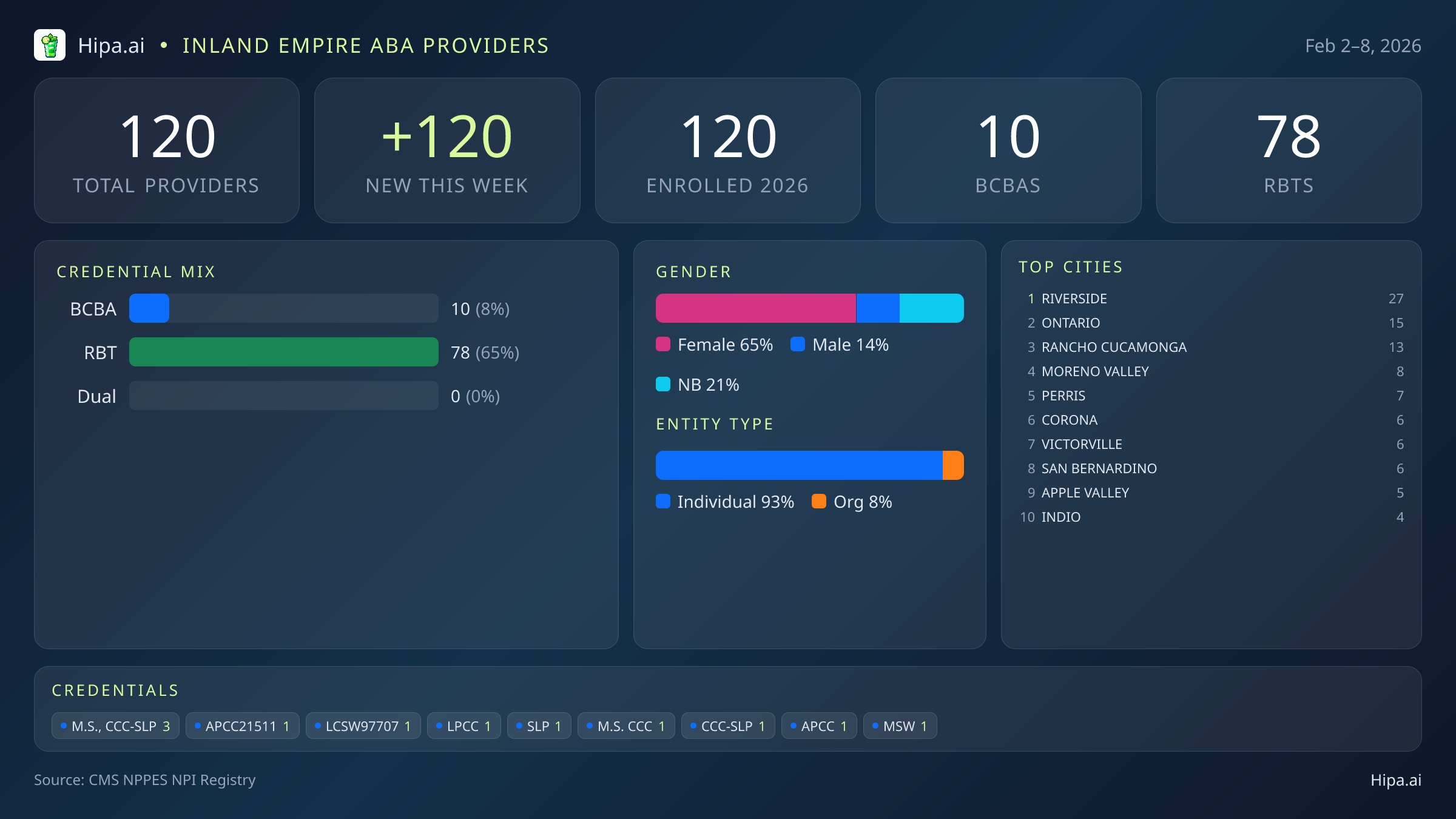
The Inland Empire's behavioral health sector saw 120 new providers in the latest CMS update, representing 3% of the national weekly total. This significant influx points to the region as a growing hub for behavioral health services, with 111 individual practitioners and 9 organizations joining the workforce.
ABA Credential Breakdown
Focusing on Applied Behavior Analysis, the data reveals 10 BCBAs and 78 RBTs. It's important to note that while these are distinct certifications, both BCBA and RBT are frequently listed as primary taxonomies in NPI registrations. The absence of dual BCBA+RBT credentials among these new providers suggests that new BCBAs are not typically progressing from RBT roles within this specific cohort. The ratio of nearly 8 RBTs for every BCBA is higher than ideal for supervision, potentially indicating a need for more supervisory-level professionals to support the growing direct-service workforce.
Workforce Demographics
The individual provider workforce in the Inland Empire is predominantly female, with 72 female providers accounting for 65%. Male providers constitute 16%, and 23 nonbinary providers make up 21%. No single organization appeared multiple times in this update. Riverside leads the urban centers with 27 providers, followed by Ontario with 15 and Rancho Cucamonga with 13. This data suggests a robust demand for direct ABA services in the Inland Empire, but also highlights a potential bottleneck in supervisory capacity if the BCBA growth doesn't keep pace with RBT expansion.