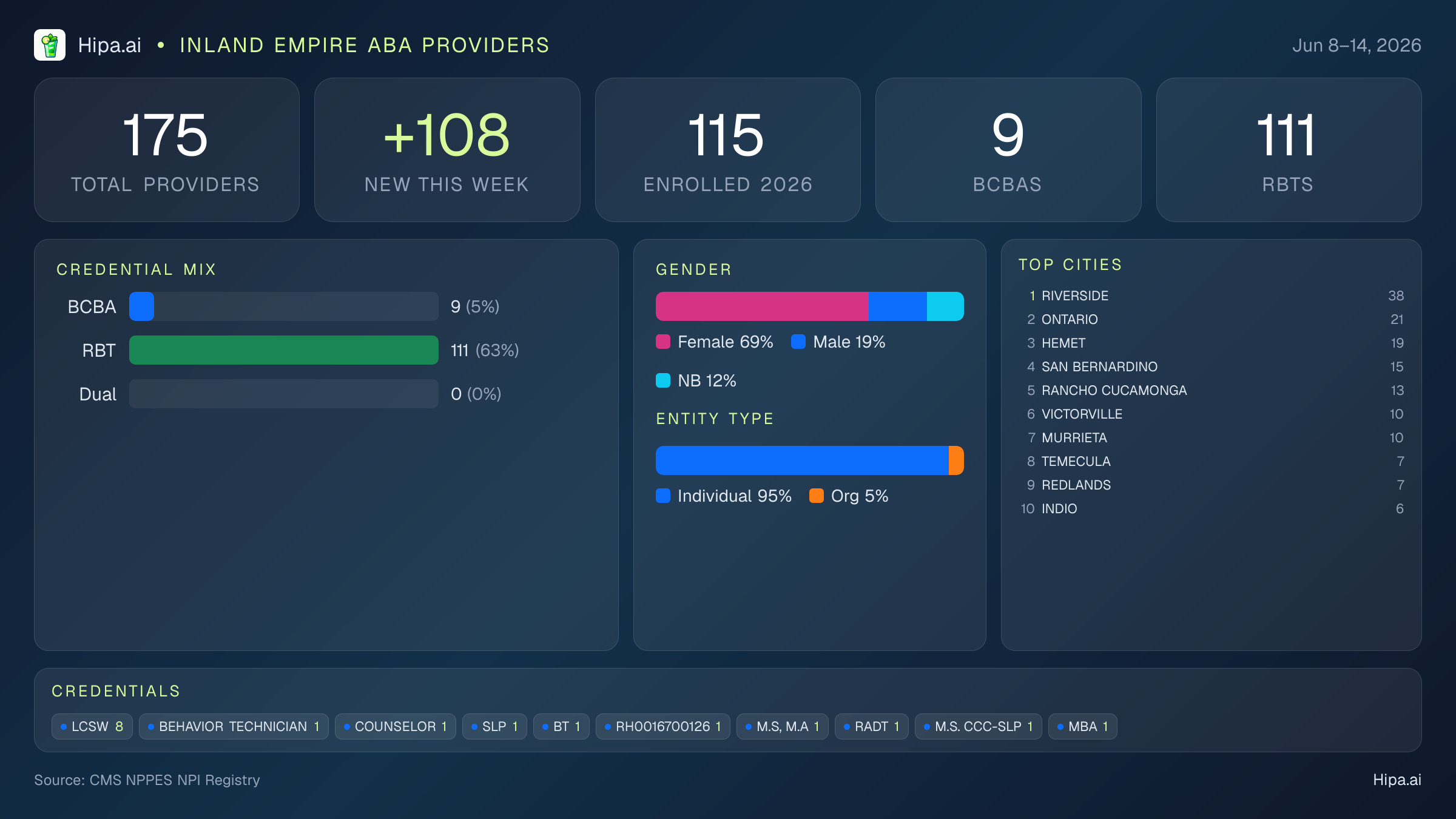
The Inland Empire behavioral health sector saw 108 new providers registered in the latest CMS NPI registry update, representing 2% of the national weekly total. This consistent growth indicates a dynamic and expanding behavioral health workforce in the region, crucial for meeting local demand. Of these, 166 are individual practitioners and 9 are organizations.
Credential Mix and Supervision Capacity
Among individual practitioners, the data shows 9 BCBAs and 111 RBTs. The absence of dual BCBA+RBT credentials suggests distinct career paths or a focus on single credential registration. With approximately one BCBA for every 12 RBTs, the supervision ratio indicates a potential need for more supervisory-level professionals to support the large RBT workforce and ensure quality ABA service delivery. Beyond ABA, the region also registered 8 LCSWs and 1 SLP, diversifying the behavioral health landscape.
Workforce Demographics and Geographic Distribution
The individual provider workforce in the Inland Empire is predominantly female, with 115 female providers accounting for 69% of the total. Male providers number 31 (19%), and 20 providers (12%) identify as nonbinary. No specific organizations appeared multiple times in this week's registry, indicating a broad distribution of new registrations across various practices. Riverside leads the urban centers with 38 providers, followed by Ontario with 21 providers, and Hemet with 19 providers.
This data suggests a robust, growing pipeline of direct-service RBTs in the Inland Empire, though the BCBA-to-RBT ratio highlights an ongoing need for increased supervisory capacity to sustain high-quality ABA services.