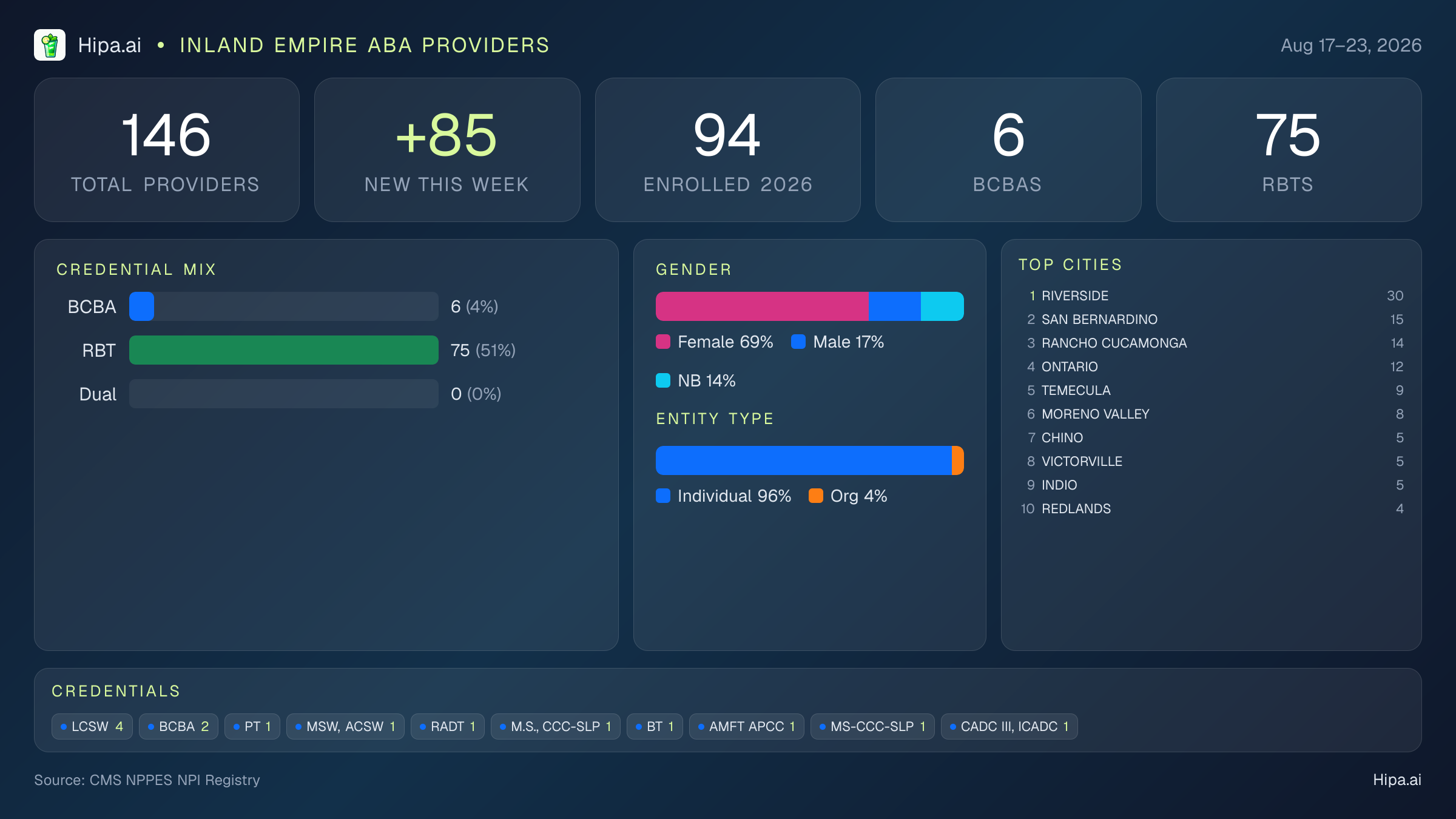
The Inland Empire recorded 146 providers in the latest CMS NPI registry weekly update, representing 1% of the national weekly total. The registry lists 85 new providers this week and 94 new providers this year. The area’s activity signals a substantial and rapidly expanding behavioral health market, although NPI registrations include clinicians and organizations and do not measure active caseloads, staffing levels or appointment availability. The registry identifies 140 individuals and 6 organizations.
ABA Credential Mix
The update reports 6 BCBA providers and 75 RBT providers, with no providers listed as holding both credentials. These credential totals are not mutually exclusive with other credential or taxonomy categories, and the registry reports 25 providers with multiple taxonomies. The large RBT population relative to the BCBA group points to strong direct-care workforce activity but limited documented supervisory capacity. Because BCBAs supervise RBTs, the imbalance may constrain how quickly clinics can add cases unless supervisors carry multiple teams or additional BCBAs enter the market. Other records include social workers, counselors, speech-language pathologists and related behavioral health professionals, indicating that the weekly activity extends beyond ABA alone.
Workforce Demographics
Women account for 96 providers, or 69% of the reported workforce. Men account for 24 providers, or 17%, while 20 providers, or 14%, are listed as nonbinary. No organization appears multiple times among the notable organizations in the data. Riverside is the leading city with 30 providers, followed by San Bernardino with 15, Rancho Cucamonga with 14, Ontario with 12 and Temecula with 9. Overall, the update suggests expanding ABA access in the Inland Empire, with RBT growth outpacing the documented BCBA supervisory base.