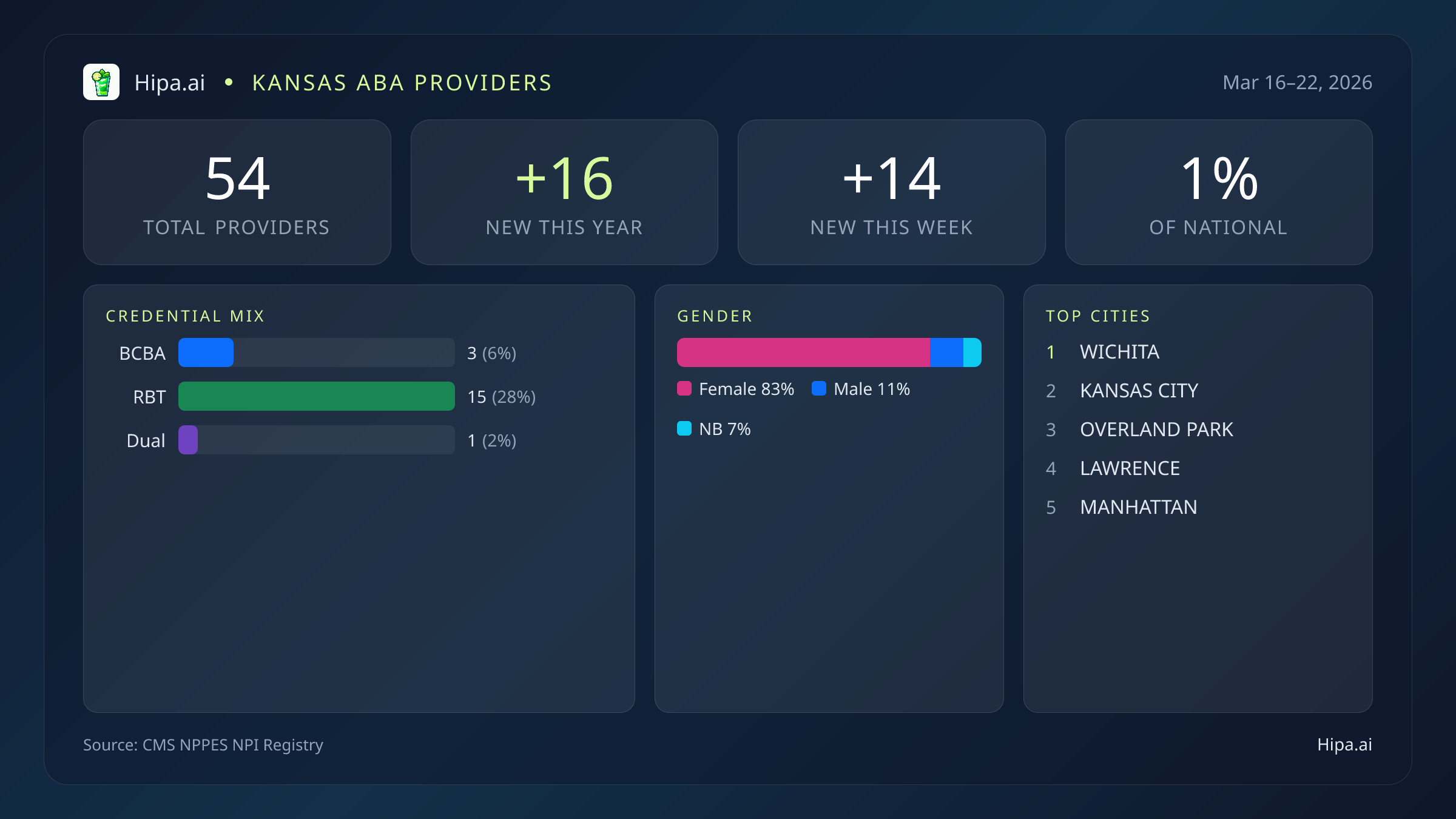
Kansas accounts for 54 providers in the latest CMS NPI registry weekly update, representing 1% of the national total. The state added 1 provider this week and 16 year-to-date, signaling steady but modest workforce growth in a region where behavioral health capacity remains constrained relative to patient demand.
The credential mix reveals a critical supervision gap. Kansas has 3 BCBAs against 15 RBTs1 provider holds dual BCBA-RBT credentials, the kind of dual credential that typically signals career progression and can ease supervisory burden. With 5 times more RBTs than BCBAs, clinics operating in Kansas likely face caseload pressures and may struggle to meet BACB supervision requirements, which mandate one BCBA per no more than a defined number of RBTs. Beyond ABA roles, 13 providers across the state hold multi-taxonomy credentials, including speech-language pathologists, licensed counselors, and clinical social workers, indicating some integration of behavioral and allied health services.
The workforce is predominantly female at 83%, with 5 male and 3 nonbinary providers rounding out the mix. Wyandot Center for Community Behavioral Healthcare, Inc. is the only organization appearing more than once, with 3 providers listed—underscoring the fragmentation typical of smaller behavioral health markets where independent practitioners and small clinics dominate over large chains.
Kansas's thin BCBA layer and reliance on RBT-heavy staffing suggest that ABA access will remain bottlenecked by supervision availability rather than technician supply.