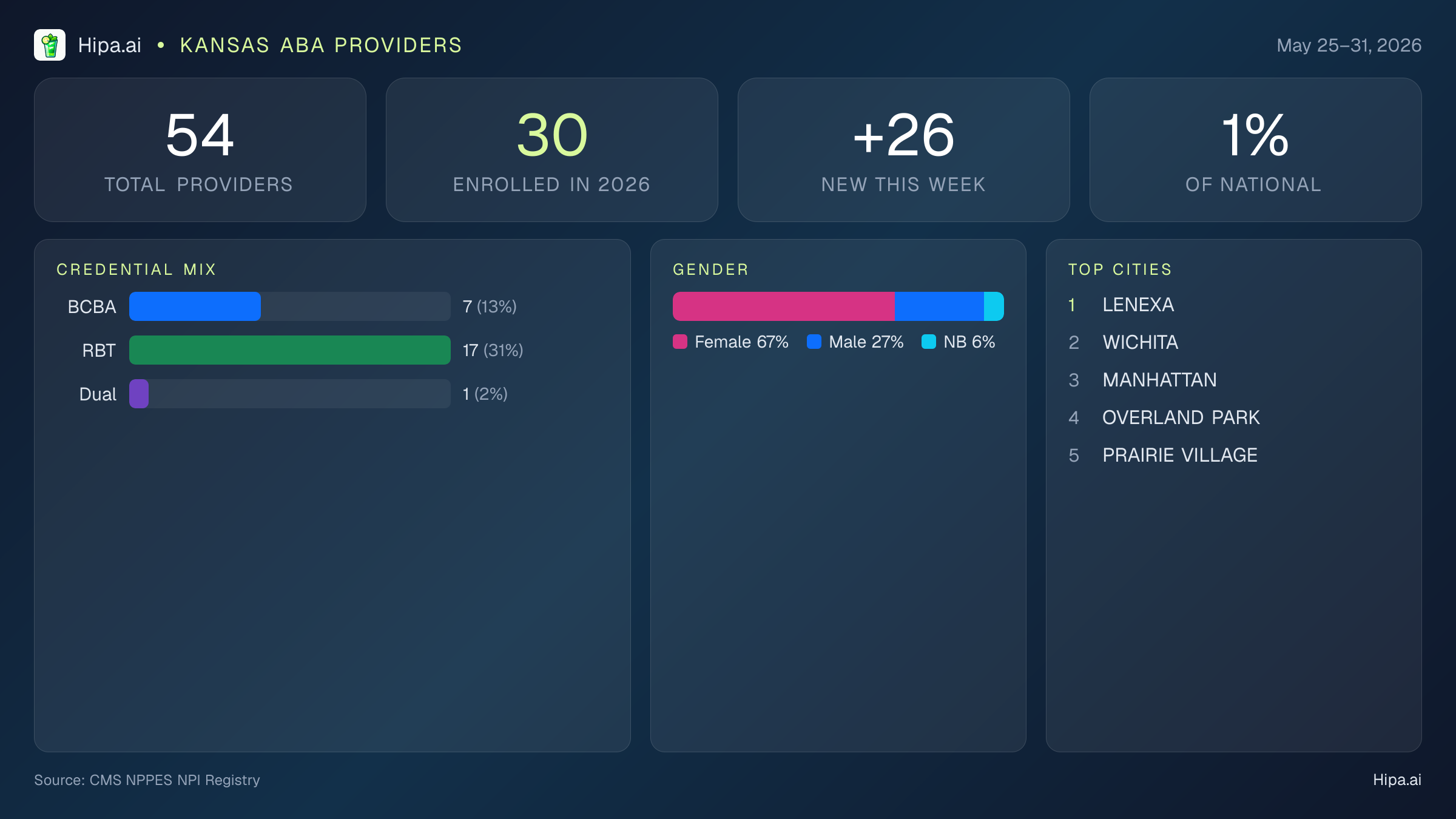
Kansas saw 54 behavioral health providers in the latest CMS NPI registry weekly update, contributing 1% to the national total. Of these, 26 were new this week, signaling consistent, albeit modest, growth in the state's behavioral health workforce. This steady influx is crucial for a state like Kansas, which often sees smaller, localized expansions rather than large-scale national chain movements.
ABA Workforce Dynamics
Within the applied behavior analysis (ABA) sector, the data shows 7 BCBA credentials and 17 RBT credentials among the providers. It is important to note that these credential categories are not mutually exclusive, as 1 individual holds both BCBA and RBT credentials, reflecting a common career progression from direct service provider to supervisor. The resulting ratio of approximately 2.4 RBTs for every BCBA indicates a healthy foundation for direct care delivery, suggesting adequate supervisory capacity for the current RBT workforce. Beyond ABA, the state also saw additions of other mental health professionals, including 5 LPCs and 2 LMSWs.
Provider Demographics
Of the 48 individual providers, 32 (67%) are female, 13 (27%) are male, and 3 (6%) identify as nonbinary. This gender distribution is consistent with broader trends observed in the behavioral health workforce, which is predominantly female. No specific organizations appeared multiple times in this week's update, suggesting a diverse range of smaller practices or individual additions rather than significant expansion from large multi-state chains.
This continued expansion of Kansas's behavioral health workforce, particularly in ABA, suggests an increasing capacity for service delivery. Maintaining a strong BCBA-to-RBT ratio will be key to sustaining high-quality ABA care and meeting the growing demand in the state.