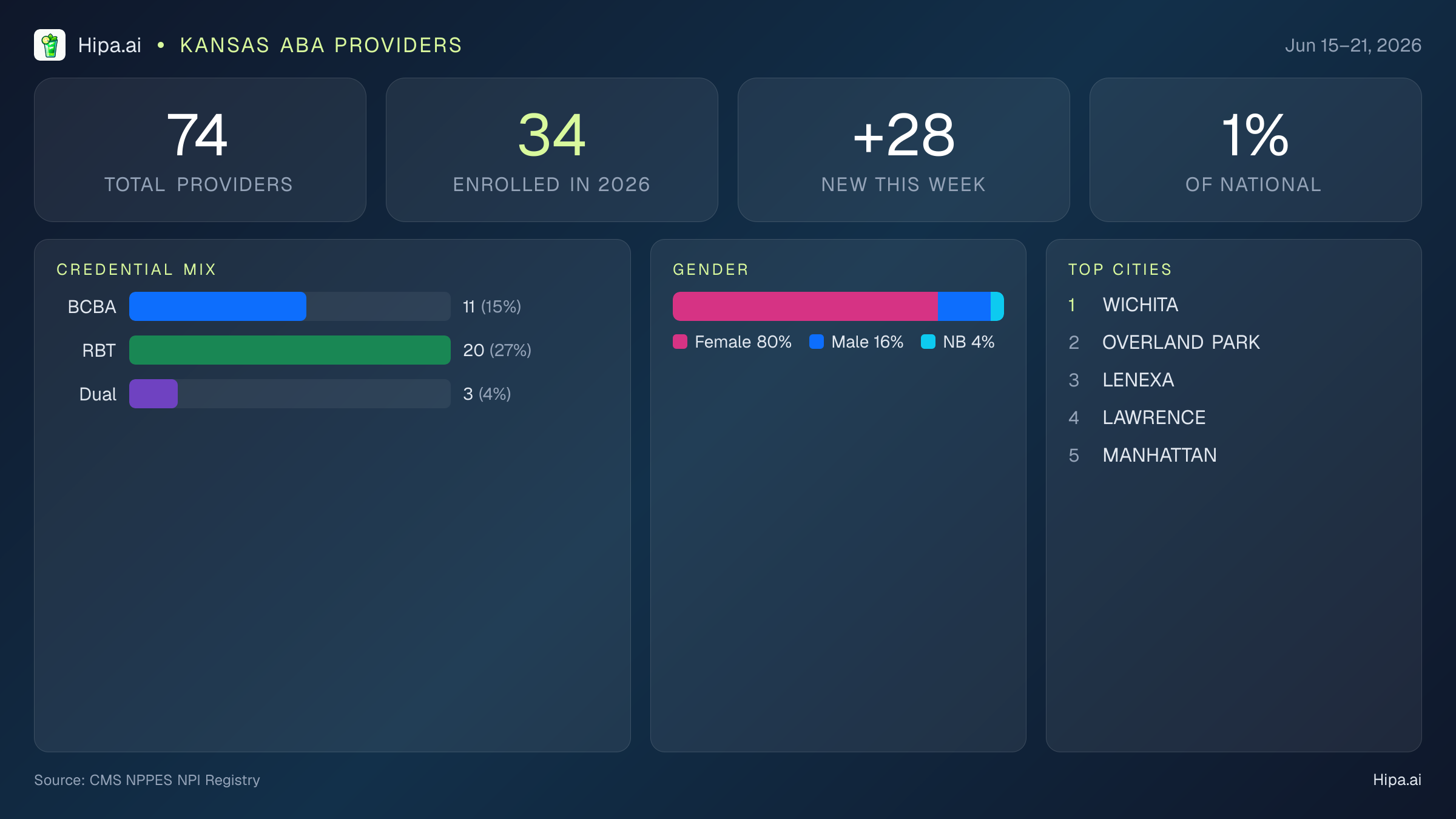
Kansas saw the addition of 74 behavioral health providers in the latest CMS NPI registry weekly update, accounting for 1% of the national total. This steady, albeit smaller, influx of new providers reflects a consistent demand for services within the state, typical for a region with a more localized growth pattern compared to national hotspots.
ABA Workforce Composition
Focusing on the applied behavior analysis (ABA) sector, the data shows 11 BCBA credentials and 20 RBT credentials. It is important to note that these counts are not mutually exclusive, as 3 individuals hold both BCBA and RBT credentials. This dual credentialing can signify career progression, with RBTs advancing to BCBA roles while maintaining their direct service skills. The ratio of approximately 1.8 RBTs for every BCBA suggests a relatively low supervision ratio, indicating that existing BCBAs may have capacity to supervise more RBTs, or are engaged in diverse service delivery models beyond direct RBT supervision. Beyond ABA, other significant credentials include 5 Licensed Professional Counselors (LPC) and 4 Licensed Clinical Social Workers (LSCSW).
Provider Demographics
Among the 56 individual providers, the workforce exhibits a clear gender distribution: 45 are female, representing 80% of individuals, while 9 are male (16%), and 2 identify as nonbinary (4%). This aligns with the broader trend of behavioral health professions being predominantly female. No single organization appeared multiple times in this week's data, suggesting a landscape of independent practices or smaller regional entities rather than dominant multi-state chains.
This data indicates a stable, localized expansion of Kansas's behavioral health workforce, with a foundational ABA presence that could support further growth in service access.