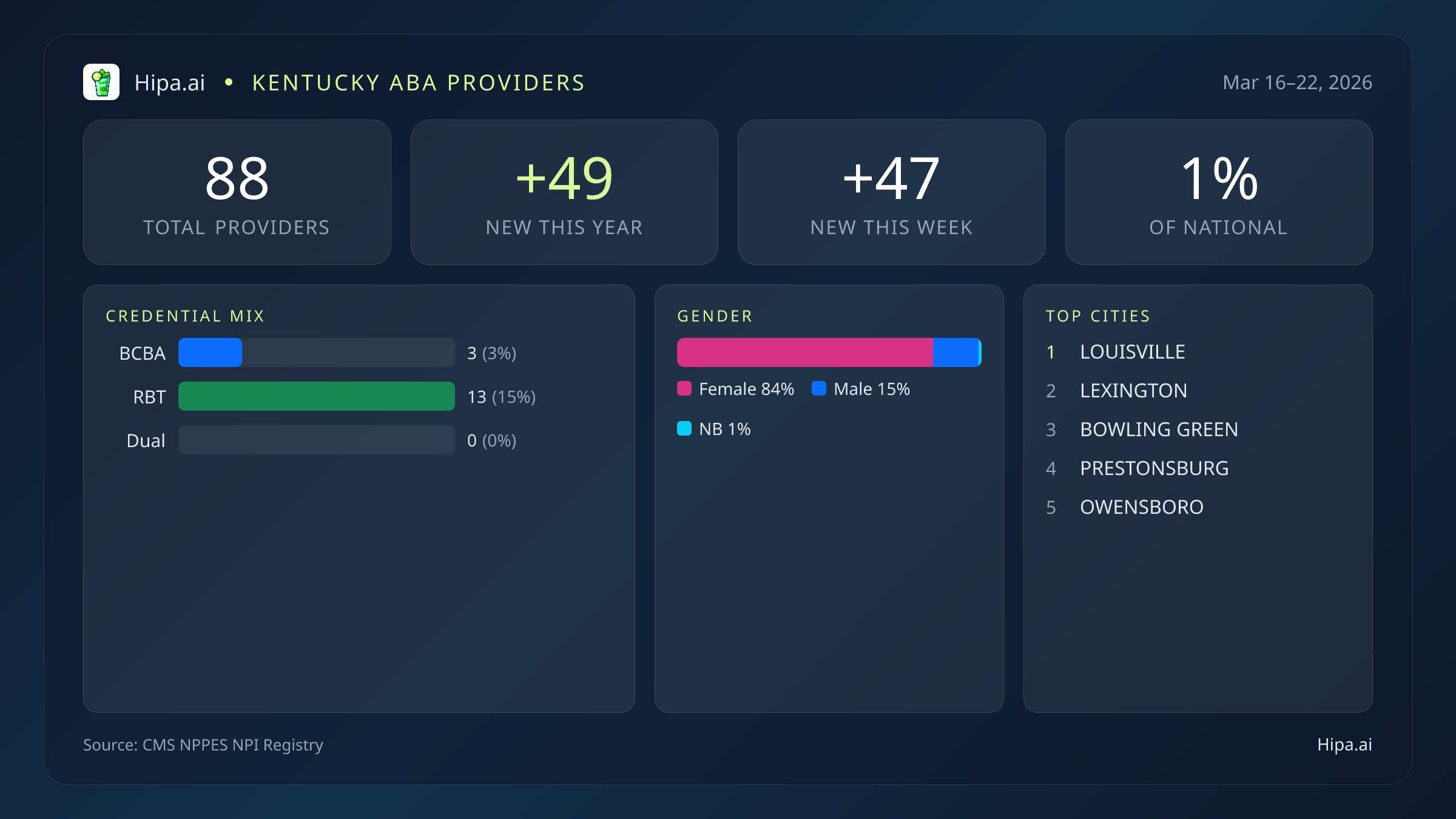
Kentucky's behavioral health provider registry reflects a small but active market: 88 total providers representing 1% of the national weekly NPI update. The state added 1 new provider this week and 49 new registrations year-to-date, signaling sustained workforce growth in a region where access to specialized behavioral services remains fragmented across multiple disciplines.
The credential mix reveals a critical gap in ABA-specific capacity. Kentucky lists only 3 BCBAs and 13 RBTs, with zero providers holding dual BCBA+RBT credentials—a pattern that signals limited internal career progression pathways and potential supervision bottlenecks. In contrast, the state's broader mental health infrastructure leans heavily on counseling and social work: 11 LCSWs, 8 LPCCs, and 5 MHAs dominate the credential distribution. This credential imbalance suggests Kentucky's ABA workforce remains underdeveloped relative to traditional outpatient mental health services.
Gender representation is heavily skewed female: 62 female providers account for 84% of the registry, while 11 male providers represent 15% and 1 nonbinary provider rounds out the demographic. No single organization appears multiple times in the data, indicating a fragmented provider landscape without dominant regional chains. Louisville and Lexington lead geographically, clustering the bulk of available services in urban corridors.
With fewer than two dozen ABA-credentialed professionals serving a state of 4.5 million residents, Kentucky's behavioral health market remains constrained by supervision capacity and may struggle to meet growing demand for evidence-based autism services.