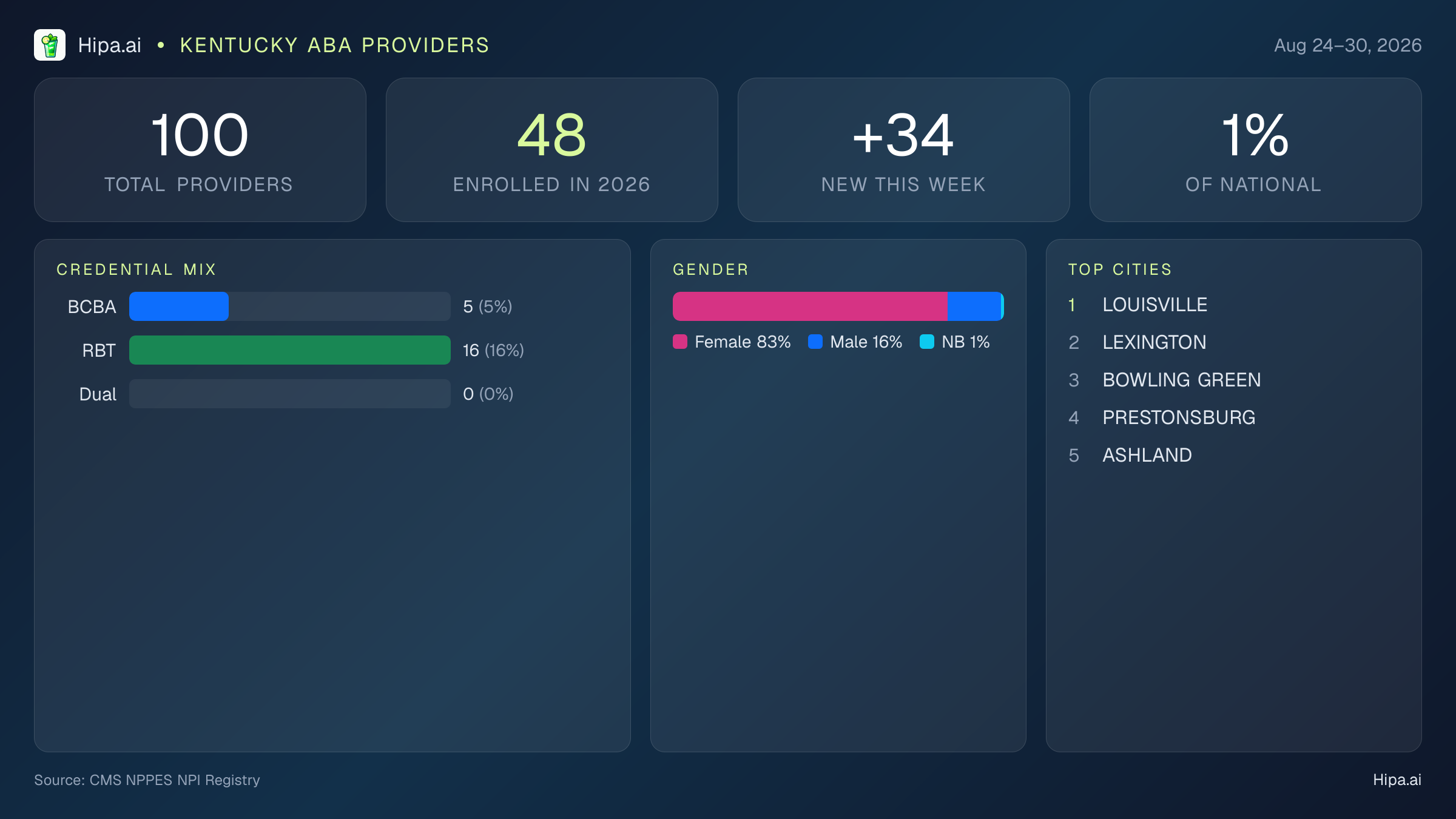
Kentucky recorded 100 providers in the latest CMS NPI registry weekly update, representing 1% of the national weekly total. The registry lists 34 new providers this week, alongside 77 individuals and 23 organizations. That 1% concentration signals a smaller but active behavioral health market, with new entries potentially affecting recruitment, contracting and service availability. NPI activity does not confirm that a provider is accepting patients or carrying an active caseload.
ABA Workforce Mix
The credential data lists 5 BCBA credentials and 16 RBT credentials, with no dual BCBA-RBT credentials. These categories should not be treated as mutually exclusive shares of the provider total: credential and taxonomy fields can overlap, and the separate credential-text field lists 2 RBT entries. The registry also includes BCBA entries with LBA in the credential text, including one listed as BCBA,LBA and another as MED, BCBA, LBA. Even with those overlaps, the wider RBT count substantially exceeds the BCBA count. Because BCBAs supervise RBTs, this mix points to a direct-service workforce with a comparatively limited pool of supervisors. That imbalance can constrain how quickly clinics expand caseloads, particularly when BCBAs must conduct assessments, develop treatment plans and monitor technician-delivered care.
Demographics and Organizations
Gender data identifies 64 female providers, 12 male providers and 1 nonbinary provider, corresponding to 83%, 16% and 1%. Louisville and Lexington are among the leading listed cities, followed by Bowling Green, Prestonsburg and Ashland. Quest Counseling appears twice in the registry. Repeated organizational entries reflect NPI activity and do not necessarily represent separate employers or equivalent clinical capacity.
Kentucky’s RBT-heavy profile suggests growing ABA direct-service capacity, while the smaller BCBA pool may remain a key limit on access and sustainable workforce expansion.