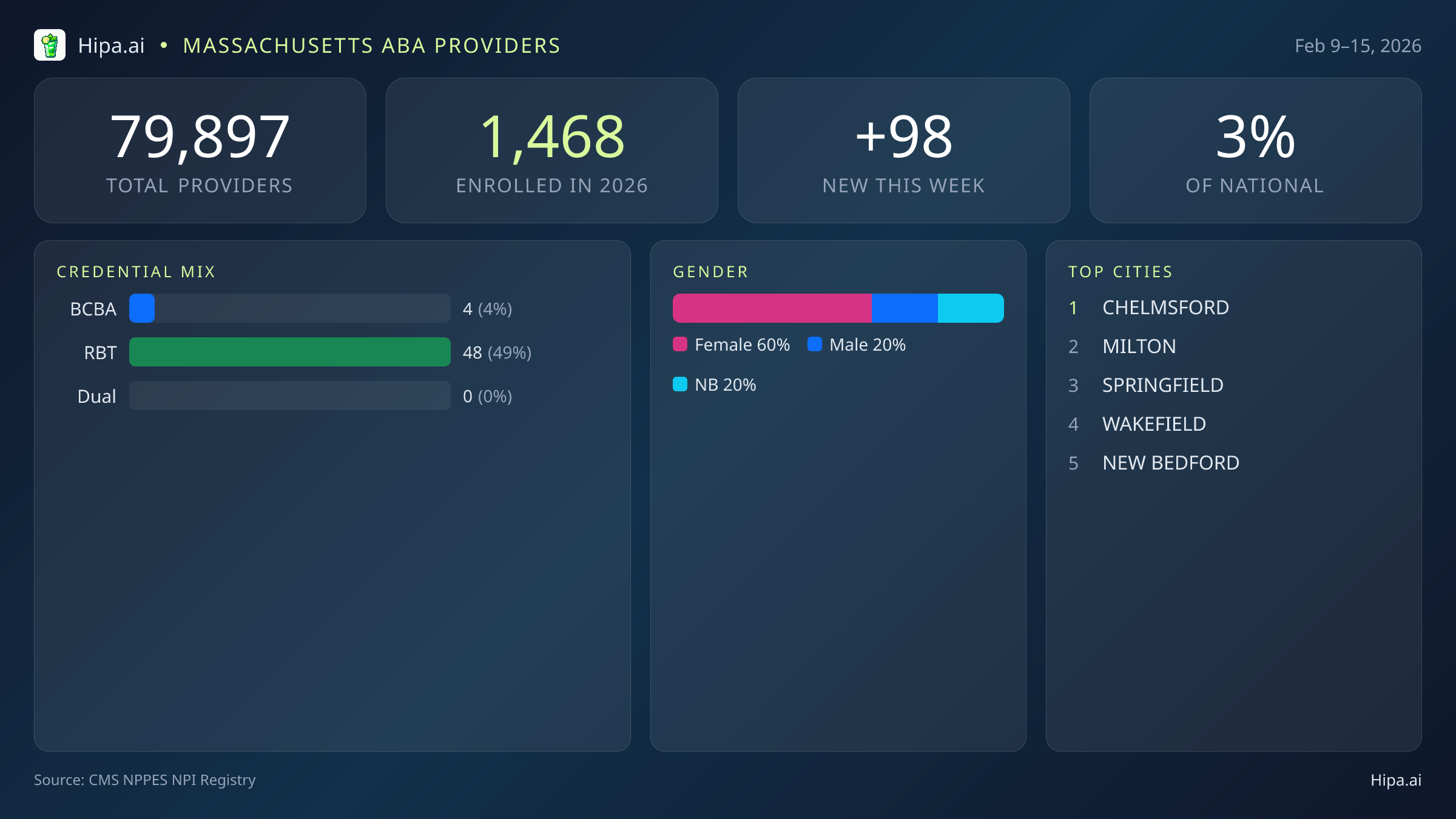
Massachusetts added 98 behavioral health providers in the latest CMS NPI registry weekly update, representing 2% of the national total. This consistent, albeit smaller, contribution indicates steady growth in the state's behavioral health workforce, signaling ongoing efforts to meet local demand for services.
ABA and Behavioral Health Workforce
The new additions include 4 BCBAs and 48 RBTs. It's important to note that credential and taxonomy counts can overlap, as providers may hold multiple certifications or list various specialties. There were no individuals identified with dual BCBA and RBT credentials in this update. The ratio of RBTs to BCBAs, at 12 RBTs for every BCBA, highlights a significant capacity for direct ABA service delivery, supported by a smaller but crucial supervisory layer. This ratio suggests a potential strain on BCBAs to provide adequate supervision.
Demographics and Organizational Activity
Among the 89 individual providers, the gender breakdown shows 53 female providers (60%), 18 male providers (20%), and 18 nonbinary providers (20%). This reflects the broader trend of a predominantly female workforce in behavioral health. The update also includes 9 new organizations, with no single organization appearing multiple times, indicating a diverse entry of new practices rather than expansion from existing multi-state chains.
The influx of RBTs, alongside other mental health professionals, suggests a continued focus on expanding direct service capacity, though the high RBT-to-BCBA ratio warrants attention for sustainable supervision models and ABA access in Massachusetts.