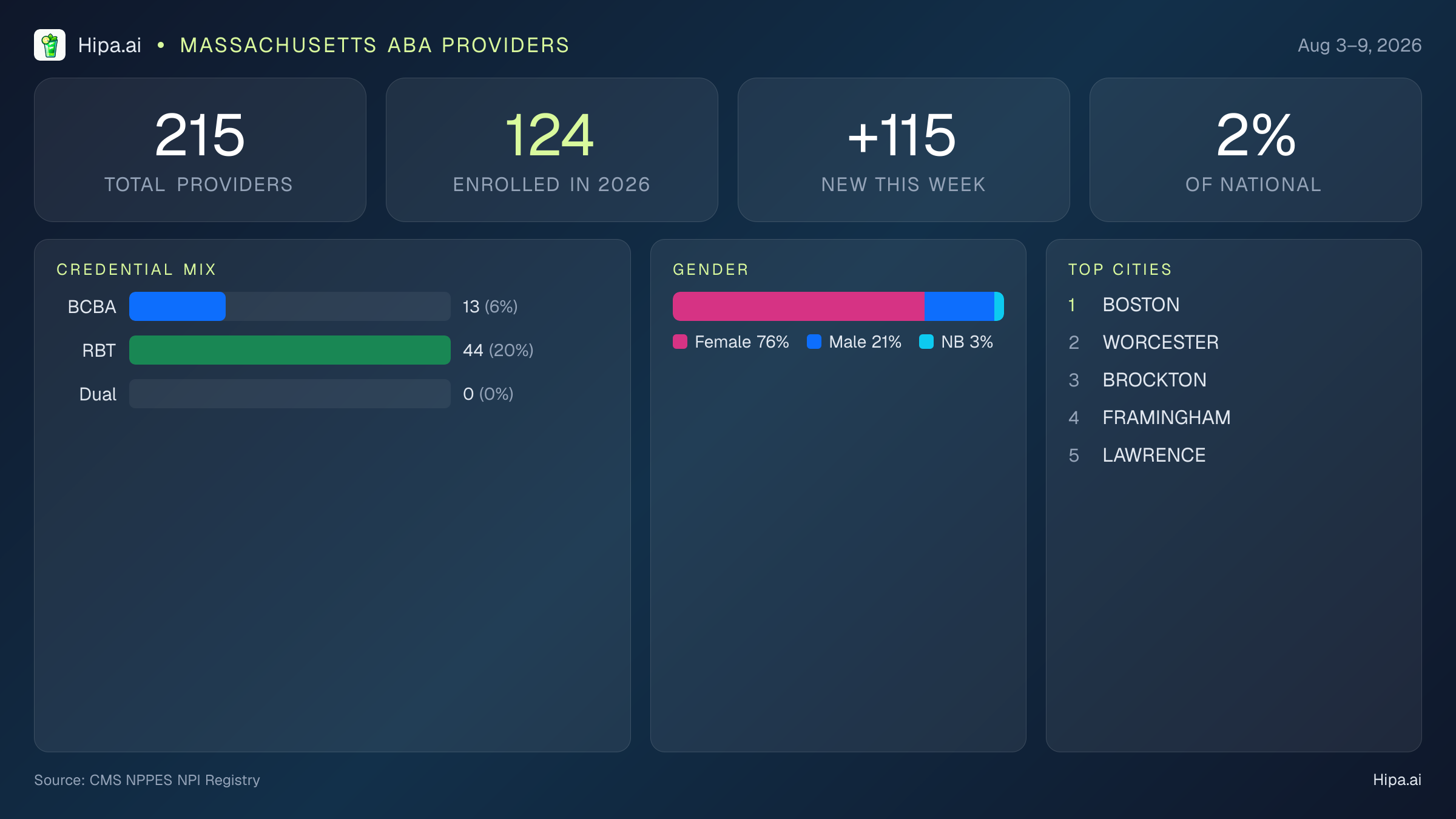
Massachusetts has 215 providers in the latest CMS NPI registry weekly update, representing 2% of the national weekly total. With 115 new providers added this week, the state accounts for a concentrated share of current registry activity, signaling continued behavioral health workforce expansion rather than a small, isolated increase.
ABA Workforce Mix
The registry identifies 13 BCBA credentials and 44 RBT credentials, with no providers listed under a dual BCBA-RBT category. The counts are taxonomy or credential classifications and are not mutually exclusive: other entries may include related or combined credentials, including one provider listed as “LABA, BCBA.” Even so, the RBT count is more than three times the BCBA count, pointing to a larger direct-service workforce than supervisory workforce. Because BCBAs design treatment and supervise RBTs, that imbalance highlights the need for adequate clinical supervision as ABA capacity grows.
Workforce Demographics
Massachusetts has 192 individuals and 23 organizations in the update. Gender data shows 145 female providers, 41 male providers and 6 nonbinary providers, corresponding to 76%, 21% and 3%, respectively. The registry’s broader behavioral health mix includes 13 LMHC credentials, 13 LICSW credentials and 6 LCSW credentials, alongside ABA and speech-language pathology classifications. No notable organization appears multiple times in the supplied data; the update instead reflects a dispersed set of individual providers and organizations across Boston, Worcester, Brockton, Framingham and Lawrence.
The combination of strong weekly additions, a sizable RBT pipeline and a smaller BCBA base suggests Massachusetts may be expanding ABA access while facing pressure to add supervisors and sustain service capacity.