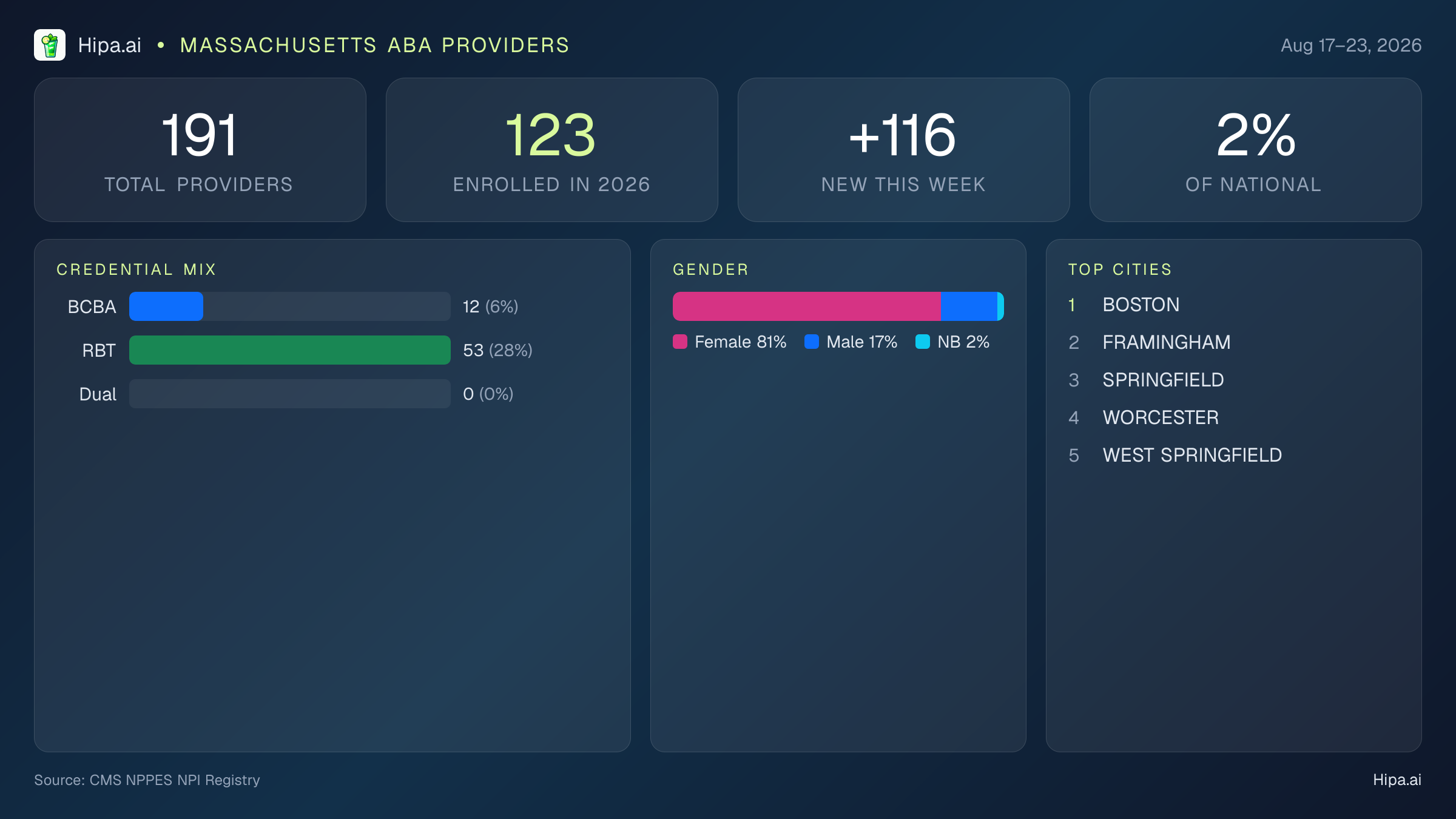
Massachusetts recorded 191 providers in the latest CMS NPI registry weekly update, representing 2% of the national weekly total. The registry lists 116 new providers this week, with activity spanning Boston, Framingham, Springfield, Worcester and West Springfield. Massachusetts accounts for a modest share of national activity but shows broad geographic distribution across major urban and regional markets. The data includes 171 individuals and 20 organizations, although NPI registrations do not necessarily indicate active clinical capacity, open caseloads or completed service availability.
ABA Workforce Mix
Credential and taxonomy fields identify 12 BCBAs and 53 RBTs, with no dual BCBA-RBT credentials listed. These categories overlap with other credential and taxonomy entries and should not be treated as mutually exclusive shares of the 191-provider total. The imbalance still points to a substantially larger direct-service workforce than supervisory workforce. In ABA, BCBAs oversee RBTs, develop treatment plans and monitor clinical quality, so a smaller BCBA pool can constrain how quickly RBT capacity translates into new services. Three entries combine BCBA with Massachusetts’s LABA designation, including credentials formatted as BCBA, LABA or M. ED, BCBA, LABA.
Demographics and Provider Activity
Among individual providers, 139 are identified as female, 29 as male and 3 as nonbinary, corresponding to 81%, 17% and 2%. The counts total 171 individuals. Aspire Learning Center LLC appears twice, once under a speech-language pathology taxonomy and once under BCBA, making it the only organization identified as recurring in the supplied data. The registry also shows multi-taxonomy activity for 15 providers, another reason taxonomy totals cannot be read as distinct workforce segments.
Massachusetts’s RBT-heavy mix suggests growing frontline ABA capacity, while the smaller BCBA pool makes supervisory recruitment central to expanding access.