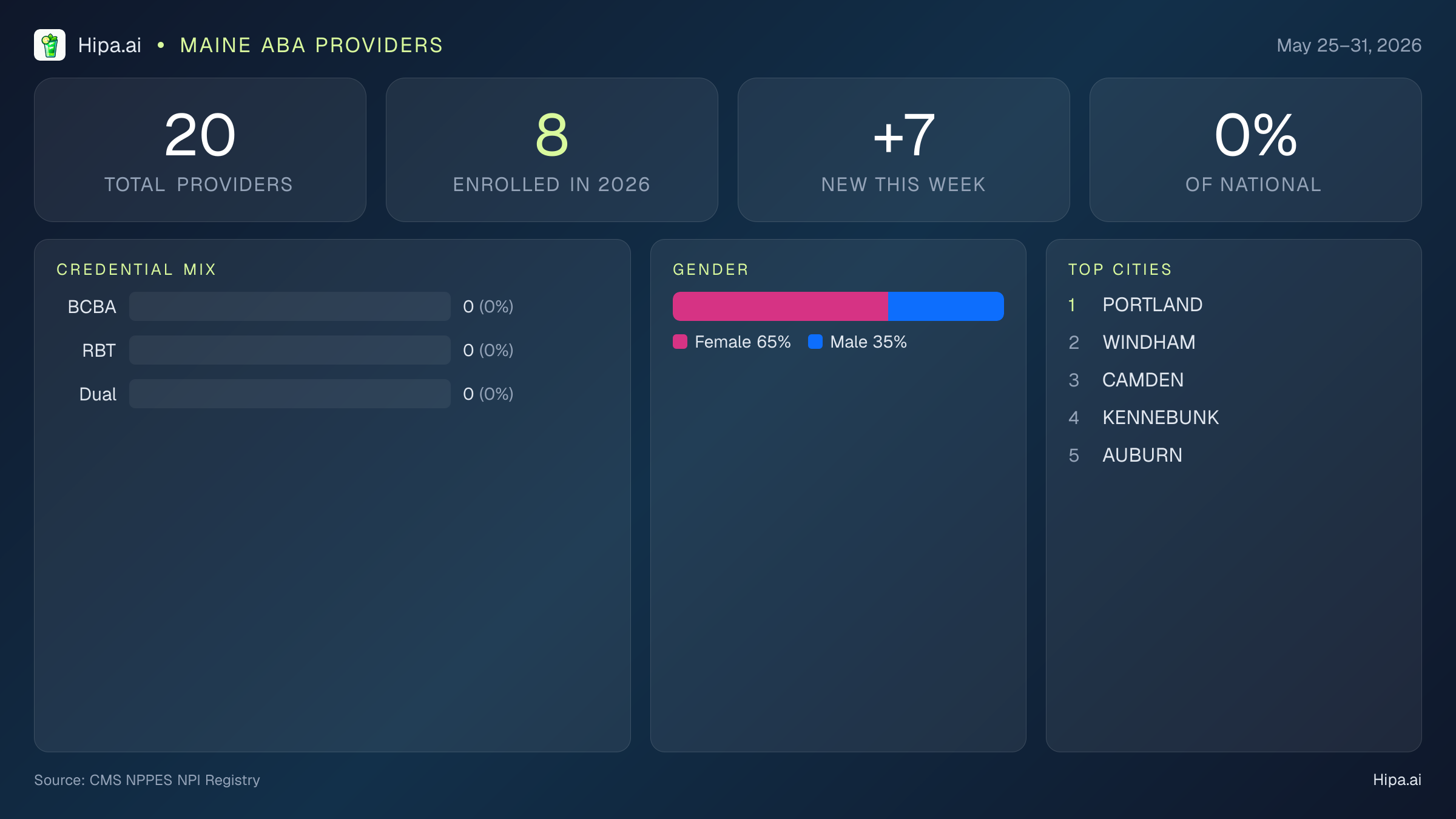
Maine saw 20 total behavioral health providers in the latest CMS NPI registry update, with 7 new registrations this week. This represents 0% of the national weekly total, indicating a modest, localized growth rather than a significant contribution to the national workforce expansion. The small number of new providers aligns with Maine's more rural character and potentially slower expansion of health services compared to more populous states.
Behavioral Health Credential Mix
Crucially for the ABA industry, the data shows no new BCBA or RBT credentials among these registrations, nor any individuals holding dual BCBA+RBT credentials. This means the recent additions do not directly bolster Maine's applied behavior analysis workforce. Instead, the 17 individual providers primarily reflect growth in other behavioral health professions, with credentials such as 4 LMSW-CCs, 2 LCPC, 2 LCSW, and other specialized licenses like LCSW, CADC and LADC, CCS, LCPC. This suggests that while overall behavioral health capacity is expanding, specialized ABA supervision and direct care roles are not seeing immediate growth from this week's NPI updates.
Workforce Demographics
Of the 17 individual providers, 11 (65%) are female and 6 (35%) are male, a gender distribution consistent with broader trends across the behavioral health sector. The three organizational providers include a speech therapy practice and two addiction counseling services. No specific organizations appeared multiple times in this week's new registrations.
This snapshot suggests that Maine's behavioral health workforce is expanding primarily in areas like social work and counseling. However, the absence of new BCBA and RBT credentials indicates that the state's ABA sector is not experiencing growth from these new NPI registrations, potentially impacting access to specialized autism services and the availability of supervisory capacity for RBTs.