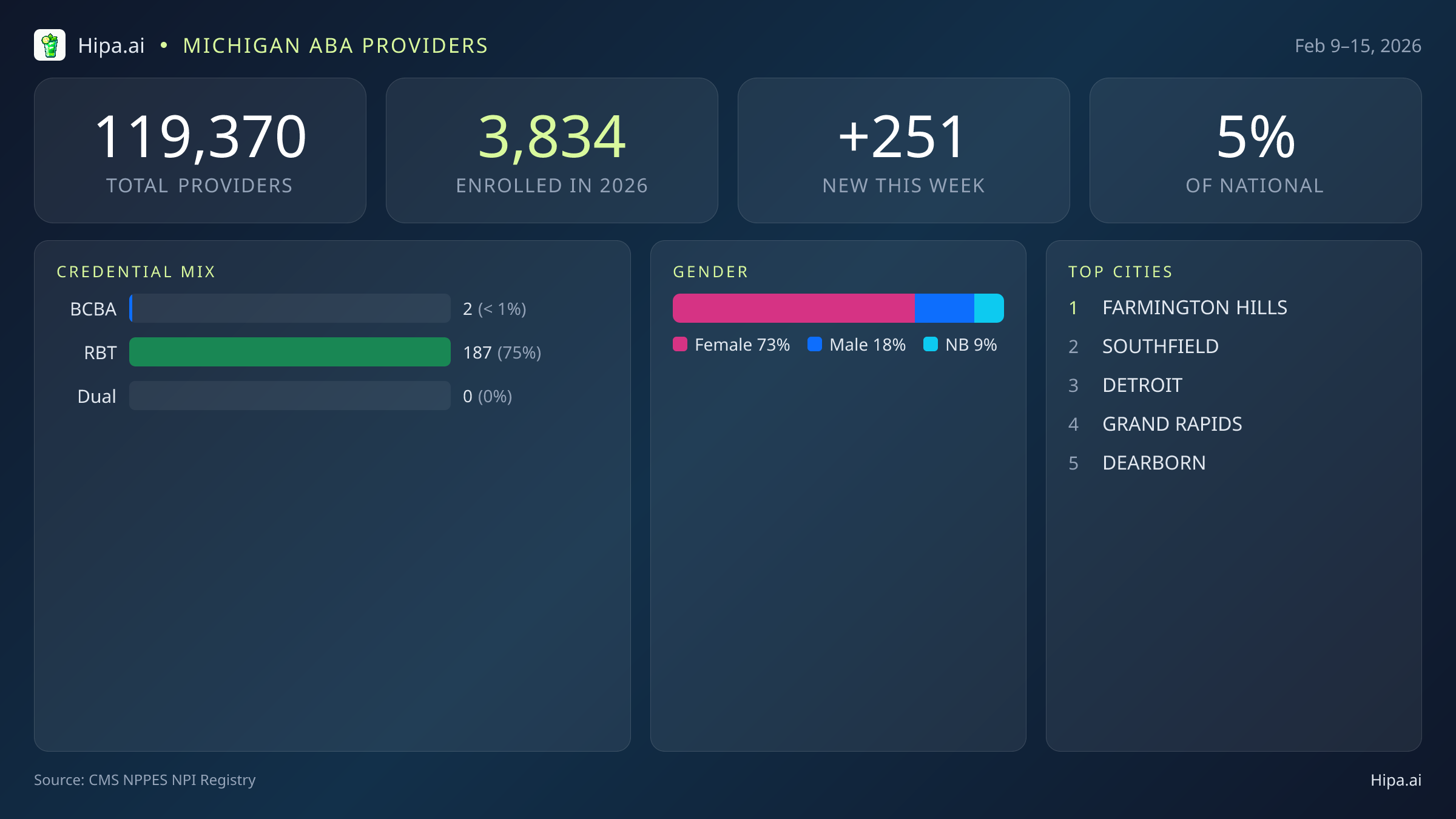
Michigan added 251 behavioral health providers in the latest weekly CMS update, representing 5% of the national total. This substantial influx of new professionals signals a growing demand for behavioral health services and an active expansion within the state's healthcare workforce. Of these, 233 are individuals and 18 are organizations.
ABA Workforce Composition
Focusing on the applied behavior analysis workforce, the data shows 187 providers with RBT credentials and 2 providers with BCBA credentials. It is important to note that credential counts can overlap if individuals hold multiple certifications, though no dual BCBA+RBT credentials were explicitly listed this week. The significant disparity between RBTs and BCBAs, with a ratio of over 90 RBTs for every BCBA, highlights a potential challenge in ensuring adequate supervision capacity for direct ABA service delivery, which is critical for RBTs.
Provider Demographics
Among the 233 individual providers, women constitute the majority, accounting for 73%. Men represent 18%, while 9% identify as nonbinary. No specific organizations appeared multiple times in this week's update, indicating a diverse range of new entities rather than a concentration from a few large employers.
The current distribution, particularly the low number of new BCBAs relative to RBTs, suggests that while Michigan is expanding its direct service capacity, there may be a growing need for more supervisory-level professionals to support sustainable ABA access.