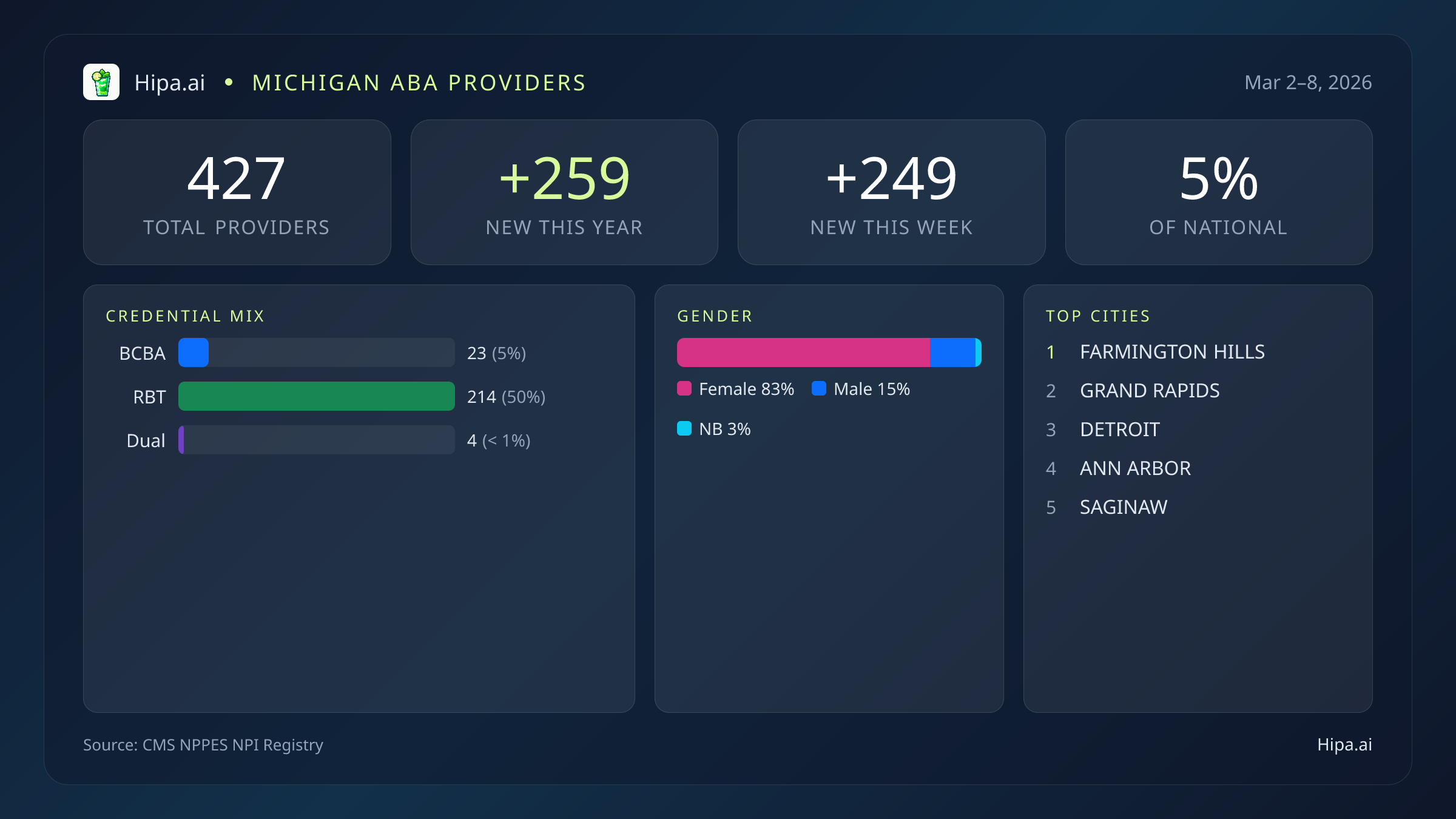
Michigan's behavioral health workforce saw significant activity this past week, adding 249 new providers to the state's total of 427 providers. This weekly influx constitutes a substantial portion of new registrations, representing 5% of the national weekly total for behavioral health providers. Of the total, 386 providers are individuals and 41 are organizations. The high concentration of new entries suggests a rapidly expanding behavioral health sector in the state, with 259 new providers joining this year to date.
The credential mix for new providers this week highlights a significant RBT presence, with 214 providers holding an RBT credential. In contrast, 23 providers are listed with a BCBA credential. Notably, 4 individuals hold both BCBA and RBT credentials, demonstrating career progression within the field. This ratio suggests a robust pool of direct service providers, but also emphasizes the need for sufficient BCBA supervisors to support the large RBT workforce. Several providers also hold Michigan's state-level LBA license, often in conjunction with their BCBA credential, indicating adherence to state-specific regulations. Beyond ABA-specific credentials, other common behavioral health credentials include 25 LMSWs, 6 LLPs, and 5 LLMSWs.
Workforce demographics reveal a predominantly female workforce, with 319 providers (83%) identifying as female, while 56 providers (15%) are male, and 11 providers (3%) identify as nonbinary. Provider activity is concentrated in key urban areas, with Farmington Hills, Grand Rapids, Detroit, Ann Arbor, and Saginaw listed as top cities. Two organizations, REGION VII AREA AGENCY ON AGING INC and WORLD MENTAL HEALTH ORGANIZATION, each appear 2 times in the new provider list. This data suggests a growing, yet unevenly distributed, behavioral health workforce in Michigan, with a particular demand for clinical supervision to match the increasing number of RBTs.