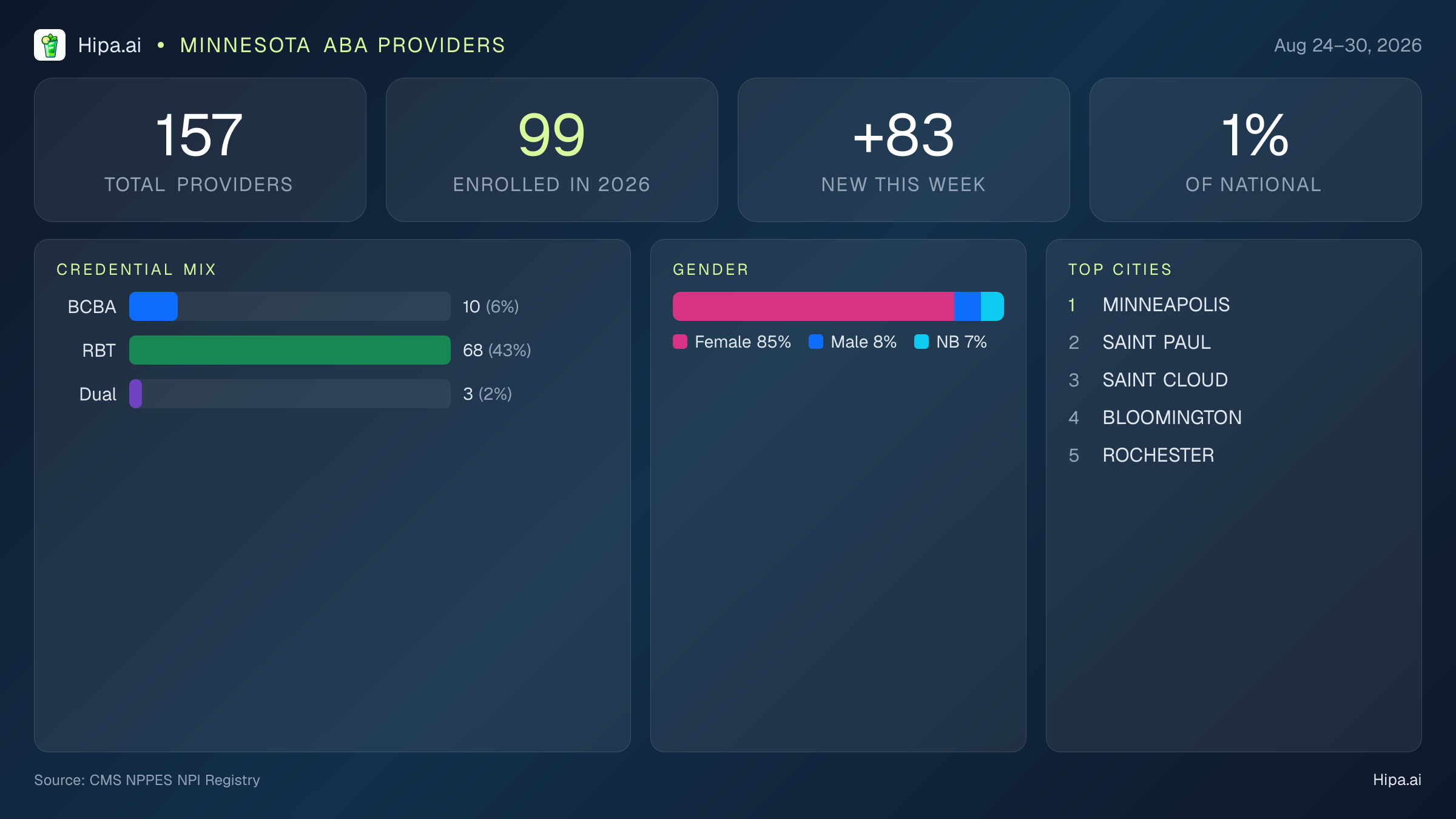
Minnesota recorded 157 providers in the latest CMS NPI registry weekly update, representing 1% of the national weekly total. The registry lists 83 providers new this week and 99 new this year; 143 are individuals and 14 are organizations. Minnesota’s limited share of national activity points to a smaller but active behavioral health market, with new registrations potentially affecting recruiting, payer contracting and service availability. NPI activity does not confirm that a provider is accepting patients or carrying an active caseload.
ABA Workforce Mix
The credential data lists 10 BCBAs and 68 RBTs, along with 3 dual BCBA-RBT credentials. These categories overlap and are not mutually exclusive shares of the provider total: a person can appear in more than one credential category, and taxonomy and credential fields may describe the same provider differently. The wide gap between BCBAs and RBTs indicates a workforce weighted toward direct implementation of treatment, with fewer credentialed supervisors available to oversee services. Because BCBAs supervise RBTs, build treatment plans and monitor clinical quality, that imbalance can limit how quickly clinics expand caseloads. The dual-credential count is relatively small, suggesting that progression between technician and advanced clinical roles is not yet a dominant pattern in this update.
Demographics and Organizations
Gender records identify 121 female providers, 12 male providers and 10 nonbinary providers, corresponding to 85%, 8% and 7%. The registry’s listed leading cities are Minneapolis, Saint Paul, Saint Cloud, Bloomington and Rochester, showing activity concentrated across major population centers as well as regional hubs. No notable organization appears multiple times in the update, and the 14 organization records therefore do not point to a named chain or dominant employer.
Minnesota’s strong RBT presence relative to BCBAs suggests expanding direct-service capacity, while supervisory supply remains the key constraint on broader ABA access.