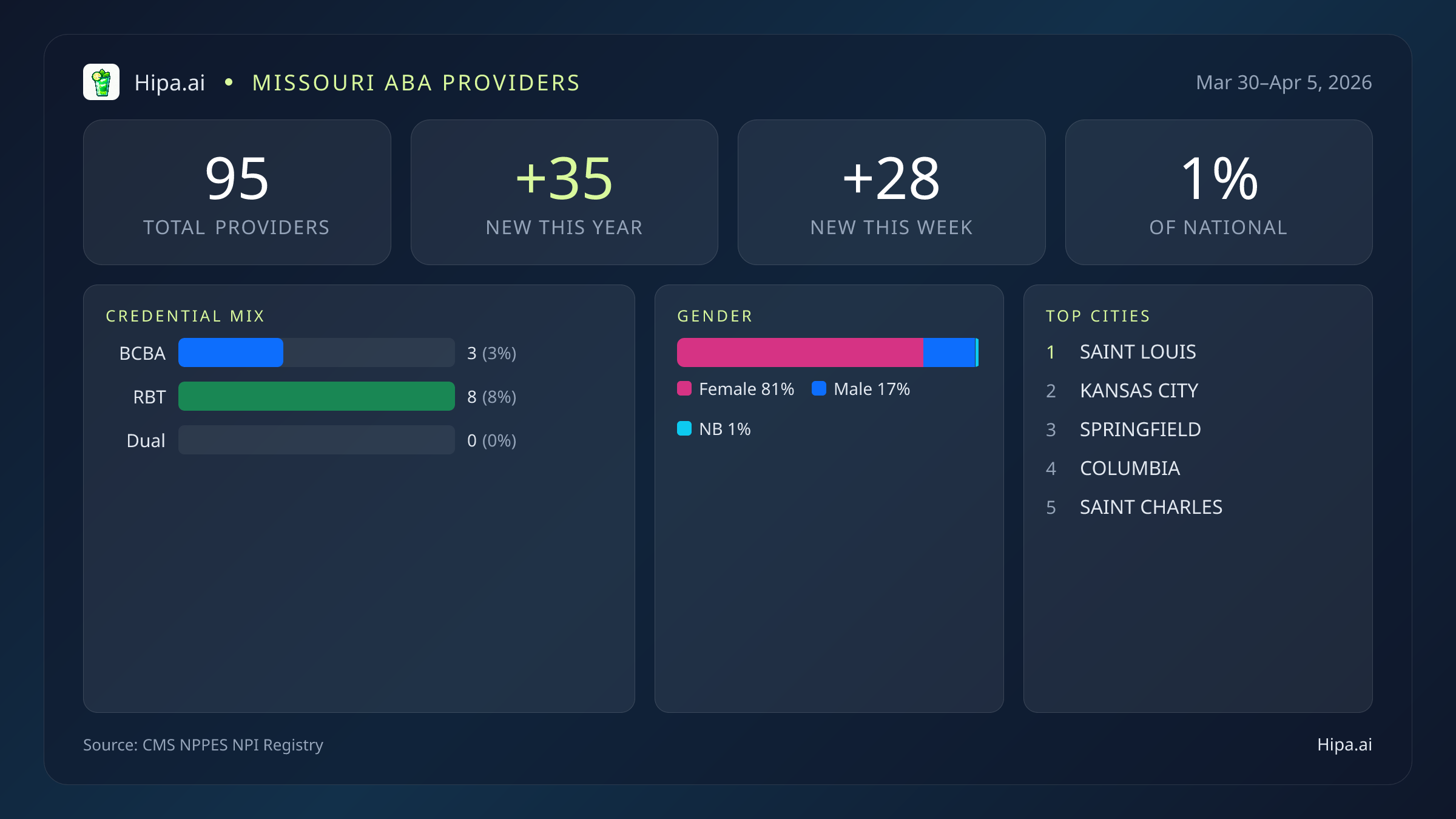
Missouri's behavioral health sector saw 95 providers added in the latest CMS NPI registry weekly update, representing 1% of the national total. Of these, 28 providers were new this week, contributing to a total of 35 new providers this year. The majority, 75 individuals, joined the registry, alongside 20 organizations. This relatively modest volume compared to national figures suggests either a more contained market or a developing stage for certain behavioral health services within the state.
Credentialing and Supervision Capacity
Within the NPI data, ABA-specific credentials show 3 individuals identified as Board Certified Behavior Analysts (BCBAs) and 8 individuals as Registered Behavior Technicians (RBTs). It's important to note that one of the BCBAs also holds a state LBA license, indicating a dual state and national credential. The absence of additional dual BCBA+RBT credentials suggests distinct roles for these professionals rather than combined supervisory and direct service provision. The ratio of RBTs to BCBAs stands at approximately 2.67 to 1, which, while numerically low, points to a potentially favorable supervision environment if these BCBAs are actively supervising RBTs. Beyond ABA, the registry also reflects a broader behavioral health landscape, with 10 providers holding LPC credentials and 6 providers as LCSWs, among other diverse professional qualifications.
Workforce Demographics and Organizational Presence
The individual provider data highlights a predominantly female workforce in Missouri's behavioral health sector, with 61 female providers accounting for 81% of the total. Male providers comprise 17% with 13 individuals, and 1 provider identifies as nonbinary, representing 1%. Among organizational entities, Cedar County Memorial Hospital appeared twice in the registry, indicating its presence in multiple locations or service lines. Additionally, 20 providers are listed with multiple taxonomies, suggesting a diverse skill set and integrated service offerings within the state.
This data indicates a growing, albeit numerically smaller, behavioral health workforce in Missouri, with a notable female majority and a specific need for continued growth in ABA-specific supervisory roles to expand access to services.