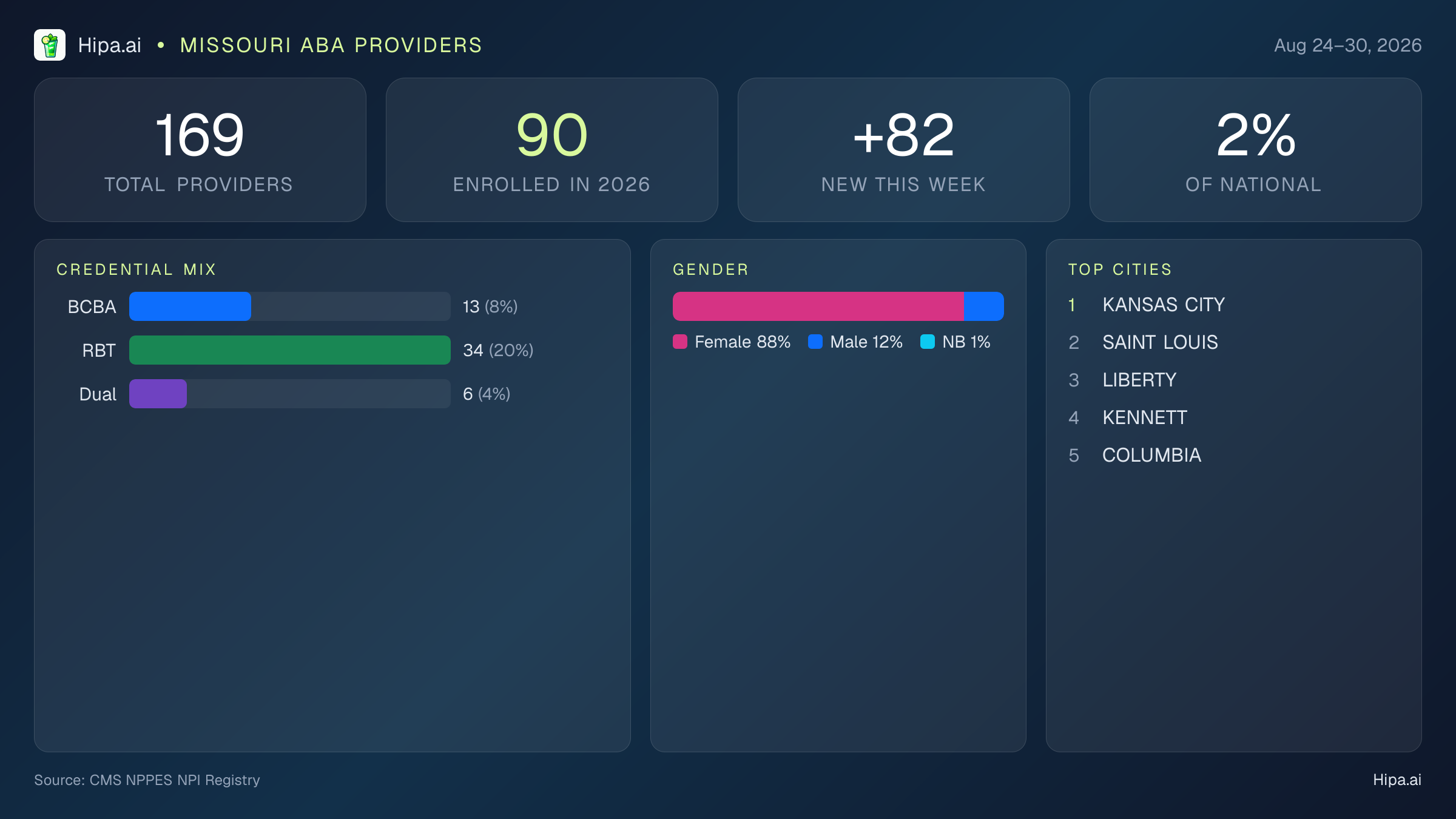
| ALEXANDER, BRITTANY | INDEPENDENCE, MO | PLPC | Mental Health Counselor | 06/16/2026 |
| ALLEN, KENDRIA | KANSAS CITY, MO | - | RBT | 08/27/2026 |
| ANDERSON, LAUREN | COLUMBIA, MO | - | RBT | 08/27/2026 |
| ANDREWS, HILARIE | KANSAS CITY, MO | MA, LPC | Professional Counselor | 04/22/2021 |
| AUDRAIN AMBULANCE DISTRICTORG | MEXICO, MO | - | Community/Behavioral Health Agency | 08/24/2026 |
| BARNES, KIMBERLEE | VAN BUREN, MO | PSY.D., L.P.C. | Psychologist | 07/18/2007 |
| BARTON, STACY | DONIPHAN, MO | LPC | Mental Health Counselor | 11/13/2020 |
| BAUERLE, BROOKLYN | LIBERTY, MO | - | Speech-Language Pathologist | 03/31/2008 |
| BEASLEY, JANICE | KANSAS CITY, MO | LCSW | Clinical Social Worker | 10/03/2006 |
| BEISHIR, OLIVIA | WENTZVILLE, MO | - | Mental Health Counselor | 08/28/2026 |
| BESCH, VERONICA | KANSAS CITY, MO | PLPC | Professional Counselor | 11/16/2021 |
| BORKOWSKI, ALEC | COLUMBIA, MO | LCSW | Clinical Social Worker | 07/10/2024 |
| BOWDEN, BRANDI | BUFFALO, MO | MS, LPC | Professional Counselor | 12/02/2021 |
| BRADSHAW, GINGER | COLUMBIA, MO | MA, PLPC | Professional Counselor | 09/04/2024 |
| BRASIER, AMBER | JEFFERSON CITY, MO | LPC | Mental Health Counselor | 08/25/2026 |
| BRUNSTROM, CHELSEA | COLUMBIA, MO | MED, LPC | Professional Counselor | 12/16/2014 |
| CALDWELL COUNTY AMBULANCE DISTRICTORG | KINGSTON, MO | - | Community/Behavioral Health Agency | 08/21/2026 |
| CANNON, SHEILA | POPLAR BLUFF, MO | LPC | Professional Counselor | 03/26/2019 |
| CANTRELL, JESSICA | CRYSTAL CITY, MO | MA, LPC | Professional Counselor | 03/05/2015 |
| CANTRELL, TAYLOR | OLDFIELD, MO | - | Mental Health Counselor | 08/24/2026 |
| CARMOSINO, KYRSTEN | LIBERTY, MO | - | Speech-Language Pathologist | 08/25/2026 |
| CHASE, JAYDIN | LIBERTY, MO | - | Speech-Language Pathologist | 08/24/2026 |
| CIOCCA, ROSA | BLUE SPRINGS, MO | PLPC | Mental Health Counselor | 08/29/2026 |
| CLAIBOURN, JESSICA | BUTLER, MO | LCSW | Clinical Social Worker | 04/11/2024 |
| COLE, ALTHIA | MONETT, MO | PLPC | Mental Health Counselor | 08/27/2026 |
| COLEMAN, DESHAWN | SPRINGFIELD, MO | PLP | Case Management Agency | 07/12/2018 |
| COOK, KAYLA | KENNETT, MO | - | RBT | 08/26/2026 |
| COOLEY BENNETT, TERESA | KANSAS CITY, MO | LCSW, LSCSW, CCDP-D | Clinical Social Worker | 02/27/2007 |
| COOLEY-SMITH, GRANT | KENNETT, MO | - | RBT | 08/26/2026 |
| CORONADO, ABBIE | CAPE GIRARDEAU, MO | - | BCBA | 07/29/2025 |
| CROSS RIVER THERAPY MOORG | BRANSON, MO | - | BCBA | 08/24/2026 |
| CRUZ, ASHLEY | KANSAS CITY, MO | BCBA | RBT | 10/19/2018 |
| CUNNINGHAM, DARLA | REPUBLIC, MO | LPC | Professional Counselor | 04/26/2022 |
| DAVIS, DIANE | SAINT LOUIS, MO | MA, PLPC | Mental Health Counselor | 08/29/2024 |
| DAVIS, SANDRA | SAINT LOUIS, MO | LPC | Professional Counselor | 05/07/2010 |
| DAVIS, WHITNEY | SAINT LOUIS, MO | - | RBT | 08/25/2026 |
| DEWEESE, JANAE | KANSAS CITY, MO | - | RBT | 08/24/2026 |
| DIXON, STEPHANIE | COLUMBIA, MO | MS, LPC | Professional Counselor | 05/03/2021 |
| DOLSKY, ANA | KANSAS CITY, MO | - | Speech-Language Pathologist | 08/28/2026 |
| DREHER, EMILY | SAINT LOUIS, MO | LPC | Professional Counselor | 12/01/2010 |
| DUVER, MEDJINE | ELLISVILLE, MO | - | RBT | 08/25/2026 |
| DWORNICK, KARA | KANSAS CITY, MO | - | RBT | 08/27/2026 |
| ELLIOTT, SAMUEL | KENNETT, MO | - | Professional Counselor | 06/06/2023 |
| ENDSLEY, ASTRID | CREVE COEUR, MO | M.S., PLPC | Professional Counselor | 08/10/2026 |
| ESSENTIAL FAMILIES MIDWEST, INCORG | KANSAS CITY, MO | - | Counselor | 04/01/2024 |
| FERRANTO, GABRIELLE | WILDWOOD, MO | - | RBT | 08/24/2026 |
| FITZGERALD, LORI | KANSAS CITY, MO | MS, CCC-SLP | Speech-Language Pathologist | 05/17/2023 |
| FRANCIS, MALLORY | SAINT LOUIS, MO | LPC | Counselor | 05/09/2024 |
| GALICIA-RODRIGUEZ, MELODY | LIBERTY, MO | - | RBT | 08/26/2026 |
| GEREAU, SAMANTHA | SAINT LOUIS, MO | SLP | Speech-Language Pathologist | 01/08/2021 |
| GILLEY COUNSELING, LLCORG | WARRENSBURG, MO | - | Mental Health Counselor | 08/26/2026 |
| GOLDBERG, DANIELLE | LIBERTY, MO | - | Speech-Language Pathologist | 08/25/2026 |
| GOODMAN, DEREK | KENNETT, MO | - | RBT | 09/30/2021 |
| GOODWIN, LYDIA | KANSAS CITY, MO | - | Speech-Language Pathologist | 08/25/2026 |
| GRIMM, DANIELLE | RAYVILLE, MO | LPC | Professional Counselor | 05/11/2022 |
| GUNN, VICTORIA | KANSAS CITY, MO | LCSW | Clinical Social Worker | 09/16/2015 |
| GUST, ALEXA | GRAIN VALLEY, MO | - | Speech-Language Pathologist | 08/26/2026 |
| GUTIERREZ, MALIA | GRAIN VALLEY, MO | - | RBT | 08/28/2026 |
| HALBERG, CAITLYN | SPRINGFIELD, MO | PLPC | Professional Counselor | 08/07/2026 |
| HAPPY STRIDES ABA MO LLCORG | SAINT LOUIS, MO | - | BCBA | 08/26/2026 |
| HARRIS, JOSLYN | NOEL, MO | - | Counselor | 08/25/2026 |
| HARRISON BRIDGE BEHAVIORAL HEALTH MO LLCORG | HARRISONVILLE, MO | - | BCBA | 08/26/2026 |
| HASSEY, DACEY | SAINT JOSEPH, MO | PLPC | Professional Counselor | 08/28/2026 |
| HASTINGS, JENNA | TOWN AND COUNTRY, MO | MA, LPC | Mental Health Counselor | 08/28/2026 |
| HAZEN, KATHERINE | KANSAS CITY, MO | SLP | Speech-Language Pathologist | 08/24/2026 |
| HEALING WITH HAROTIAN, LLCORG | FLORISSANT, MO | - | Case Manager/Care Coordinator | 08/24/2026 |
| HEMPHILL, DESTINY | KANSAS CITY, MO | - | RBT | 08/24/2026 |
| HEURING, SARAH | CAPE GIRARDEAU, MO | - | RBT | 08/25/2026 |
| HICKMAN, AMY | LEBANON, MO | - | Professional Counselor | 08/25/2026 |
| HOLLAND, JULIA | KANSAS CITY, MO | LPC | Professional Counselor | 03/01/2018 |
| HORN, ABIGAIL | LIBERTY, MO | - | Speech-Language Pathologist | 08/26/2026 |
| HUGHES, TIFFANY | KANSAS CITY, MO | - | Professional Counselor | 08/27/2026 |
| IBARRA, MARIA | KENNETT, MO | LMSW | Clinical Social Worker | 08/02/2023 |
| JACKSON, KYENDIA | KENNETT, MO | - | RBT | 08/26/2026 |
| JANOKA-GARNER, CAROLINE | SPRINGFIELD, MO | PHD | Psychologist | 11/06/2006 |
| JOHNSON, EMILY | SAINT CHARLES, MO | - | Speech-Language Pathologist | 08/26/2026 |
| JOHNSON, JORDAN | SAINT LOUIS, MO | - | RBT | 08/25/2026 |
| KAUFFMAN, KATIE | INDEPENDENCE, MO | - | BCBA | 10/20/2025 |
| KAUFFMAN, LAURA | LIBERTY, MO | M.S., CCC-SLP | Speech-Language Pathologist | 08/26/2026 |
| KEEGAN, MOLLY | SAINT CHARLES, MO | MHS, CCC-SLP | Speech-Language Pathologist | 07/29/2021 |
| KELLEY, JOHANNA | KANSAS CITY, MO | LCSW, LSCSW | Clinical Social Worker | 09/28/2021 |
| KENDRICK, ROSEMARY | KENNETT, MO | - | RBT | 08/28/2026 |
| KNUDSEN, TATE | KANSAS CITY, MO | BCBA | RBT | 12/30/2019 |
| KOLODZIEJ, MARGARET | LIBERTY, MO | - | Speech-Language Pathologist | 08/25/2026 |
| KORTHANKE, ELIZABETH | LIBERTY, MO | - | Speech-Language Pathologist | 08/26/2026 |
| LANE, KAREN | KANSAS CITY, MO | LPC | Professional Counselor | 02/22/2023 |
| LARKIN, LILY | LEES SUMMIT, MO | - | RBT | 08/25/2026 |
| LEMMONES, MARGAUX | KANSAS CITY, MO | LPC | Professional Counselor | 05/27/2014 |
| LEVINSON, MARGARET | SAINT LOUIS, MO | L.C.S.W. | Clinical Social Worker | 09/27/2006 |
| LEWIS, CHRISTINA | FESTUS, MO | LPC | Professional Counselor | 04/25/2023 |
| LEWIS, CLARENCE | SAINT LOUIS, MO | MA (PLPC) | Professional Counselor | 04/29/2013 |
| LINEAR FOCUS LLCORG | SAINT LOUIS, MO | - | BCBA | 08/25/2026 |
| LIVESAY, BENJAMIN | JOPLIN, MO | - | Clinical Social Worker | 09/05/2018 |
| LOPEZ, ASHLEY | COLUMBIA, MO | PLPC | Professional Counselor | 08/21/2026 |
| MAHON, MICHAEL | CREVE COEUR, MO | PSY.D., LPC | Professional Counselor | 10/07/2009 |
| MALONE-DURHAM, ASHLEY | KENNETT, MO | RBT | RBT | 08/26/2026 |
| MCCONNELL, AMARIA | INDEPENDENCE, MO | - | RBT | 08/24/2026 |
| MCDANIEL, ARIANNA | KENNETT, MO | - | RBT | 08/27/2026 |
| MCELROY, DAVID | KANSAS CITY, MO | MA,PLPC,NCC | Mental Health Counselor | 09/26/2022 |
| MCGOUGH, KRYSTEN | SAINT PETERS, MO | - | Speech-Language Pathologist | 03/24/2011 |
| MED TECH CARE INCORG | CHESTERFIELD, MO | - | Clinic/Center | 08/24/2026 |
| MELLING, JOELLE | KANSAS CITY, MO | MA, PLPC, LPC | Mental Health Counselor | 08/27/2026 |
| MONTAGUE, BROOKE | KANSAS CITY, MO | - | Speech-Language Pathologist | 02/20/2014 |
| MOUNT, AVERIE | FLORISSANT, MO | - | Professional Counselor | 02/06/2025 |
| NICKERSON, MCKENZIE | SPRINGFIELD, MO | MS, LPC | Professional Counselor | 12/31/2020 |
| NORFOLK NEURODIVERSE EVALUATIONS & SUPPORT, LLCORG | BLUE SPRINGS, MO | - | Psychologist | 09/26/2025 |
| OLIVER, ALYSA | SULLIVAN, MO | - | Speech-Language Pathologist | 09/02/2025 |
| ORAL MED CENTER INCORG | CHESTERFIELD, MO | - | Clinic/Center | 08/24/2026 |
| OZARK SUNRISE MENTAL WELLNESSORG | GOODMAN, MO | - | Mental Health Counselor | 08/25/2026 |
| PALMER, COLLETTE | CAMDENTON, MO | LPC | Professional Counselor | 07/07/2014 |
| PARGO, SINISKI | WENTZVILLE, MO | - | Mental Health Counselor | 08/26/2026 |
| PARTELOW, RACHEL | KANSAS CITY, MO | MA, PLPC, NCC | Professional Counselor | 03/05/2018 |
| PEOPLES, BRANDY | HAZELWOOD, MO | PHD | Psychologist | 08/28/2026 |
| PICKEL, KRISTA | BARNHART, MO | BCBA | BCBA | 07/30/2019 |
| PIERCE, GEORGE | KENNETT, MO | - | RBT | 07/08/2014 |
| PRINSEN, SOPHIA | KANSAS CITY, MO | MS | Speech-Language Pathologist | 08/28/2026 |
| PRITCHETT, KAITLYN | MARBLE HILL, MO | PLPC | Mental Health Counselor | 08/25/2026 |
| READMAN, SHAWNESSAY | ROLLA, MO | PLPC | Professional Counselor | 08/27/2026 |
| RIMPSON, VANESSA | INDEPENDENCE, MO | - | RBT | 08/24/2026 |
| ROAD TO RECOVERY COUNSELING, LLCORG | LEES SUMMIT, MO | - | Professional Counselor | 08/24/2026 |
| ROOK, JORDAN | SAINT LOUIS, MO | BCBA | BCBA | 08/09/2024 |
| ROSE, ANNA | KANSAS CITY, MO | LMSW | Clinical Social Worker | 06/05/2023 |
| ROSENSTOCK, KAYLA | KANSAS CITY, MO | - | RBT | 08/28/2026 |
| RUYBAL, NOAH | BOLIVAR, MO | LCSW | Clinical Social Worker | 08/09/2023 |
| SANDYDAVISLPC LLCORG | SAINT LOUIS, MO | - | Community/Behavioral Health Agency | 01/05/2024 |
| SAVERINO-JORGENSEN, KATHERINE | LIBERTY, MO | M.S., CCC-SLP | Speech-Language Pathologist | 02/13/2007 |
| SAX, MEGAN | INDEPENDENCE, MO | LCSW | Clinical Social Worker | 11/08/2023 |
| SCHMIDT, EMILY | BELTON, MO | LPC | Professional Counselor | 10/19/2015 |
| SCHMUCK, ALLYSON | SAINT CHARLES, MO | MS SLP | Speech-Language Pathologist | 08/27/2026 |
| SCRIVENER, SALLY | SPRINGFIELD, MO | - | Mental Health Counselor | 08/27/2026 |
| SELVY, MALLORY | KIRKSVILLE, MO | MA, PLPC | Professional Counselor | 08/13/2026 |
| SHIPMAN, KAITLYN | WELDON SPRING, MO | BCBA | BCBA | 04/27/2021 |
| SIMPSON, KATHRYN | KANSAS CITY, MO | - | Clinical Social Worker | 03/11/2021 |
| SLAGEL, MEGAN | COLUMBIA, MO | PHD | Psychologist | 04/08/2026 |
| SMITH, INGRID | BRIDGTON, MO | L.C.S.W | Clinical Social Worker | 06/26/2014 |
| SMITH, JULIE | KANSAS CITY, MO | LMSW | Mental Health Counselor | 07/14/2023 |
| SMITH, KAELY | SAINT JOSEPH, MO | - | RBT | 08/27/2026 |
| SMITH, SOPHIA | CAPE GIRARDEAU, MO | - | RBT | 08/25/2026 |
| SOUTHARDS, EMMA | SALEM, MO | M.A., CF-SLP | Speech-Language Pathologist | 08/27/2026 |
| ST. FRANCOIS COUNTY AMBULANCE DISTRICTORG | FARMINGTON, MO | - | Community/Behavioral Health Agency | 08/26/2026 |
| STELLING, HAILEY | SAINT PETERS, MO | - | Speech-Language Pathologist | 08/27/2026 |
| STEPHENSON, BRIANNA | PLATTE CITY, MO | - | RBT | 08/28/2026 |
| SUMMERS, ALEXA | COLUMBIA, MO | MSW, LCSW | Clinical Social Worker | 11/05/2014 |
| SUMY, TEAGAN | LIBERTY, MO | - | Speech-Language Pathologist | 08/24/2026 |
| SUTHER, JENNIFER | SAINT LOUIS, MO | LCSW | Clinical Social Worker | 08/31/2006 |
| SUTHERLAND, CONNER | KENNETT, MO | - | RBT | 08/26/2026 |
| TAYLOR, MELINDA | POPLAR BLUFF, MO | LCSW | Clinical Social Worker | 10/04/2015 |
| TECH NOVA MEDS CARE INCORG | CHESTERFIELD, MO | - | Clinic/Center | 08/24/2026 |
| TECHNO HEALTH CARE CHI INCORG | CHESTERFIELD, MO | - | Clinic/Center | 08/24/2026 |
| TICHICH, EMILY | JEFFERSON CITY, MO | CF-SLP | Speech-Language Pathologist | 08/24/2026 |
| TILL, JEFFRY | POPLAR BLUFF, MO | LCSW | Clinical Social Worker | 01/04/2006 |
| TINSLEY HOME MEDICAL SERVICES, LLCORG | POPLAR BLUFF, MO | - | Clinical Social Worker | 01/19/2021 |
| TINSLEY, NINA | SPRINGFIELD, MO | M.S. CCC-SLP | Speech-Language Pathologist | 03/26/2007 |
| TRENT, ZOE | GLADSTONE, MO | LPC | Professional Counselor | 08/24/2026 |
| UHL, JOSEPH | SPRINGFIELD, MO | LMSW | Clinical Social Worker | 08/05/2025 |
| UNION COMMUNITY AMBULANCE DISTRICTORG | UNION, MO | - | Community/Behavioral Health Agency | 08/28/2026 |
| WEAKLEY, AVA | LIBERTY, MO | SLP-CF | Speech-Language Pathologist | 08/25/2026 |
| WEBER, CHRISTOFFER | BRANSON, MO | MD | Specialist | 05/09/2006 |
| WEISOLY, JOSHUA | KANSAS CITY, MO | - | Mental Health Counselor | 08/26/2026 |
| WHITAKER, RAYCHEL | HAMILTON, MO | - | Speech-Language Pathologist | 07/22/2021 |
| WHITNEY BALDRIDGE, LCSW, LLCORG | COLUMBIA, MO | - | Clinical Social Worker | 08/27/2026 |
| WIEBERG, MAGGIE | JEFFERSON CITY, MO | - | BCBA | 08/27/2026 |
| WILKINSON, ASHLEY | SAINT LOUIS, MO | MA, LPC | Professional Counselor | 05/27/2021 |
| WINDSOR C-1 SCHOOL DISTRICTORG | IMPERIAL, MO | - | Speech-Language Pathologist | 08/27/2026 |
| WINNINGHAM, SAVANNAH | SAINT LOUIS, MO | LMSW | Clinical Social Worker | 07/17/2026 |
| WISE, SHANIECE | LEES SUMMIT, MO | PLPC | Professional Counselor | 08/24/2026 |
| WITTE, LUNDEN | KANSAS CITY, MO | - | Speech-Language Pathologist | 12/05/2023 |
| WORK, KATHERINE | SAINT LOUIS, MO | - | Speech-Language Pathologist | 07/17/2019 |
| YOUNG, MADELINE | BLUE SPRINGS, MO | - | Speech-Language Pathologist | 08/15/2024 |