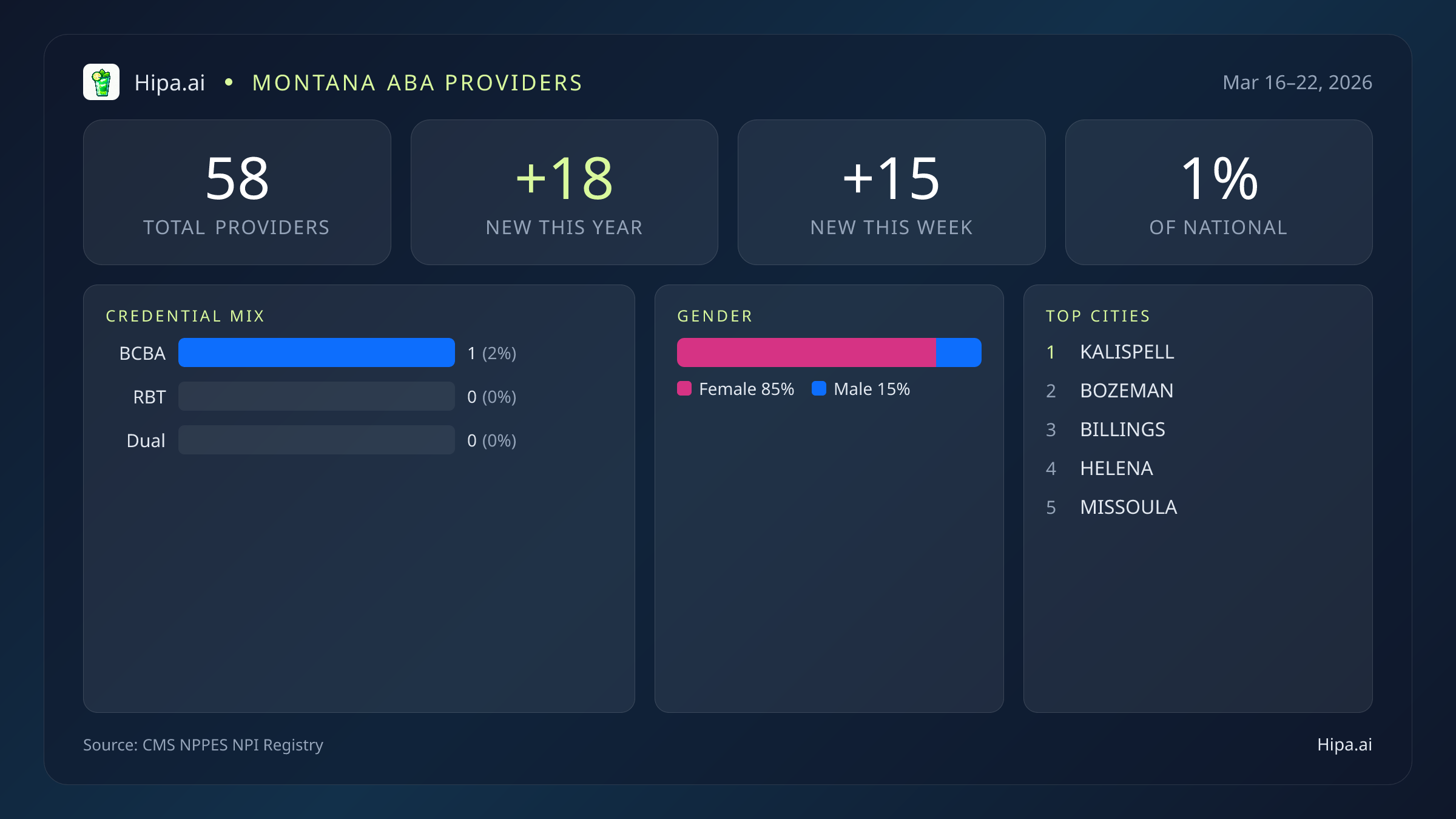
Montana's behavioral health provider roster in the latest CMS NPI weekly update stands at 58 total providers, representing 1% of the national weekly total. This modest concentration reflects Montana's smaller population and geographic dispersion, a pattern common in rural states where behavioral health capacity constraints are structural rather than temporary.
The credential mix in Montana reveals a significant gap in ABA-specific workforce depth. The registry shows 1 BCBA, 0 RBTs, and 0 dual BCBA-RBT credentials. Instead, the majority of providers—organized around counselors, social workers, and allied mental health professionals—hold credentials like LCPC (6 providers), LCSW (3 providers), and LAC (2 providers). This absence of RBTs and the single BCBA signals that autism and intensive behavioral intervention services likely depend on out-of-state supervision or regional partnerships rather than in-state capacity. 24 providers carry multiple taxonomies, suggesting some cross-training, but this does not offset the structural shortage of credentialed ABA supervisors.
The workforce skews heavily female: 23 providers (85%) identify as female, while 4 (15%) are male. Notable organizations include Kalispell Regional Medical Center variants (combined 9 provider registrations) and Logan Health–Whitefish (3 registrations), anchoring service delivery in northwest Montana. Montana added 18 new providers year-to-date, suggesting modest growth, but without BCBA or RBT expansion, the state's ability to scale ABA services remains constrained.