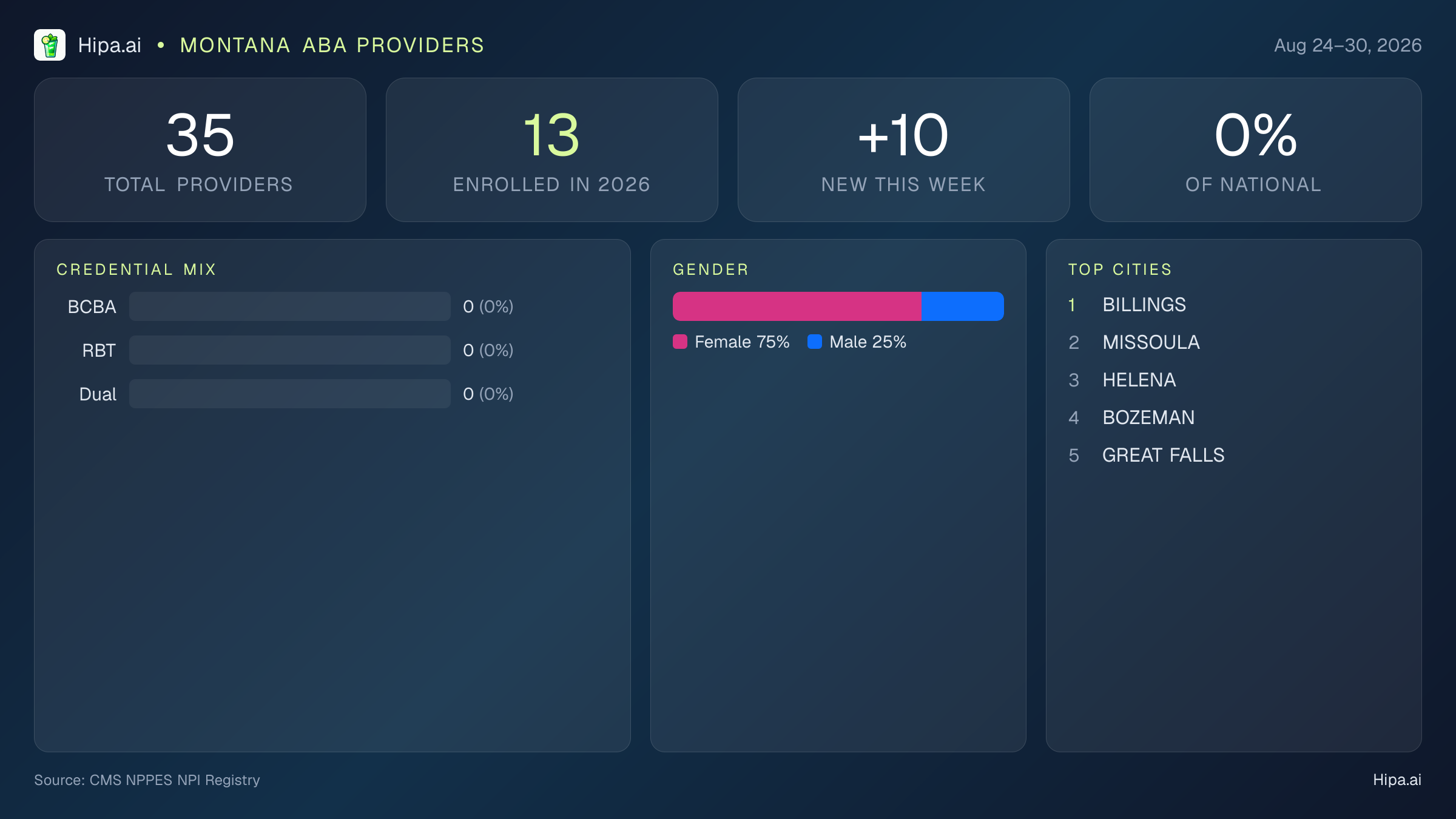
Montana recorded 35 providers in the latest CMS NPI registry weekly update, with a reported share of 0% of the national weekly total. The update includes 10 new providers this week and 13 new providers this year. Individuals account for 24 entries and organizations for 11. The zero-percent share signals that Montana’s activity is small relative to the national update, although NPI registrations do not confirm active caseloads, staffing levels or available appointments. The listed activity spans Billings, Missoula, Helena, Bozeman and Great Falls, among other communities.
Credential Mix
The registry reports zero BCBA credentials, zero RBT credentials and zero dual BCBA-RBT credentials. That means this update does not show a credentialed ABA supervision or technician pipeline, despite including behavioral health professionals who may work in adjacent services. Other listed credentials include three LCPC entries, two LCSW entries and two MS, LCPC entries, along with physicians, social workers, counselors and speech-language pathologists. These credential categories overlap: a provider can hold multiple credentials, and the taxonomy and credential fields are not mutually exclusive. Ten providers have multiple taxonomies, further limiting direct comparisons between category counts. For ABA operators, the absence of BCBAs and RBTs suggests no measurable ABA-specific supervision capacity in this weekly snapshot.
Workforce Profile
Gender data identifies 18 female providers, or 75%, and six male providers, or 25%; no nonbinary providers are recorded. No notable organization appears multiple times in the update. The mix includes 24 individuals and 11 organizations, indicating both solo or individual practice activity and agency-level registrations. The registry’s broad behavioral health composition, rather than an ABA-centered workforce, suggests Montana’s immediate access picture is shaped more by counseling, social work and related services.
Montana’s update points to a limited ABA-specific workforce signal and a broader behavioral health market that may require additional BCBA and RBT recruitment to expand ABA access.