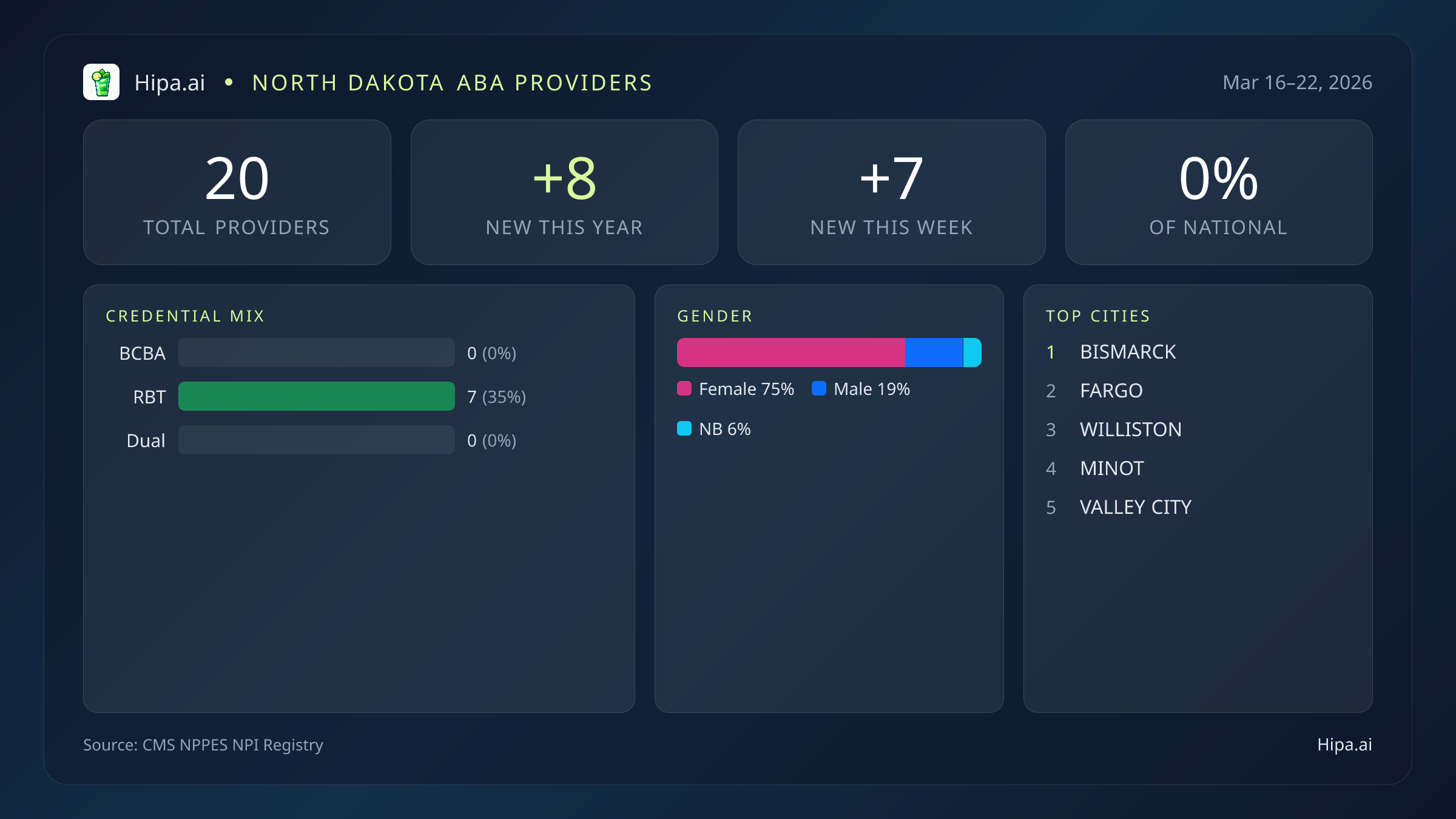
North Dakota's behavioral health provider registry holds 20 total providers, with 1 new addition this week as part of a steady recruitment pattern—8 new providers have registered year-to-date. The state's small absolute count reflects both its rural population density and limited ABA market penetration compared to urban centers, though the weekly growth rate suggests ongoing workforce interest in the state's behavioral health sector.
The credential mix reveals a significant structural gap: North Dakota has 7 RBTs but zero BCBAs and no dual-credentialed providers. This absence of board-certified behavior analysts creates a supervision bottleneck that threatens service delivery capacity. RBTs require BCBA supervision to practice; without any registered BCBAs in the state, these technicians cannot legally deliver ABA services unless supervised by out-of-state practitioners. The registry also shows 3 LPCCs and 1 SLPD, indicating that behavioral health support in North Dakota relies on allied mental health and speech pathology credentials rather than ABA-specific expertise.
The workforce skews heavily female: 12 providers (75%) identify as women, 3 (19%) as men, and 1 (6%) as nonbinary. Providers concentrate in five cities—Bismarck, Fargo, Williston, Minot, and Valley City—reflecting North Dakota's geographic dispersion and limiting rural access to behavioral health services. No single organization dominates the registry, suggesting a fragmented provider landscape without consolidation around national chains.
North Dakota's complete absence of board-certified behavior analysts signals a workforce crisis that will constrain ABA service expansion unless BCBA recruitment accelerates dramatically.