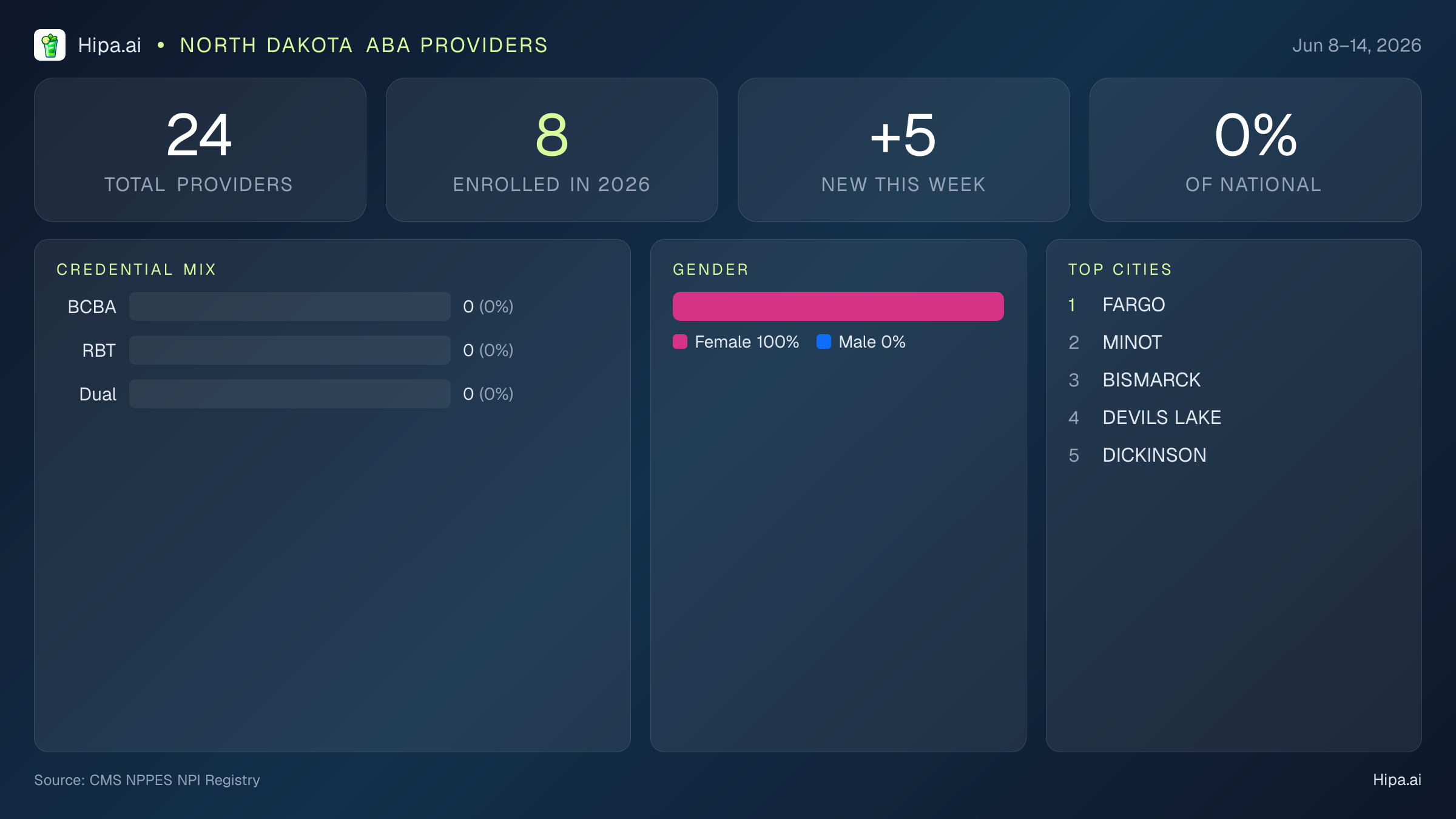
North Dakota added 24 behavioral health providers in the latest CMS NPI registry weekly update, representing 0% of the national total for the week. This modest figure, with 5 new providers this week and 8 new this year, suggests a steady but limited expansion of the behavioral health workforce in a state with a smaller population and potentially localized provider markets. The additions included 20 individuals and 4 organizations.
Credential Mix and Workforce Focus
Notably, the recent registry update for North Dakota shows no new BCBA or RBT credentials. This indicates that the growth observed is not within the specialized field of Applied Behavior Analysis. Instead, the state's additions include other crucial behavioral health professionals, such as 2 Licensed Clinical Social Workers (LCSW), 1 Speech-Language Pathologist (SLP), 1 Licensed Addiction Counselor (LCAC), 1 Licensed Independent Clinical Social Worker (LICSW), 1 Licensed Master Social Worker (LMSW), 1 Master of Science (MS), 1 Licensed Associate Professional Counselor (LAPC), 1 Licensed Associate Counselor (LAC), 1 Licensed Professional Clinical Counselor (LPCC), and 1 individual holding both LPC and LPCC credentials. This diverse mix points to a focus on broader mental health, substance use, and communication disorder services rather than ABA-specific expansion.
Provider Demographics
The individual providers added to North Dakota's registry this week were exclusively female, accounting for 100% of the 20 individual additions. There were no male or nonbinary individual providers listed in this update. No specific organizations appeared multiple times in the new registrations, which is common in states with fewer overall additions, suggesting fragmented or smaller-scale organizational growth rather than large multi-state chains expanding.
This data suggests that while North Dakota is seeing some growth in its overall behavioral health workforce, the current trend does not indicate an expansion of ABA-specific services, which could impact access for individuals seeking those specialized interventions in the state.