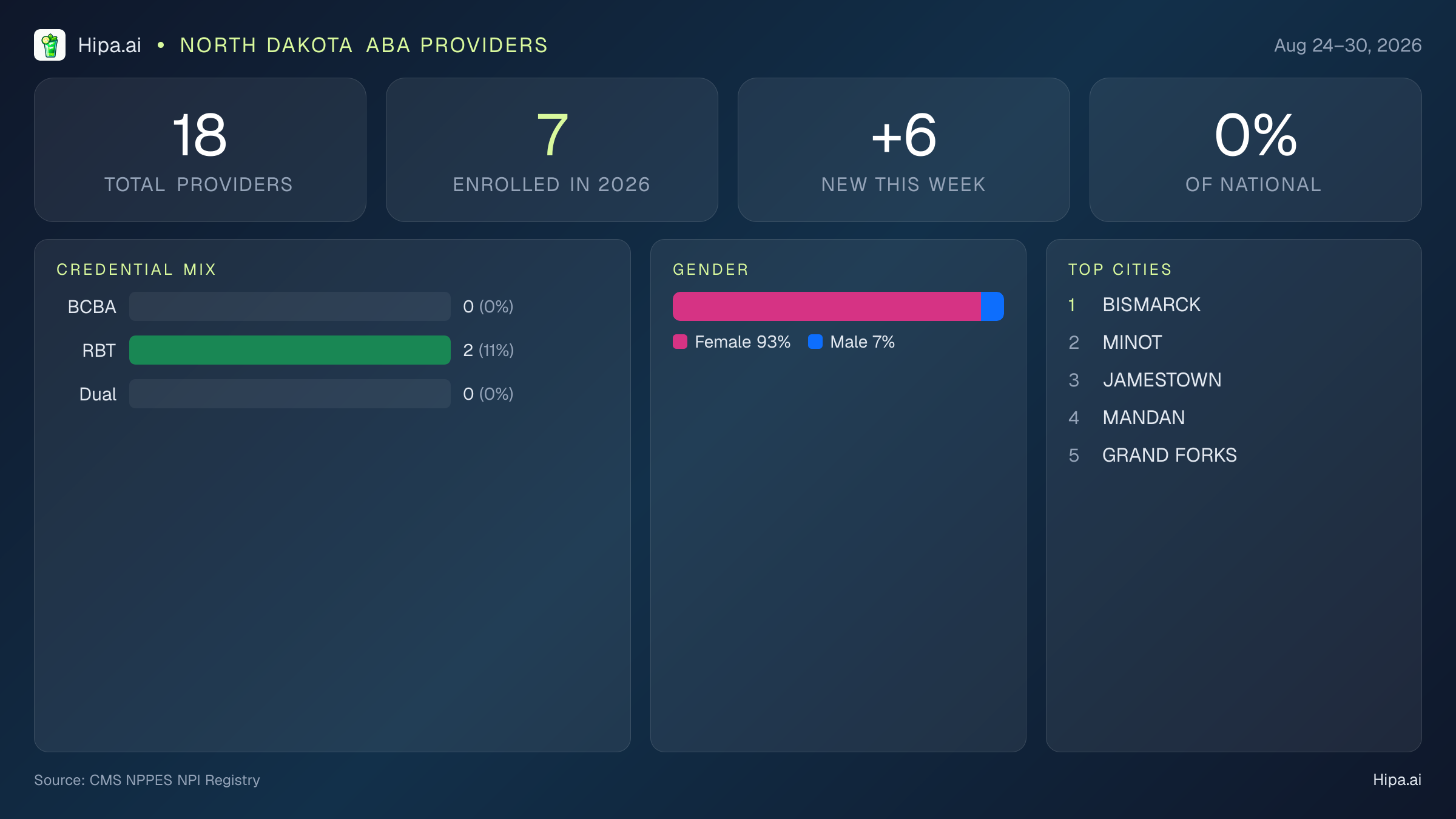
North Dakota recorded 18 providers in the latest CMS NPI registry weekly update, representing 0% of the national weekly total. The registry added 6 new providers this week, bringing the year-to-date count to 7. The file includes 15 individuals and 3 organizations. That near-zero national concentration signals a small, geographically dispersed behavioral health market, where changes in a handful of NPIs can materially affect the visible workforce. NPI activity does not confirm active caseloads, hiring status or appointment availability.
ABA Workforce Mix
The registry lists 0 BCBA credentials and 2 RBT credentials, with no dual BCBA-RBT credentials. The credential-text field shows 1 RBT, while the taxonomy field identifies 2 RBT providers; those counts overlap and should not be treated as mutually exclusive shares of the total. The file also includes LCSW, LAPC, MSW and LAC credentials, reflecting a broader behavioral health workforce rather than an ABA-only provider base. The absence of a listed BCBA and the presence of RBT taxonomy activity point to limited visible ABA supervision capacity. Because BCBAs supervise RBTs and oversee treatment planning and clinical quality, a small supervisory pool can constrain service growth even when direct-service workers are available. Seven providers have multiple taxonomies, further underscoring that registry categories may describe overlapping roles rather than separate workers.
Demographics and Organizations
Gender data identifies 14 female providers, 1 male provider and 0 nonbinary providers, corresponding to 93%, 7% and 0%. The listed cities span Bismarck, Minot, Jamestown, Mandan and Grand Forks, with additional providers in other North Dakota communities. No notable organization appears multiple times in the update; the 3 organizational entries are distributed across Mandan, Fargo and Bismarck.
North Dakota’s update suggests limited visible ABA depth and a workforce pattern in which supervisory capacity may be the main barrier to expanding access.