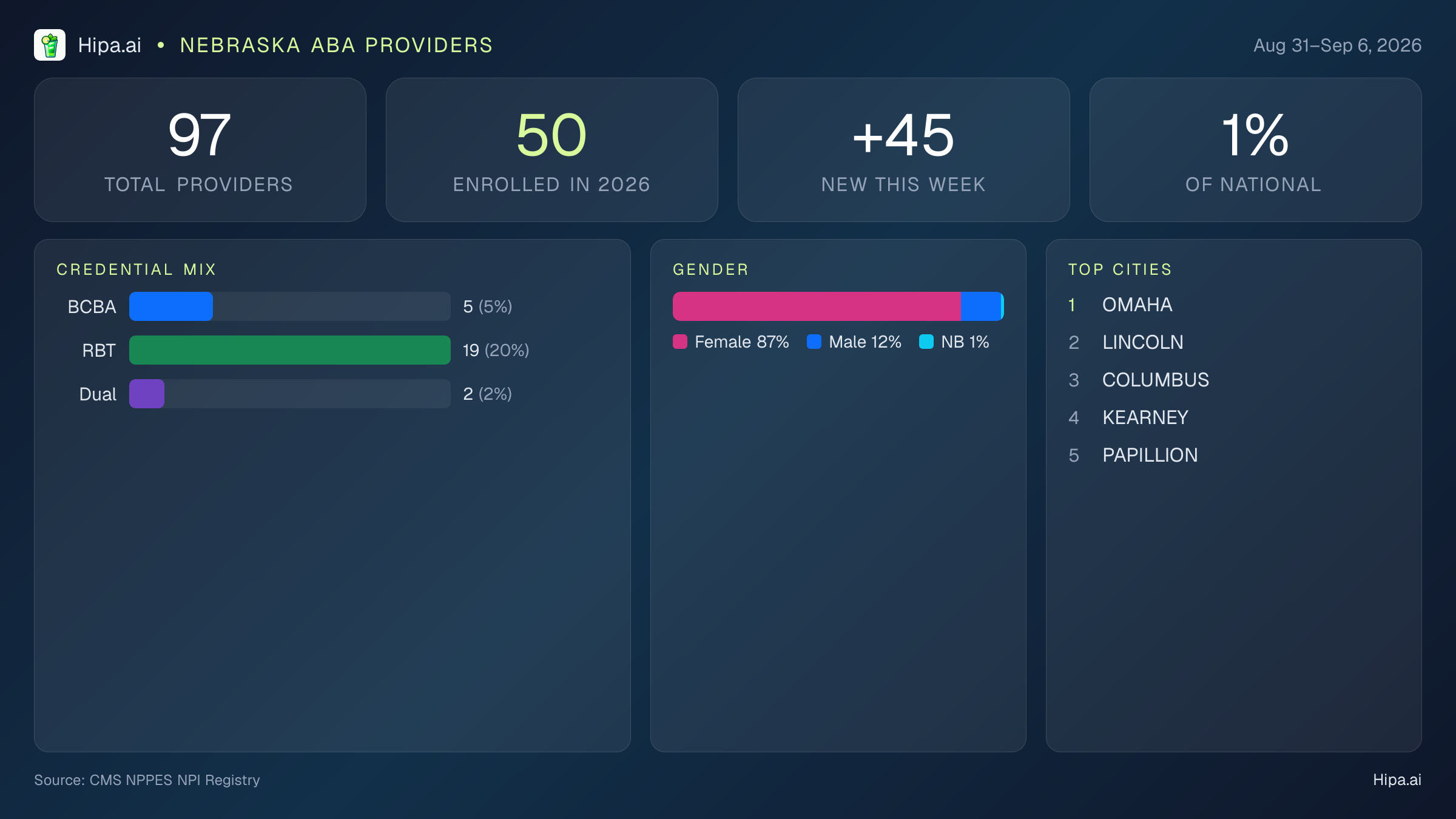
Nebraska recorded 97 providers in the latest CMS NPI registry weekly update, representing 1% of the national weekly total. The registry lists 45 additions this week and 50 added this year. The records include 92 individuals and 5 organizations. Nebraska’s small national share points to a limited but active behavioral health market in the registry; the weekly influx suggests ongoing workforce entry rather than a concentration of large provider organizations. NPI activity does not confirm active caseloads, staffing levels or appointment availability.
ABA Workforce Mix
The credential summary lists 5 BCBAs and 19 RBTs, including 2 dual BCBA-RBT credentials. Those categories overlap: the dual-credentialed providers are included in both counts and should not be treated as separate, mutually exclusive groups. The distribution shows a much larger technician pool than documented supervisory pool. Because BCBAs supervise RBTs, develop treatment plans and oversee clinical quality, Nebraska’s recorded ABA capacity may depend heavily on a small number of supervisors. The broader registry includes counselors, speech-language pathologists, social workers, psychologists and other behavioral health professionals, so the credential totals do not describe the entire provider population.
Demographics and Organizations
Gender data identifies 80 female providers, 11 male providers and 1 nonbinary provider, corresponding to 87%, 12% and 1%. Omaha and Lincoln are the leading cities listed, followed by Columbus, Kearney and Papillion. No notable organization appears multiple times in the update. However, Alice Watson Therapy, LLC and Alice Watson appear as separate organization and individual records, illustrating why NPI entries should not automatically be read as independent service locations. The registry reports 31 providers with multiple taxonomies; those classifications can overlap and may reflect broader roles rather than additional providers.
Nebraska’s update suggests growing registry activity but a thin documented BCBA supervisory base relative to RBT participation, a pattern that could constrain ABA access as technician hiring expands.