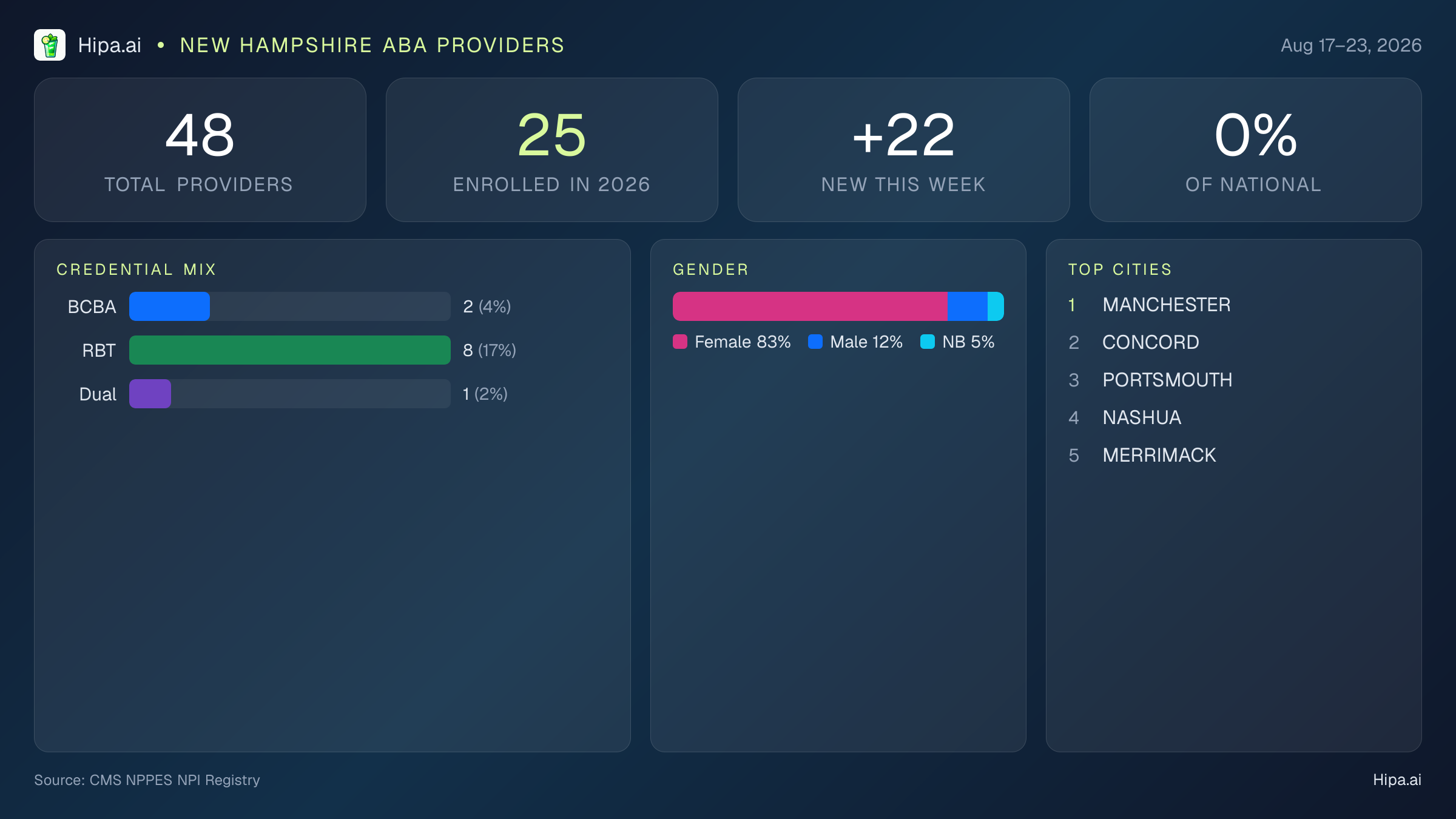
New Hampshire recorded 48 providers in the latest CMS NPI registry weekly update, representing 0% of the national weekly total. The update lists 22 providers added this week and 25 added this year. With 41 individuals and seven organizations, New Hampshire accounts for a small share of the registry’s national activity, signaling a limited statewide footprint in this week’s behavioral health provider data rather than the scale of a major regional concentration. NPI records indicate registry activity, not necessarily active clinical capacity or immediate service availability.
ABA Workforce Mix
The credential data includes 2 BCBA credentials, 8 RBT credentials and one dual BCBA-RBT credential. These counts overlap with other credential and taxonomy fields and should not be treated as mutually exclusive shares of the 48 providers. The RBT count is four times the BCBA count, although one provider holds both credentials. That pattern points to more direct-service capacity than supervisory capacity in the ABA segment. Because BCBAs supervise RBTs, oversee treatment implementation and monitor clinical quality, a small BCBA pool could constrain how quickly RBT-based services expand. The registry also lists 11 providers with multiple taxonomies, another reason the categories cannot be added together as unique workforce totals.
Demographics and Activity
Gender data identifies 34 female providers, five male providers and two nonbinary providers, corresponding to 83%, 12% and 5%. These figures describe 41 individuals, matching the individual-provider count. Manchester, Concord, Portsmouth, Nashua and Merrimack are the leading listed cities. The data identifies no notable organizations appearing multiple times, so there is no clear evidence in this update of concentrated activity by a repeated provider organization.
New Hampshire’s limited registry footprint and small BCBA base suggest that ABA access will depend on building supervisory capacity alongside the RBT workforce.