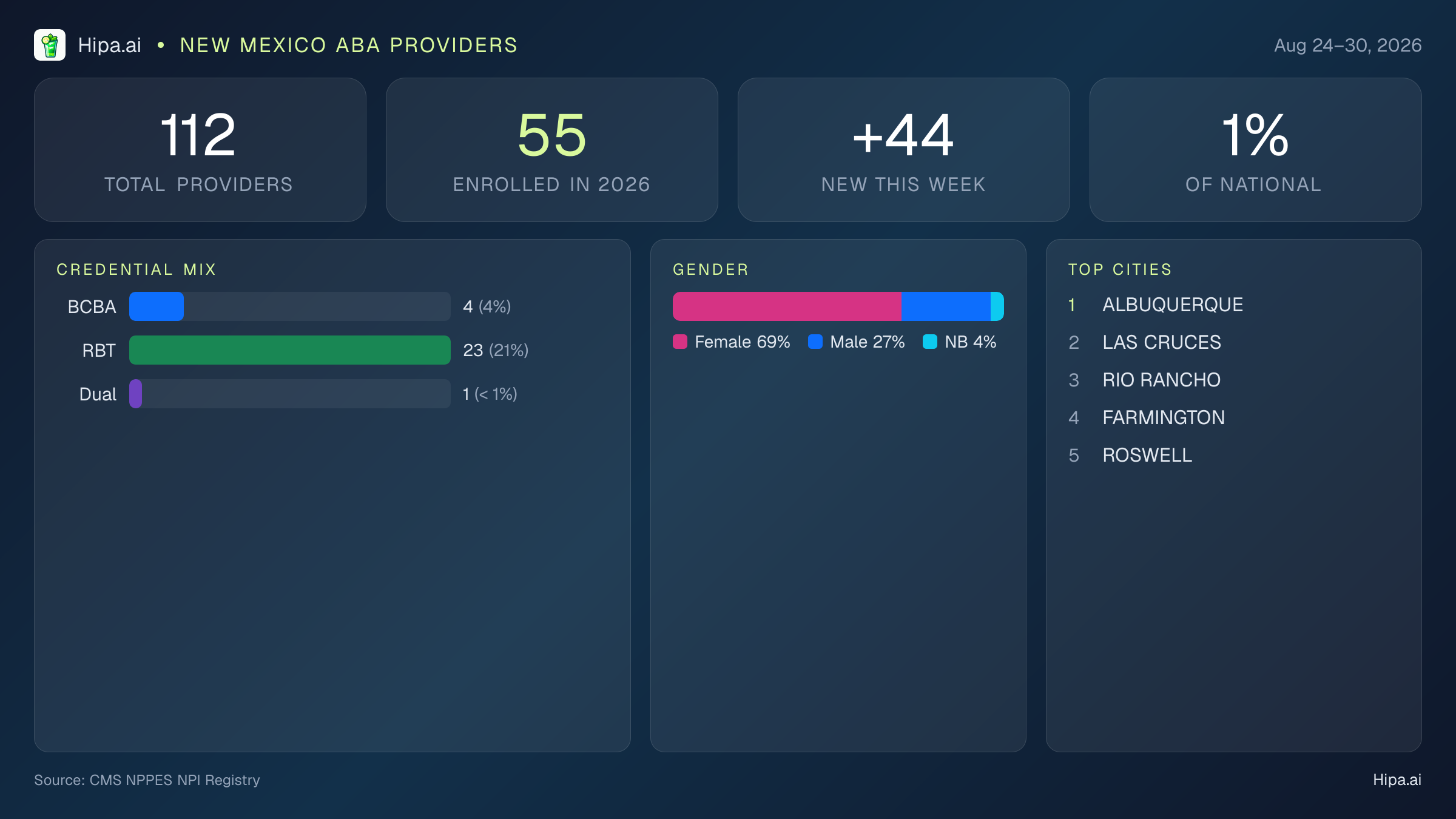
New Mexico recorded 112 providers in the latest CMS NPI registry weekly update, representing 1% of the national weekly total. The update includes 44 new this week, alongside 94 individuals and 18 organizations. That limited national concentration points to a smaller behavioral health market, where changes in a handful of providers or organizations can have an outsized effect on local hiring, contracting and service availability. NPI activity does not confirm active caseloads or open appointment capacity.
ABA Workforce Mix
The registry lists 4 BCBA credentials and 23 RBT credentials, plus 1 dual BCBA-RBT credential. These counts overlap: a provider may appear in more than one credential or taxonomy category, so they are not mutually exclusive shares of the 112-provider total. One provider is also listed with an LCSW credential and an RBT taxonomy, illustrating why the fields should not be treated as interchangeable. The gap between BCBAs and RBTs suggests a direct-service workforce with a relatively small identified supervisory layer. Because BCBAs supervise RBTs and oversee treatment quality, limited BCBA capacity could restrict how quickly technician growth translates into expanded ABA access. The dual credential signals career progression, but its presence is limited in this update.
Demographics and Organizations
Gender data identifies 65 female providers, 25 male providers and 4 nonbinary providers, corresponding to 69%, 27% and 4%. The listed cities include Albuquerque, Las Cruces, Rio Rancho, Farmington and Roswell, with activity extending across other New Mexico communities. The registry’s notable-organization field identifies no organizations appearing multiple times; entries include Positive Pathways ABA NM LLC and several community and counseling agencies, but the data does not establish repeated activity for any one organization.
New Mexico’s RBT-heavy, BCBA-light profile suggests that supervisory capacity—not technician availability alone—may be the sharper constraint on ABA access.