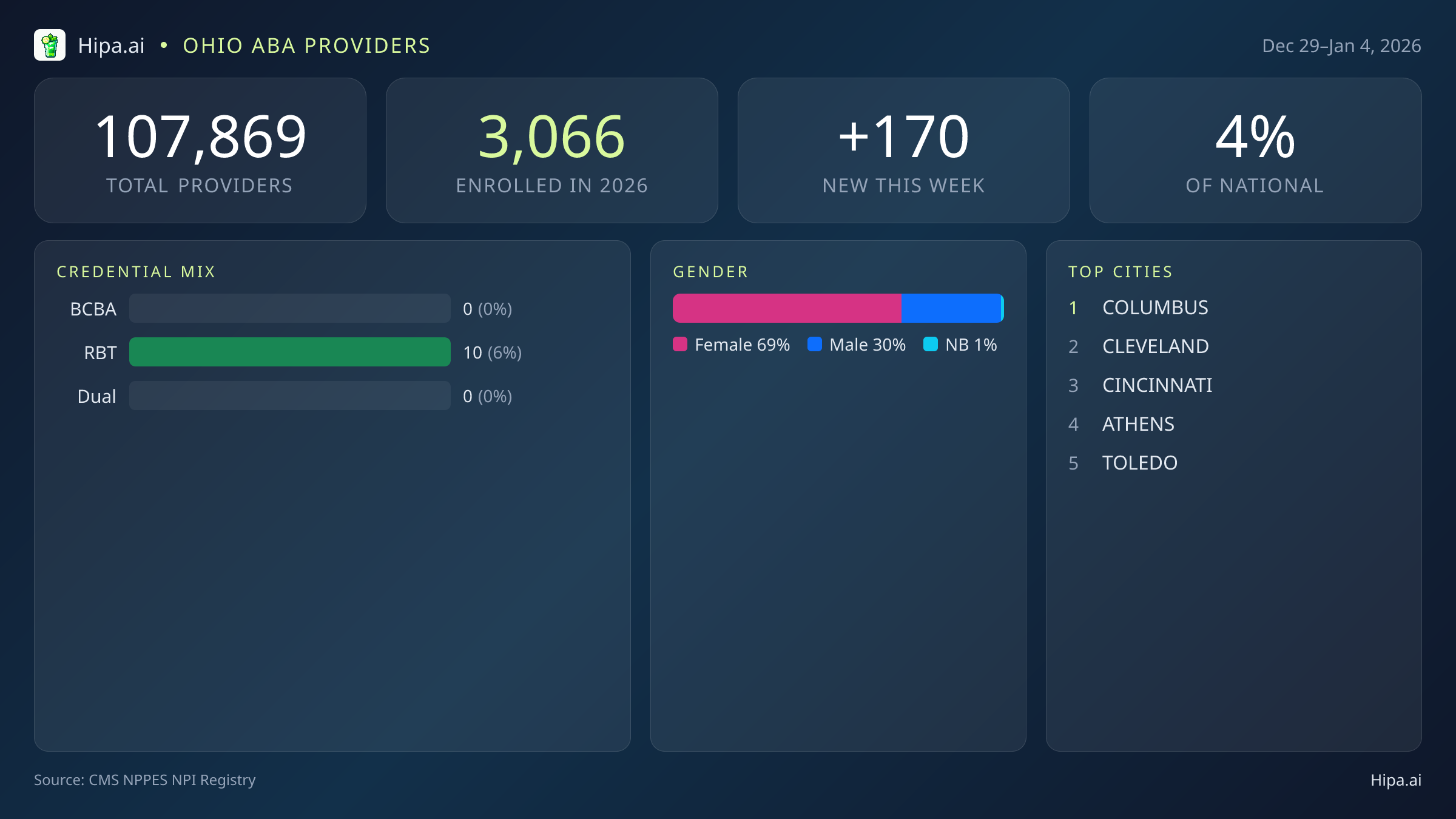
Ohio saw the addition of 170 behavioral health providers in the latest CMS NPI registry update, representing 6% of the national weekly total. This consistent influx indicates a steady, albeit moderate, expansion of the state's behavioral health workforce, signaling ongoing demand for services across various specialties.
ABA Workforce Dynamics
For the Applied Behavior Analysis sector, the data shows 10 Registered Behavior Technicians (RBTs) were added this week. Crucially, there were 0 Board Certified Behavior Analysts (BCBAs) and no providers with dual BCBA+RBT credentials reported in this update. This absence of new BCBAs, who are essential for supervising RBTs and designing ABA treatment plans, highlights a potential bottleneck in expanding direct ABA service capacity. While 21 providers across all specialties reported multiple taxonomies, this does not reflect an overlap in BCBA and RBT credentials in this specific dataset.
Provider Demographics and Organizational Activity
Among the 157 individual providers, the workforce remains predominantly female, with 109 female providers accounting for 69% of the total. Male providers number 47, making up 30%, and 1% identified as nonbinary. The update also included 13 organizational providers. No single organization appeared multiple times in this week's data, suggesting a diverse range of smaller entities or new practices rather than significant expansion from established multi-state chains. Other credentials observed include CDCA, LPCC-SUPV, LISW, and QMHS, indicating a broad spectrum of behavioral health roles.
The current data suggests that while Ohio continues to grow its RBT workforce, the lack of new BCBA additions in this period could pose a challenge for scaling up supervised ABA services and improving access for individuals needing comprehensive behavioral support.