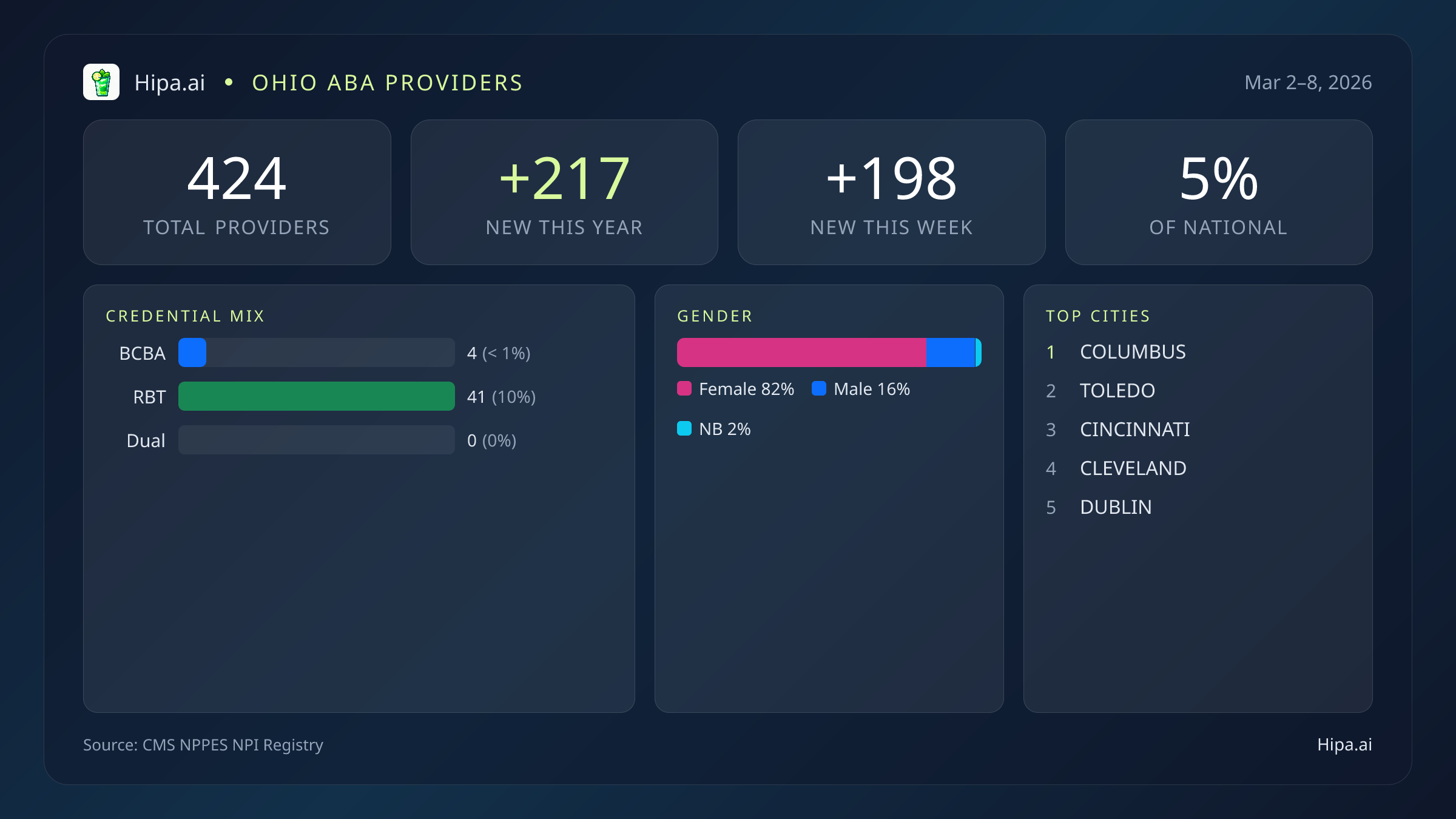
| AARON, LACRESHA | BEREA, OH | - | Acupuncturist | 05/31/2025 |
| ABDALLA, SHARIFFA | WORTHINGTON, OH | - | RBT | 03/05/2026 |
| ADAIR, KAITLIN | EAST LIVERPOOL, OH | LPC | Counselor | 06/14/2024 |
| ADAMS JONES, DEBORAH | AKRON, OH | - | Addiction Counselor | 03/07/2026 |
| ADAMS, CHERISSE | FAIRFIELD TOWNSHIP, OH | - | Acupuncturist | 11/20/2019 |
| ADAMS, HALEY | DELAWARE, OH | LSW | Acupuncturist | 07/31/2024 |
| ADORNETTO, ISABELLA | WESTERVILLE, OH | LPC | Mental Health Counselor | 12/05/2024 |
| AGAPE SUPPORT LLCORG | COLUMBUS, OH | - | Community/Behavioral Health Org | 10/12/2024 |
| AGUILAR, HANNAH | NORWALK, OH | - | RBT | 04/19/2022 |
| AIELLO, STEPHANIE | DAYTON, OH | - | Addiction Counselor | 03/03/2026 |
| ALBALADEJO, CHRISTINA | NORWALK, OH | LPCC | Pastoral Counselor | 10/07/2021 |
| ALMEIDA, FRANCISCO | CLEVELAND, OH | MD, MS | Specialist/Technologist | 06/11/2006 |
| ANTHONY, AJOILYN | COLUMBUS, OH | LSW | Acupuncturist | 03/06/2018 |
| ASCEND ABA OHIO LLCORG | CLEVELAND, OH | - | BCBA | 03/02/2026 |
| ASCEND BEHAVIORAL SUPPORT NETWORK LLCORG | CLEVELAND, OH | - | Community/Behavioral Health Org | 03/04/2026 |
| ASH, STEPHANIE | SHAKER HEIGHTS, OH | LISW | Clinical Social Worker | 03/03/2026 |
| ATKINSON, ERIN | LISBON, OH | CDCA | Addiction Counselor | 12/01/2025 |
| AVILA, COURTNEY | CELINA, OH | - | Acupuncturist | 01/11/2021 |
| BAGAYOKO, COUMBA | EUCLID, OH | - | Acupuncturist | 03/25/2024 |
| BANKS, SAMANTHA | CINCINNATI, OH | - | Mental Health Counselor | 03/02/2026 |
| BARRON, JACK | HILLIARD, OH | - | Mental Health Counselor | 01/05/2026 |
| BARTHOLOMEW, ASHTON | LIBERTY TOWNSHIP, OH | LCSW | Clinical Social Worker | 07/18/2019 |
| BEASLEY, CHELSEA | MENTOR, OH | LPC | Mental Health Counselor | 11/19/2018 |
| BEAVER, SARAH | HAMILTON, OH | - | RBT | 05/01/2024 |
| BED BUG BURNERS, LLCORG | KENT, OH | - | Specialist/Technologist | 07/30/2014 |
| BENTON /, KRISTIANNA | CINCINNATI, OH | - | Counselor | 03/04/2026 |
| BERNARD, MARINA | STRONGSVILLE, OH | LPCC | Mental Health Counselor | 01/15/2019 |
| BESOZZI, THOMAS | NORTH CANTON, OH | M.A. | Speech-Language Pathologist | 05/12/2009 |
| BETHEL, CHELSEA | CIRCLEVILLE, OH | CDCA | Acupuncturist | 03/05/2026 |
| BINGHAM, EMILY | COLUMBUS, OH | LPCC | Pastoral Counselor | 08/18/2020 |
| BLACK, RENINA | DUBLIN, OH | - | Acupuncturist | 07/19/2021 |
| BLAIR, MIAISHA | TOLEDO, OH | - | Acupuncturist | 03/03/2026 |
| BLAIR, ROXANNE | LANCASTER, OH | - | Acupuncturist | 12/02/2025 |
| BLYTHE, CINDY | PICKERINGTON, OH | - | Acupuncturist | 03/05/2026 |
| BONBRIGHT, MADISON | FAIRBORN, OH | - | RBT | 03/05/2026 |
| BOND, BREANNA | CINCINNATI, OH | MS, LPCC-S | Pastoral Counselor | 03/21/2019 |
| BONETTI, JESSICA | YOUNGSTOWN, OH | - | Acupuncturist | 03/02/2026 |
| BOWENS, JAMILA | AKRON, OH | INDEPENDENT PROVIDER | Acupuncturist | 10/24/2024 |
| BRIDGE2HEALTHCARE CONSULTANTS LLCORG | TOLEDO, OH | - | 163WC1500X | 03/16/2021 |
| BRIONES, YASMIN | CINCINNATI, OH | - | Acupuncturist | 03/04/2026 |
| BROBECK, GINA | COLUMBUS, OH | LPCC-S | Pastoral Counselor | 05/11/2015 |
| BRONSON, REGINALD | CINCINNATI, OH | LCDC II | Addiction Counselor | 07/18/2013 |
| BROOKSHIRE, TIARA | COLUMBUS, OH | - | Acupuncturist | 03/03/2026 |
| BROWN, NICOLE | MOUNT GILEAD, OH | MSW, LSW | Clinical Social Worker | 09/25/2023 |
| BRYANT, DANITA | DEFIANCE, OH | - | Acupuncturist | 03/05/2026 |
| BRYANT, ROBIN | COLUMBUS, OH | - | Acupuncturist | 03/04/2026 |
| BURNEY, TASHLAI | TOLEDO, OH | - | Acupuncturist | 11/06/2024 |
| BURNS, KODY | MINGO JUNCTION, OH | - | Acupuncturist | 03/02/2026 |
| BUSSE, ANDREA | MACEDONIA, OH | M.A., CCC-SLP | Speech-Language Pathologist | 09/26/2012 |
| CABE, SHANNON | ATHENS, OH | LCDC II | Addiction Counselor | 06/26/2023 |
| CAMMON, ANGEL | FAIRBORN, OH | - | RBT | 03/03/2026 |
| CAMPBELL, ASHLEY | CLEVELAND, OH | - | Acupuncturist | 03/03/2026 |
| CARGO, MEAGAN | MARIETTA, OH | - | Addiction Counselor | 09/10/2019 |
| CARROLL, LATISHA | COLUMBUS, OH | R.N. | Addiction Counselor | 06/13/2009 |
| CARTER, LAURA | WARREN, OH | - | Acupuncturist | 08/12/2024 |
| CASE, LAURA | WEST UNION, OH | - | Pastoral Counselor | 11/14/2017 |
| CASTRO, LUIS | CINCINNATI, OH | - | RBT | 03/03/2026 |
| CATALYST COUNSELING LLCORG | WEST CHESTER, OH | - | 261QR0405X | 06/30/2015 |
| CATHERINE FOYTIK LISW-SORG | STRONGSVILLE, OH | - | 363LP0808X | 03/13/2024 |
| CAUDY, YASHONNA | CIRCLEVILLE, OH | CMS, QMHS | Acupuncturist | 10/31/2024 |
| CEGELSKI, SANDRA | CLEVELAND, OH | - | 172V00000X | 06/05/2025 |
| CHURCHWELL, DOMINIQUE | COLUMBUS, OH | - | Mental Health Counselor | 03/04/2026 |
| CIRCLE OF SERENITY MENTAL HEALTH & RECOVERYORG | EUCLID, OH | - | 363LP0808X | 01/12/2026 |
| CLARK, KATHERINE | DAYTON, OH | - | Mental Health Counselor | 03/03/2026 |
| CLARK, KEITRAYANA | MANSFIELD, OH | SWT | 1041S0200X | 03/05/2018 |
| CLARK, LAKLISHA | MAYFIELD HEIGHTS, OH | COUNSELOR AAS, MHFAB | Addiction Counselor | 10/17/2017 |
| CLARK, TANNER | WEST CHESTER, OH | - | Addiction Counselor | 03/06/2026 |
| COFFMAN-WHITLOW, RAYQUAN | COLUMBUS, OH | - | RBT | 03/03/2026 |
| COLLEY, RAHHSHAHUN | ENGLEWOOD, OH | - | Acupuncturist | 03/07/2026 |
| COLLINS, KENSHAYA | INDEPENDENCE, OH | - | Acupuncturist | 03/06/2026 |
| COLTER, TINA | DUBLIN, OH | - | 104100000X | 09/09/2024 |
| COMMON BOND COUNSELING, LLCORG | LOGAN, OH | - | Mental Health Counselor | 03/21/2018 |
| CONLEY, JEAN | PORTSMOUTH, OH | - | Addiction Counselor | 03/03/2026 |
| CONRAD, AMY | PICKERINGTON, OH | - | Acupuncturist | 08/04/2021 |
| COOKE, TRACI | PICKERINGTON, OH | LPCC | Mental Health Counselor | 04/12/2017 |
| COOPER, JASMINE | COLUMBUS, OH | - | Mental Health Counselor | 03/06/2026 |
| COTTRELL, TONIA | COLUMBUS, OH | LCSW | Clinical Social Worker | 12/21/2006 |
| COURTS, ANGIE | WASHINGTON COURT HOUSE, OH | CDCA | Acupuncturist | 09/26/2024 |
| COVINGTON, ELEANOR | WILLOUGHBY HILLS, OH | - | RBT | 03/03/2026 |
| CREATIVE SOLUTIONS CLEORG | CLEVELAND, OH | - | Addiction Counselor | 03/06/2026 |
| CULBERT, MELODY | CLEVELAND, OH | - | Speech-Language Pathologist | 03/06/2026 |
| CUMMINGS, LAYSHAONA | BEACHWOOD, OH | - | Acupuncturist | 02/27/2026 |
| DAILEY, SASHA | TOLEDO, OH | - | Acupuncturist | 03/04/2026 |
| DANSO, JOHN | EAST LIVERPOOL, OH | MSW, LSW | Clinical Social Worker | 03/02/2020 |
| DAVID, VALERIE | TOLEDO, OH | LPCC | Mental Health Counselor | 12/04/2025 |
| DAVIS, ALICIA | BEACHWOOD, OH | - | Acupuncturist | 10/13/2019 |
| DAVIS, MONICA | NELSONVILLE, OH | - | Acupuncturist | 03/03/2026 |
| DAVIS, NATHAN | EAST LIVERPOOL, OH | - | Acupuncturist | 03/04/2026 |
| DEHAAS, LINDSAY | CANTON, OH | MSW, LISW-S | Clinical Social Worker | 03/29/2018 |
| DELAWDER, KAMA | CHESAPEAKE, OH | - | 104100000X | 02/29/2024 |
| DELGADO, ABIGAIL | PICKERINGTON, OH | CPRS,QBHS | Acupuncturist | 08/20/2024 |
| DELGADO, KEVIN | CLEVELAND, OH | - | Acupuncturist | 03/04/2026 |
| DEPASQUALE, DIANA | SYLVANIA, OH | LPC | Mental Health Counselor | 12/23/2024 |
| DICKEY, ROSETTA | KETTERING, OH | CPRS | 175T00000X | 03/07/2025 |
| DIEHL, DYLAN | TOLEDO, OH | - | Counselor | 03/04/2026 |
| DILLARD, DANISHA | CINCINNATI, OH | - | Mental Health Counselor | 03/05/2026 |
| DIXON, VICKY | CANTON, OH | LPC | Mental Health Counselor | 12/15/2016 |
| DOLIN, ALEXANDER | LANCASTER, OH | LPCC-S | Mental Health Counselor | 08/06/2014 |
| DOMROY, DAVID | WEST CHESTER, OH | - | Addiction Counselor | 03/03/2026 |
| DORSEY, ROWENA | COLUMBUS, OH | PSY.D. | Psychologist | 01/27/2026 |
| DRAGANOWSKI, KIMBERLY | CHESAPEAKE, OH | CMS | Acupuncturist | 03/07/2026 |
| DROWN, BROOKE | SPRING VALLEY, OH | RBT | RBT | 08/27/2025 |
| DRUGAN, EMMETT | RAVENNA, OH | M.ED. | Counselor | 05/13/2020 |
| EDGELL, JESSICA | TOLEDO, OH | - | RBT | 07/05/2016 |
| EMERGING LIGHT COUNSELING GROUP LLCORG | REYNOLDSBURG, OH | - | Mental Health Counselor | 03/04/2026 |
| ENGSTROM, RACHEL | MOUNT ORAB, OH | - | Acupuncturist | 03/05/2026 |
| ENLIGHTENED SOULS, LLCORG | LANCASTER, OH | - | Mental Health Counselor | 09/03/2024 |
| ENTERLOCK CORPORG | FAIRFIELD, OH | - | Community/Behavioral Health Org | 02/20/2026 |
| EPICENE PSYCHOLOGICAL LLCORG | MANTUA, OH | - | 276400000X | 02/25/2026 |
| ESSENTIAL BEHAVIORAL HEALTHORG | BEDFORD, OH | - | Community/Behavioral Health Org | 02/26/2026 |
| ESTLACK, SARAH | WARREN, OH | LSW | Clinical Social Worker | 10/10/2023 |
| EUSEBIO, LUKE | PARMA, OH | CDCA | Addiction Counselor | 08/29/2024 |
| EVANS, ELENA | ELYRIA, OH | - | Acupuncturist | 10/14/2025 |
| EVEN ME LIFE COACHING AND COUNSELINGORG | REYNOLDSBURG, OH | - | Community/Behavioral Health Org | 03/04/2026 |
| EVERHARD, GRETCHEN | AKRON, OH | - | Acupuncturist | 04/01/2025 |
| FALEN, GILLIAN | WEST CHESTER, OH | - | Acupuncturist | 03/03/2026 |
| FEASEL, RAVEN | BELLEFONTAINE, OH | - | Acupuncturist | 03/03/2026 |
| FINNEY, RYAN | STEUBENVILLE, OH | - | Acupuncturist | 03/02/2026 |
| FOERSTER, TIFFANY | SALEM, OH | - | Acupuncturist | 03/05/2026 |
| FONTES, FANTASIA | CLEVELAND HEIGHTS, OH | - | Acupuncturist | 03/05/2026 |
| FRAHN, DANYELLE | COLUMBUS, OH | - | Acupuncturist | 03/02/2026 |
| FRANCISCO, LAUREN | STRONGSVILLE, OH | CT | Counselor | 02/19/2025 |
| FULTON, AMBER | TOLEDO, OH | - | Acupuncturist | 03/04/2026 |
| GARCIA, BRANDEIS | TOLEDO, OH | - | Acupuncturist | 05/12/2022 |
| GARDNER, JAMERIAL | CINCINNATI, OH | - | Mental Health Counselor | 02/24/2026 |
| GARVER MEGENHARDT, SARAH | SHAKER HEIGHTS, OH | - | Mental Health Counselor | 08/25/2021 |
| GASTON, SABLE | DUBLIN, OH | - | Acupuncturist | 03/02/2026 |
| GEORGE, SAMANTHA | PORTSMOUTH, OH | - | Addiction Counselor | 03/05/2026 |
| GERDE, JO-ANN | GARFIELD HEIGHTS, OH | - | Acupuncturist | 05/21/2021 |
| GIBSON, EMILY | WORTHINGTON, OH | - | Acupuncturist | 08/08/2023 |
| GLASSER, TERRENCE | LANCASTER, OH | - | Acupuncturist | 03/02/2026 |
| GLOWUP RECOVERY LLCORG | REYNOLDSBURG, OH | - | Clinical Social Worker | 03/04/2026 |
| GOFORTH, ROBERT | AMHERST, OH | - | Acupuncturist | 03/03/2026 |
| GOODLING, TIFFANY | CIRCLEVILLE, OH | - | Addiction Counselor | 11/05/2025 |
| GOODMAN, RYLIE | CARDINGTON, OH | - | Speech-Language Pathologist | 08/16/2024 |
| GOSSETT, ALEXIS | POWHATAN POINT, OH | M.S., CCC-SLP | Speech-Language Pathologist | 09/24/2018 |
| GREENBERG, CODY | JACKSON, OH | - | Addiction Counselor | 03/03/2026 |
| GREENE, ANGELA | COLUMBUS, OH | CHW, CPRS, CDCA | Addiction Counselor | 05/15/2025 |
| GROSS, KAYLA | BEAVERCREEK, OH | LPC | Pastoral Counselor | 06/20/2018 |
| GUBANY, CHARLES | YOUNGSTOWN, OH | - | RBT | 08/07/2024 |
| GUTTER-JACKSON, MELISSA | CINCINNATI, OH | - | Addiction Counselor | 12/12/2017 |
| HADDAD, LILLIAN | WESTERVILLE, OH | LPCC | Pastoral Counselor | 08/28/2023 |
| HALE, ELIZABETH | AKRON, OH | QMHS 3 | Acupuncturist | 03/03/2026 |
| HAMDEN, SUZAN | DAYTON, OH | MS/LPCC | Pastoral Counselor | 10/22/2012 |
| HAMILTON COUNSELING & CONSULTING LLCORG | LAKEWOOD, OH | - | Community/Behavioral Health Org | 07/02/2019 |
| HAMILTON, LAUREN | DUBLIN, OH | RN, CDCA | 163WA0400X | 03/06/2026 |
| HAMILTON, SHANNON | PICKERINGTON, OH | - | Acupuncturist | 03/03/2026 |
| HARBUT, JOANNA | DAYTON, OH | - | Mental Health Counselor | 03/03/2026 |
| HARDISON, TAMI | TOLEDO, OH | - | Acupuncturist | 03/04/2026 |
| HARMON, CHELSEA | WORTHINGTON, OH | MSW, LISW-S | Clinical Social Worker | 03/08/2016 |
| HARVEY, CAROLANDA | DUBLIN, OH | - | Acupuncturist | 06/06/2024 |
| HEARD, DESAREE | CLEVELAND, OH | - | Acupuncturist | 02/27/2026 |
| HENNINGTON, EVAN | WESTERVILLE, OH | SLP | Speech-Language Pathologist | 03/04/2026 |
| HERU, MARIANA | LORAIN, OH | - | Acupuncturist | 03/02/2026 |
| HILL, ARVESHA | BEACHWOOD, OH | MSW, LISW | Clinical Social Worker | 11/10/2021 |
| HILL, TIARA | COLUMBUS, OH | - | Addiction Counselor | 03/04/2026 |
| HINES, KANDISE | COLUMBUS, OH | - | Acupuncturist | 03/04/2026 |
| HOFFMAN, RICHARD | TOLEDO, OH | - | Counselor | 07/05/2012 |
| HOGUE, KAYLI | DUBLIN, OH | - | RBT | 03/02/2026 |
| HOLLINGER, MADISON | COLUMBUS, OH | - | RBT | 03/04/2026 |
| HOLMES, EDIE | NEW ALBANY, OH | L.P.C.C. | Mental Health Counselor | 07/12/2010 |
| HONEYWOOD POWELL, ALORIAN | COLUMBUS, OH | - | Pastoral Counselor | 12/10/2021 |
| HOOSIER, SHYTRA | DAYTON, OH | - | Acupuncturist | 03/05/2026 |
| HOPE AND DREAMS LLCORG | COLUMBUS, OH | - | Addiction Counselor | 03/06/2026 |
| HOPKINS, KELLI | DUBLIN, OH | - | Acupuncturist | 02/24/2022 |
| HORTON, ASIA | DUBLIN, OH | - | Acupuncturist | 03/05/2026 |
| HOUBEN, VIVIAN | WARRENSVILLE HEIGHTS, OH | - | Speech-Language Pathologist | 03/08/2023 |
| HOWELL, TASHA | CANTON, OH | - | Acupuncturist | 03/07/2026 |
| HUGHES, LINDA | LANCASTER, OH | LPCC | Mental Health Counselor | 02/26/2018 |
| HUNTER, WENDY | CLEVELAND, OH | LPCC-S | Pastoral Counselor | 09/15/2010 |
| HYMAN, NATALIA | SPRINGFIELD, OH | - | RBT | 03/02/2026 |
| ILLUMINATED SELF THERAPY SERVICES LLCORG | SPRINGDALE, OH | - | Mental Health Counselor | 03/03/2026 |
| IMPACT RESOLUTION LLCORG | BEACHWOOD, OH | - | Clinical Social Worker | 01/27/2026 |
| IVERY, ADDERLY | DAYTON, OH | - | Acupuncturist | 03/05/2026 |
| JACKSON, JAZZMIN | PICKERINGTON, OH | - | Acupuncturist | 03/06/2026 |
| JACKSON, KELLY | HIGHLAND HEIGHTS, OH | - | 171400000X | 10/21/2025 |
| JACOBSON, HALEY | TOLEDO, OH | - | Speech-Language Pathologist | 03/04/2026 |
| JAMAR, KHARMAINE | COLUMBUS, OH | - | Addiction Counselor | 03/02/2026 |
| JAMES, HEATHER | MEDINA, OH | - | Pastoral Counselor | 03/04/2026 |
| JANIS, DOREEN | YOUNGSTOWN, OH | - | Acupuncturist | 03/02/2026 |
| JENKINS, BIANCA | WESTLAKE, OH | - | RBT | 03/05/2026 |
| JENKINS, SHARA | CLEVELAND, OH | - | Acupuncturist | 03/04/2026 |
| JOHNSON, ACACIA | HILLIARD, OH | - | Acupuncturist | 03/06/2026 |
| JOHNSON, AMANDA | CINCINNATI, OH | APS | 175T00000X | 04/22/2024 |
| JOHNSON, JOSHUA | MARION, OH | - | Addiction Counselor | 03/03/2026 |
| JOHNSON, JULIE | NEWARK, OH | - | Addiction Counselor | 10/05/2021 |
| JOHNSON, KELLY | FAYETTEVILLE, OH | - | Acupuncturist | 12/03/2025 |
| JOHNSON, KIARA | DAYTON, OH | - | RBT | 03/04/2026 |
| JOHNSON, TAMICA | AKRON, OH | CDCA | Addiction Counselor | 11/02/2023 |
| JONES, ALEXIS | PORTSMOUTH, OH | - | Acupuncturist | 03/05/2026 |
| JONES, ALYSHA | TOLEDO, OH | QMHS | Acupuncturist | 06/20/2018 |
| JONES, ANTWAN | BATAVIA, OH | - | Acupuncturist | 03/05/2026 |
| JONES, PATRICIA | PICKERINGTON, OH | - | Acupuncturist | 02/27/2026 |
| JORDAN, JERRY | WALNUT HILLS, OH | QMHS | 104100000X | 01/30/2019 |
| JOYCE ARNETT UMBRELLA HOLDINGSORG | MOUNT VICTORY, OH | - | Acupuncturist | 03/07/2026 |
| JUMP, MELANIE | CINCINNATI, OH | - | Acupuncturist | 03/15/2021 |
| K CS CALMING RETREATORG | PERRYSBURG, OH | - | Community/Behavioral Health Org | 02/24/2025 |
| KAIN-FISHER, ALLYSON | DAYTON, OH | LCDCIII | Addiction Counselor | 07/11/2019 |
| KATTEWAR, SHRADDHA SHRIDHAR | KENT, OH | - | Pastoral Counselor | 02/09/2026 |
| KELLAR, JAMES | WAVERLY, OH | - | Addiction Counselor | 03/03/2026 |
| KEMP, CONNOR | AKRON, OH | CDCA | Addiction Counselor | 03/03/2026 |
| KERNS, CHARLES | COAL GROVE, OH | CDCAPRE.195369 | Mental Health Counselor | 03/04/2026 |
| KILLING, ANNABELLE | BROOKFIELD, OH | - | Acupuncturist | 03/04/2026 |
| KING, BRIELLE | WARREN, OH | - | Addiction Counselor | 03/05/2026 |
| KING, JOSHUA | JACKSON, OH | - | Addiction Counselor | 11/06/2025 |
| KING, MELLISICA | DUBLIN, OH | - | Acupuncturist | 03/04/2026 |
| KINNEY, JASON | DAYTON, OH | LCDCII | Addiction Counselor | 01/07/2025 |
| KIRKLAND, HEATHER | ENGLEWOOD, OH | MS, SLP-CCC | Speech-Language Pathologist | 03/03/2026 |
| KOLTERMAN, SADDIE | COLUMBUS, OH | - | Acupuncturist | 03/02/2026 |
| KRAMER, KRISTIN | CINCINNATI, OH | MSW, LISW | Clinical Social Worker | 02/26/2021 |
| KUBIAK, CONNOR | WOOSTER, OH | - | Acupuncturist | 03/05/2026 |
| KUCKER, LINDSAY | SANDUSKY, OH | CT, RBT | Counselor | 11/15/2023 |
| KYLE, JOHANA | COLUMBUS, OH | - | Acupuncturist | 03/04/2026 |
| L.O.V.E HEALTH CARE AGENCYORG | BEDFORD HEIGHTS, OH | - | Case Management Org | 02/18/2019 |
| LAFOUNTAINE, RUTH | BOWLING GREEN, OH | - | Acupuncturist | 01/05/2026 |
| LAKE POINT MEDICAL GROUP, LLCORG | LAKEWOOD, OH | - | Pastoral Counselor | 01/01/2018 |
| LAVI, RICHARD | CUYAHOGA FALLS, OH | M.D. | 207K00000X | 07/05/2006 |
| LAWSON, ALEXANDRA | DAYTON, OH | - | Acupuncturist | 03/03/2026 |
| LEWIS, IZJAHANA | MAYFIELD HEIGHTS, OH | - | 104100000X | 06/16/2022 |
| LEWIS, JORDEN | MIDDLETOWN, OH | - | RBT | 04/25/2025 |
| LIEBHART, MELISSA | WOOSTER, OH | - | RBT | 03/05/2026 |
| LINTON, DOMINIQUE | RAVENNA, OH | - | RBT | 03/06/2026 |
| LITTLES, JORDIN | CINCINNATI, OH | MA,LPCC | Pastoral Counselor | 12/13/2021 |
| LIVADA, MAX | DAYTON, OH | LPCC | Pastoral Counselor | 08/02/2020 |
| LOFTIN, RIAJO | AKRON, OH | - | Addiction Counselor | 10/02/2017 |
| LUNA BLOOM PSYCHIATRY LLCORG | COLUMBUS, OH | - | 261QM0801X | 12/15/2025 |
| LYNCH, BESS | LAKEWOOD, OH | LPCC-S | Mental Health Counselor | 05/27/2020 |
| LYONS, CHRISTINA | AMHERST, OH | - | Mental Health Counselor | 10/04/2021 |
| MACINSKI, HEATHER | CENTERVILLE, OH | CDCA | Addiction Counselor | 04/06/2022 |
| MACKEY, CHRISTINE | ATHENS, OH | - | Pastoral Counselor | 08/22/2018 |
| MACKEY, KELLY | CLEVELAND, OH | LPC | Pastoral Counselor | 02/02/2021 |
| MADDEN, KEVIN | COLUMBUS, OH | CPRS, QMHS | 175T00000X | 08/31/2024 |
| MADUKA, KELVIN | WORTHINGTON, OH | - | RBT | 03/04/2026 |
| MALONE, JENNIFER | SOUTH POINT, OH | - | Mental Health Counselor | 05/28/2024 |
| MALONE, LAUREN | COLUMBUS, OH | - | Acupuncturist | 03/04/2026 |
| MARIETTA MEMORIAL HOSPITALORG | MARIETTA, OH | - | Clinic/Center | 03/06/2026 |
| MARIETTA MEMORIAL HOSPITALORG | MARIETTA, OH | - | Clinic/Center | 03/06/2026 |
| MARIETTA MEMORIAL HOSPITALORG | MARIETTA, OH | - | Clinic/Center | 03/06/2026 |
| MARIETTA MEMORIAL HOSPITALORG | MARIETTA, OH | - | Clinic/Center | 03/06/2026 |
| MARSHALL, VALERIE | DUBLIN, OH | - | Acupuncturist | 03/02/2026 |
| MARTIN, KATHERINE | WEST CHESTER, OH | - | Addiction Counselor | 05/19/2021 |
| MASON, SAMARA | BROOKFIELD, OH | - | Acupuncturist | 03/04/2026 |
| MASTERS, SAMANTHA | MARIETTA, OH | - | Acupuncturist | 12/09/2020 |
| MATTHEWS, TINA | CINCINNATI, OH | - | Acupuncturist | 08/09/2022 |
| MAYS, COURTNEY | FAIRBORN, OH | - | RBT | 03/06/2026 |
| MCALEAR, MADISON | ATHENS, OH | - | Acupuncturist | 03/02/2026 |
| MCCOY, KATHLEEN | CANFIELD, OH | LICDC, LISW-S | Clinical Social Worker | 02/25/2016 |
| MCCOY, MORGAN | WORTHINGTON, OH | - | RBT | 03/05/2026 |
| MCERATH, CHI'YENNE | FAIRBORN, OH | - | RBT | 03/02/2026 |
| MCGILL, DARIUS | IRONTON, OH | CDCA, QHMS | Acupuncturist | 03/27/2019 |
| MCLEMORE, FAITH | TOLEDO, OH | - | Acupuncturist | 03/02/2026 |
| MERCED, KAREN | CLEVELAND, OH | - | Acupuncturist | 03/05/2026 |
| MID-OHIO COUNSELING, LLCORG | GRANVILLE, OH | - | Community/Behavioral Health Org | 12/24/2008 |
| MIDCALF, KEISHON | TOLEDO, OH | - | Acupuncturist | 03/03/2026 |
| MILLER-DAUB, AMY | PORTSMOUTH, OH | - | Addiction Counselor | 11/11/2017 |
| MILLER, JORDYN | COLUMBUS, OH | - | BCBA | 03/02/2026 |
| MILLER, LASHAWN | CLEVELAND, OH | - | Mental Health Counselor | 03/03/2026 |
| MILLER, TARA | WASHINGTON COURT HOUSE, OH | CDCA | Addiction Counselor | 11/18/2021 |
| MILNER, RACHELLE | CLEVELAND, OH | LISW-S | Mental Health Counselor | 01/23/2026 |
| MIND BODY SUCCESS INITIATIVEORG | TOLEDO, OH | - | Community/Behavioral Health Org | 03/02/2026 |
| MINGUS, KAITLIN | PORTSMOUTH, OH | - | Addiction Counselor | 12/28/2017 |
| MITCHELL, EBONY | DAYTON, OH | - | Acupuncturist | 06/14/2018 |
| MITRI, JORDAN | ROSSFORD, OH | - | Acupuncturist | 03/07/2026 |
| MIVINGOU, GITE | COLUMBUS, OH | - | RBT | 03/04/2026 |
| MOCNIAK, SUSAN | COLUMBUS, OH | LISW, CDCA | Clinical Social Worker | 03/05/2014 |
| MOE, AUBREY | COLUMBUS, OH | PHD | Psychologist | 02/06/2017 |
| MONNIN, MARISSA | NILES, OH | - | Acupuncturist | 03/02/2026 |
| MONTANA, TA'LIYAH | EUCLID, OH | - | 343900000X | 01/31/2024 |
| MONTGOMERY, STACEY | AKRON, OH | LPCC | Pastoral Counselor | 08/08/2019 |
| MOORE, MALLORY | COLUMBUS, OH | - | Clinical Social Worker | 09/09/2025 |
| MOREAU, HAYDEN | COLUMBUS, OH | - | 390200000X | 03/02/2026 |
| MORRIS, CHRISTIN | WILMINGTON, OH | - | BCBA | 01/11/2014 |
| MOSLEY, TAKEA | TOLEDO, OH | - | Acupuncturist | 03/03/2026 |
| MULLINS, REBEKAH | CIRCLEVILLE, OH | LPCC | Mental Health Counselor | 06/13/2018 |
| MURAN, NICOLE | CINCINNATI, OH | - | Mental Health Counselor | 03/03/2026 |
| MUSGROVE, ALEXIS | NILES, OH | - | Pastoral Counselor | 07/27/2021 |
| NABERHAUS, MELISSA | LANCASTER, OH | LISW-S | Clinical Social Worker | 11/16/2011 |
| NEAL, EBONY | RAVENNA, OH | - | 376K00000X | 09/12/2019 |
| NEELY, EMILY | SPRINGFIELD, OH | - | Pastoral Counselor | 12/22/2016 |
| NESBITT, GUY | HAMILTON, OH | - | Acupuncturist | 03/04/2026 |
| NEW TRAILS COUNSELING, LLCORG | BELLEFONTAINE, OH | - | Clinical Social Worker | 02/23/2026 |
| NEWBERN, TYLER | ROSSFORD, OH | - | RBT | 02/23/2026 |
| NGUYEN, JENNY | CLEVELAND, OH | LPCC | Mental Health Counselor | 05/20/2021 |
| NICHOLSON, BREANA | BLUE ASH, OH | LPC | Mental Health Counselor | 08/09/2021 |
| NIGH, URSULA | TOLEDO, OH | - | Acupuncturist | 03/03/2026 |
| NIMELY, ANCELIA | COLUMBUS, OH | - | Addiction Counselor | 03/02/2026 |
| NJOUKEANG NDECKE, SANTANA | WORTHINGTON, OH | - | RBT | 03/02/2026 |
| NZAYISENGA, EMMANUEL | WORTHINGTON, OH | - | RBT | 03/04/2026 |
| OASIS COUNSELING SOLUTIONS LLCORG | STRONGSVILLE, OH | - | Pastoral Counselor | 08/13/2021 |
| OLSEN, KRISTEN | TOLEDO, OH | - | Acupuncturist | 03/05/2026 |
| OWSLEY, CARON | DUBLIN, OH | LISW | Mental Health Counselor | 06/20/2018 |
| PARKS, ANGELA | COLUMBUS, OH | - | RBT | 03/06/2026 |
| PARRISH, JULIE | MARTINS FERRY, OH | MS, CCC-SLP | Speech-Language Pathologist | 03/07/2026 |
| PASTURES OF HOPE LLCORG | HARTVILLE, OH | - | Mental Health Counselor | 01/30/2025 |
| PAYTON, TERESA | WARREN, OH | LPCC | Mental Health Counselor | 12/02/2019 |
| PENNINGTON, SARAH | BROADVIEW HEIGHTS, OH | - | RBT | 03/03/2026 |
| PETRILLO, NATALIE | DUBLIN, OH | CCC-SLP | Speech-Language Pathologist | 03/03/2026 |
| PHARION, RILEY | DUBLIN, OH | - | Acupuncturist | 03/05/2026 |
| PHILLIPS, ASHLEY | SPRINGFIELD, OH | LPC | Counselor | 02/14/2023 |
| PHILLIPS, JANE | MARIETTA, OH | - | Addiction Counselor | 03/05/2026 |
| PHIPPS, FLASH | W PORTSMOUTH, OH | LPCC | Pastoral Counselor | 12/05/2006 |
| PLUMMER, JESSICA | DAYTON, OH | - | Addiction Counselor | 12/21/2024 |
| POPOVICH, SAMANTHA | AKRON, OH | CPHT | Community/Behavioral Health Org | 07/31/2023 |
| POWELL, TANASHA | COLUMBUS, OH | - | RBT | 03/04/2026 |
| PRICE, AMIEE | ATHENS, OH | - | 172V00000X | 03/05/2026 |
| PRIDEMORE, JACALYN | GAHANNA, OH | - | Clinical Social Worker | 03/02/2026 |
| PRINGLE, DAVIENNA | TOLEDO, OH | - | 163W00000X | 03/02/2026 |
| PROCTOR, KIAUNIE | AKRON, OH | - | Community/Behavioral Health Org | 08/22/2025 |
| PRUIETT, JILLENE | CLEVELAND, OH | - | Community/Behavioral Health Org | 03/03/2026 |
| PULLOM, KIMBERLY | TOLEDO, OH | LSW | Clinical Social Worker | 05/25/2016 |
| QUINONES, ANGELA | DAYTON, OH | CDCA, QBHS, | Addiction Counselor | 05/31/2023 |
| RAINEY, LYNDA | BLUE ASH, OH | QMHS-B | RBT | 02/25/2026 |
| RANGE, TAMIKA | CLEVELAND, OH | - | 172V00000X | 03/03/2026 |
| RATCHFORD, ROTISHA | CLEVELAND, OH | - | RBT | 03/02/2026 |
| REEVES-GOLLIHUE, LEA ANN | WHEELERSBURG, OH | LPCC | Mental Health Counselor | 12/20/2016 |
| RENEWED HARMONY COUNSELING, LLCORG | WORTHINGTON, OH | - | Pastoral Counselor | 07/15/2024 |
| REVEAL, ASHLEY | ATHENS, OH | - | 172V00000X | 03/05/2026 |
| REYNOLDS, MAGGIE | DUBLIN, OH | - | RBT | 03/04/2026 |
| REYNOLDS, TIFFANY | WAVERLY, OH | - | Addiction Counselor | 03/03/2026 |
| RICHARDS, GILLIAN | COLUMBUS, OH | - | Acupuncturist | 03/05/2026 |
| RIES, KAYLEE | TOLEDO, OH | - | Counselor | 03/04/2026 |
| RING, JAYNE | DUBLIN, OH | - | Acupuncturist | 03/02/2026 |
| ROBINSON, ARLENA | SYLVANIA, OH | - | 175T00000X | 07/26/2022 |
| ROBINSON, PRIEST | TOLEDO, OH | - | Acupuncturist | 03/06/2026 |
| ROCKWELL, JAMIE | CINCINNATI, OH | LISW | Acupuncturist | 09/04/2019 |
| RODRIGUEZ, APRIL | DUBLIN, OH | - | Acupuncturist | 03/05/2026 |
| RODRIGUEZ, CYNTHIA | ASHTABULA, OH | - | Acupuncturist | 04/24/2023 |
| ROGINSKI, LEAH | BLUE ASH, OH | LISW, MSW | Clinical Social Worker | 07/01/2020 |
| ROSARIO, TRACY | PARMA HEIGHTS, OH | CHW, CDCA | 172V00000X | 03/02/2026 |
| ROSS, ALLISON | ASHLAND, OH | - | 104100000X | 08/10/2022 |
| ROSS, KAMRYN | CHESAPEAKE, OH | - | Acupuncturist | 01/09/2023 |
| ROSS, LAKIAYA | WESTLAKE, OH | - | RBT | 03/03/2026 |
| RUBINSTEIN, TATE | DUBLIN, OH | BCBA | BCBA | 03/02/2026 |
| RUPPEN, MELINDA | COLUMBUS, OH | CDCA | Addiction Counselor | 03/17/2021 |
| RUSH, TIFFANY | CINCINNATI, OH | LISW | Clinical Social Worker | 05/25/2006 |
| RUTH, NATALIE | SHAKER HTS, OH | - | Speech-Language Pathologist | 03/04/2026 |
| SAKAMOTO, MINA | AKRON, OH | LPCC | Pastoral Counselor | 05/03/2022 |
| SALOMON, JARED | MENTOR, OH | - | Acupuncturist | 03/05/2026 |
| SAYLOR, ARIAH | HAMILTON, OH | LCDC III | Addiction Counselor | 08/31/2023 |
| SCHMIDT, KADE | JOHNSTOWN, OH | - | 261QD1600X | 03/06/2026 |
| SCHNEIR, PAMELA | BETHESDA, OH | LPCC-S | 106H00000X | 03/31/2007 |
| SCOTT-JACKSON, HOLLY | CINCINNATI, OH | LICDC | 390200000X | 12/13/2024 |
| SEEDS WELLNESS COLLECTIVEORG | CANTON, OH | - | Community/Behavioral Health Org | 03/03/2026 |
| SEIBERT, ANGELES | DAYTON, OH | - | Specialist/Technologist | 03/02/2026 |
| SELFY BRANDSORG | BEACHWOOD, OH | - | 251E00000X | 03/04/2026 |
| SENATUS, LUDIE | COLUMBUS, OH | - | Community/Behavioral Health Org | 03/02/2026 |
| SERENITY KEEPERS HOME CAREORG | MACEDONIA, OH | - | Acupuncturist | 03/07/2026 |
| SETTY, ANGELA | LANCASTER, OH | CDCA | Addiction Counselor | 03/02/2022 |
| SEYMOUR, HALLE | CLEVELAND, OH | - | 172V00000X | 05/25/2023 |
| SHACKLE, CARLY | DUBLIN, OH | - | Speech-Language Pathologist | 03/04/2020 |
| SHANES, JAMI | BEACHWOOD, OH | - | Pastoral Counselor | 09/04/2015 |
| SHEILA THOMAS, SHEILA THOMAS | CLEVELAND, OH | MSW, LSW, ACHP | 376J00000X | 03/02/2026 |
| SHEPPARD, CHARLES | COLUMBUS, OH | - | Acupuncturist | 03/06/2026 |
| SHIMKO, ABBEY | YOUNGSTOWN, OH | LPN | Acupuncturist | 06/08/2017 |
| SILVERMAN, DANIEL | COLUMBUS, OH | MSW, LISW-S, LICDC | Clinical Social Worker | 05/18/2021 |
| SIMS, SAWYER | PICKERINGTON, OH | - | Acupuncturist | 03/03/2026 |
| SIMS, WHITNEY | VINCENT, OH | - | Acupuncturist | 03/04/2026 |
| SIMUEL, SHANNON | PICKERINGTON, OH | - | Acupuncturist | 12/09/2024 |
| SINCERE ANT QUALITYORG | CINCINNATI, OH | - | Community/Behavioral Health Org | 03/02/2026 |
| SINGER, NEKISHA | ATHENS, OH | - | Acupuncturist | 03/05/2026 |
| SLOVER, AUTUMN | LOVELAND, OH | M.A. E.D., LPCC | Pastoral Counselor | 08/02/2021 |
| SMITH, MARCEAL | BEREA, OH | MSSA, LSW | Clinical Social Worker | 03/05/2012 |
| SMITH, NICOLE | COLUMBUS, OH | - | RBT | 03/06/2026 |
| SMITH, RACHELE | DAYTON, OH | CDCA | Addiction Counselor | 12/11/2019 |
| SMITH, THOMAS | COLUMBUS, OH | - | Addiction Counselor | 03/17/2021 |
| SMITH, VALERIE | TOLEDO, OH | - | Acupuncturist | 03/03/2026 |
| SNYDER, MADISON | PORTSMOUTH, OH | - | Addiction Counselor | 09/15/2022 |
| SNYDER, THOMAS | RAVENNA, OH | - | Acupuncturist | 03/06/2026 |
| SODALIS MENTAL WELLNESS LLCORG | SPRINGFIELD, OH | - | Mental Health Counselor | 03/03/2026 |
| SPATARO, AVA | AVON, OH | LPCC | Mental Health Counselor | 07/16/2021 |
| SPENCER, KELSIE | DELAWARE, OH | LSW | Clinical Social Worker | 02/09/2023 |
| STARKS, CARLISHA | DUBLIN, OH | - | Acupuncturist | 07/29/2022 |
| STATTMILLER, ANTHONY | COLUMBUS, OH | - | Nursing Facility | 03/02/2026 |
| STEADFAST LOVING HOMESORG | COLUMBUS, OH | - | Case Management Org | 03/04/2026 |
| STEINBRUGGE, BROOKLYNE | LOVELAND, OH | - | RBT | 07/22/2025 |
| STOUT, KERI | CINCINNATI, OH | - | Acupuncturist | 03/02/2026 |
| STRATTON, HONORE | DAYTON, OH | - | 104100000X | 04/01/2021 |
| SUMMERS, NATOSHIA | CHILLICOTHE, OH | LCDCII | Addiction Counselor | 09/19/2019 |
| SVISCO, CASSIE | YELLOW SPRINGS, OH | - | Pastoral Counselor | 05/17/2021 |
| SWAIN, BREANNA | WHITEHALL, OH | CMS | Acupuncturist | 03/02/2026 |
| SWAIN, JULIE | MIDDLETOWN, OH | LSW | Acupuncturist | 09/03/2020 |
| SWANSON, MELANIE | PORTSMOUTH, OH | - | Addiction Counselor | 11/15/2017 |
| SWIGER, ABIGAIL | CLEVELAND, OH | LISW-S | Clinical Social Worker | 11/07/2018 |
| SWINEHART, JAMES | ATHENS, OH | QMHS | Acupuncturist | 03/02/2026 |
| TAHA, MARY | CLEVELAND, OH | LISW | Clinical Social Worker | 03/13/2012 |
| TANGELDER, NATALIE | BOWLING GREEN, OH | - | Acupuncturist | 02/19/2026 |
| TASSILE, RACHEL | CANTON, OH | LISW | Clinical Social Worker | 04/27/2018 |
| TAYLOR, JAMES | CINCINNATI, OH | - | 385H00000X | 02/03/2023 |
| TCHEGNELENE, SUZY | WEST CHESTER, OH | - | Addiction Counselor | 03/06/2026 |
| TEA, BRITTANY | SANDUSKY, OH | LCDCIII | Addiction Counselor | 12/02/2020 |
| THE PRIME AGENCYORG | BLACKLICK, OH | - | Acupuncturist | 03/05/2026 |
| THOMAS, MATELYN | CINCINNATI, OH | - | Acupuncturist | 03/05/2026 |
| TOOLE CO LLCORG | CINCINNATI, OH | - | Mental Health Counselor | 03/06/2026 |
| TUBBS, JASMINE | COLUMBUS, OH | - | RBT | 12/29/2017 |
| TUBBS, QUINETTA | CINCINNATI, OH | - | Acupuncturist | 03/03/2026 |
| TURNER, RAYNOTTA | RICHMOND HEIGHTS, OH | - | 372500000X | 03/03/2026 |
| ULLMAN, ALEXANDRA | COLUMBUS, OH | LPC | Pastoral Counselor | 05/30/2019 |
| UNIFIED CARE AGENCYORG | EAST CLEVELAND, OH | - | Clinical Social Worker | 07/14/2025 |
| VALTIERRA, JESUS | DAYTON, OH | - | Acupuncturist | 04/29/2021 |
| VIRTUOUS SERVICES & SUPPORT LLCORG | TOLEDO, OH | - | Case Management Org | 03/06/2026 |
| WALLER, DONNA | COLUMBUS, OH | C-TRNE | Mental Health Counselor | 09/03/2014 |
| WALTON, NAKAYA | COLUMBUS, OH | - | Acupuncturist | 03/03/2026 |
| WARNER, KATIE | COLUMBUS, OH | CT | Counselor | 03/06/2026 |
| WARSINSKY, LARKIN | MARIETTA, OH | LISW | Clinical Social Worker | 11/06/2018 |
| WASHINGTON, NAJHAY | TOLEDO, OH | - | Acupuncturist | 03/04/2026 |
| WATERS, LACARMEN | TOLEDO, OH | - | Acupuncturist | 03/03/2026 |
| WEBB-TRAUGH, OLIVIA | CINCINNATI, OH | - | Acupuncturist | 03/02/2026 |
| WEIR, AMBER | CANTON, OH | - | RBT | 03/04/2026 |
| WELLNESS CLEVELAND, LLCORG | CLEVELAND, OH | - | Clinical Social Worker | 03/04/2026 |
| WEST, DALTON | BROOKFIELD, OH | - | Acupuncturist | 03/06/2026 |
| WESTERVILLER, KASANDRA | COAL GROVE, OH | LCDCII.162224 | Mental Health Counselor | 01/13/2025 |
| WHITMIRE, JASMINE | WHITEHALL, OH | - | 104100000X | 08/06/2024 |
| WIGGINS, BRIANA | COLUMBUS, OH | LPC | Mental Health Counselor | 02/08/2022 |
| WILLIAMS, JANITA | BATAVIA, OH | - | Mental Health Counselor | 01/23/2023 |
| WILLIAMS, KYLA | CINCINNATI, OH | - | Acupuncturist | 07/24/2025 |
| WILLIS, LARAY | CINCINNATI, OH | QHBS | Mental Health Counselor | 03/05/2026 |
| WILSON, MYA | DUBLIN, OH | - | Acupuncturist | 03/05/2026 |
| WISE, LATANYA | TOLEDO, OH | - | Acupuncturist | 01/07/2026 |
| WOODSTREAM WELLNESSORG | MIAMISBURG, OH | - | Mental Health Counselor | 06/23/2021 |
| WRIGHT, DALAQUAN | WEST CHESTER, OH | - | Addiction Counselor | 03/03/2026 |
| WRIGHT, ROBERT | CLEVELAND, OH | - | Acupuncturist | 03/02/2026 |
| YAWORSKI, LEONARD | TOLEDO, OH | - | Counselor | 03/04/2026 |
| YOUNG, CECILIA | DUBLIN, OH | - | Acupuncturist | 09/09/2025 |
| YOUNGERMAN, MERCEDES | DAYTON, OH | - | Acupuncturist | 03/05/2026 |