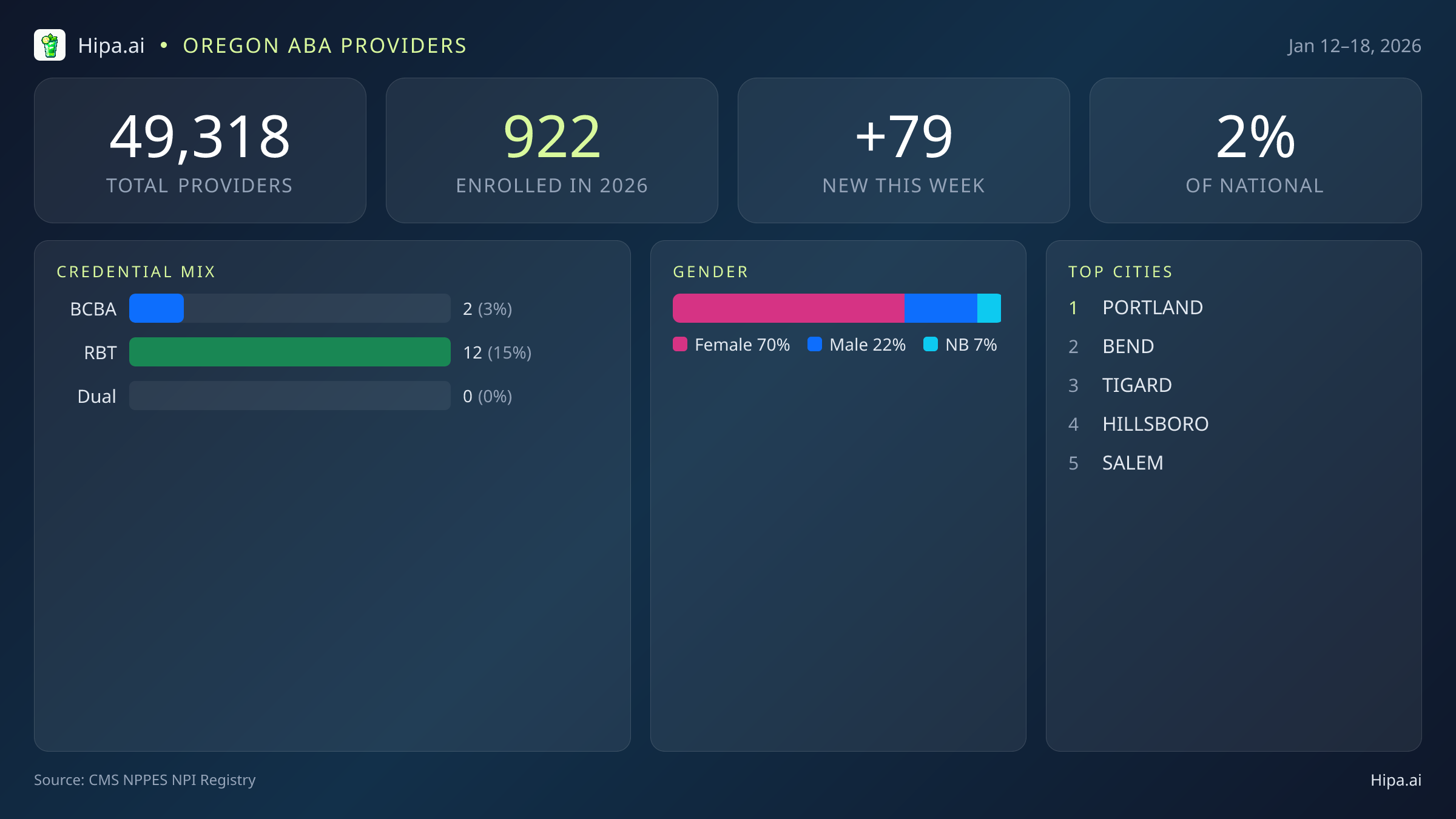
Oregon added 79 behavioral health providers in the latest weekly CMS update, representing 2% of the national total. This modest share suggests a steady, rather than surging, growth in the state's behavioral health workforce, indicating a consistent but not exceptionally high demand or influx compared to larger states.
ABA Workforce Composition
Focusing on applied behavior analysis, the data includes 2 BCBAs and 12 RBTs. It's important to note that these counts can overlap if individuals hold multiple credentials or taxonomies. There were no individuals identified with dual BCBA and RBT credentials in this update. The 6-to-1 ratio of RBTs to BCBAs indicates a significant number of direct service providers relative to supervisors, which is typical in ABA and highlights the need for BCBAs to oversee RBT teams.
Provider Demographics
Among the 67 individual providers, the workforce is predominantly female, with women accounting for 70%. Male providers make up 22%, and 7% identify as nonbinary. The update did not highlight any organizations appearing multiple times, suggesting a diverse range of smaller practices or individual practitioners rather than dominant multi-state chains.
This snapshot suggests a continued, albeit measured, expansion of the ABA workforce in Oregon, with a clear need for more BCBA supervisors to support the growing RBT pool and enhance access to care.