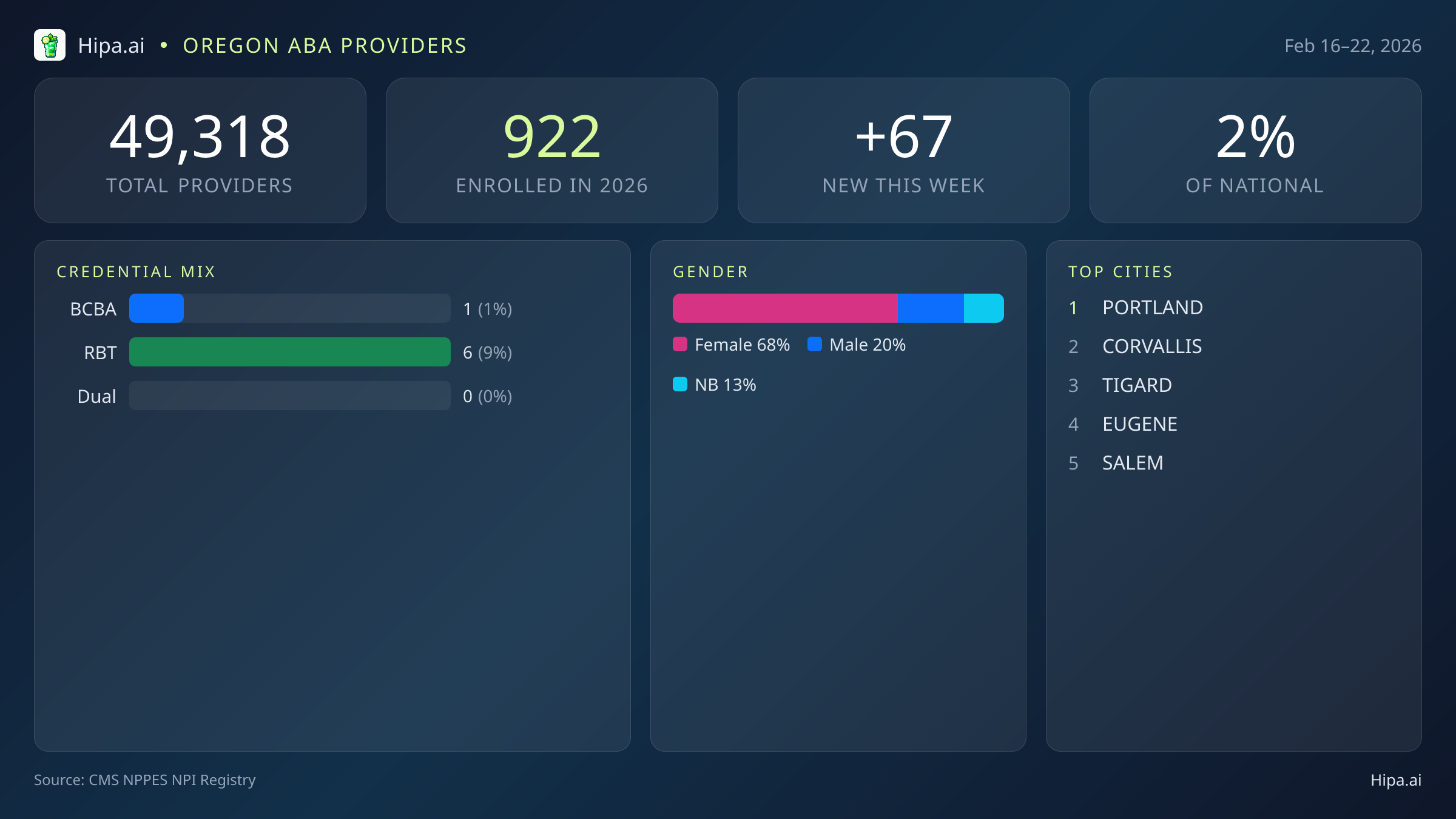
Oregon added 67 behavioral health providers in the latest weekly CMS update, accounting for 1% of the national total. This modest share indicates steady, localized growth in the state's behavioral health sector, with 56 new individual providers and 11 organizations joining the workforce this week. The additions are concentrated in cities like Portland, Corvallis, Tigard, Eugene, and Salem.
ABA Workforce Composition
Within the applied behavior analysis field, the update includes 1 Board Certified Behavior Analyst (BCBA) and 6 Registered Behavior Technicians (RBTs). No providers reported dual BCBA and RBT credentials this week. While individual providers may hold multiple credentials or taxonomies, the 6-to-1 ratio of RBTs to BCBAs suggests a high demand for direct service providers, potentially straining the supervisory capacity necessary for quality ABA service delivery in the state. This ratio is higher than the commonly recommended 2-3 RBTs per BCBA, highlighting a critical need for more BCBAs in Oregon.
Provider Demographics
Among the 56 individual providers, the workforce is predominantly female, with 38 women comprising 68% of the total. Male providers account for 11 individuals (20%), and 7 providers (13%) identify as nonbinary. No specific organizations appeared multiple times in this week's data, suggesting a diverse entry of smaller practices rather than expansion by dominant multi-state chains.
The current data, particularly the low number of new BCBAs relative to RBTs, suggests that while Oregon's overall behavioral health workforce is expanding, specialized ABA access may face challenges in scaling to meet demand without a significant increase in supervisory-level professionals.