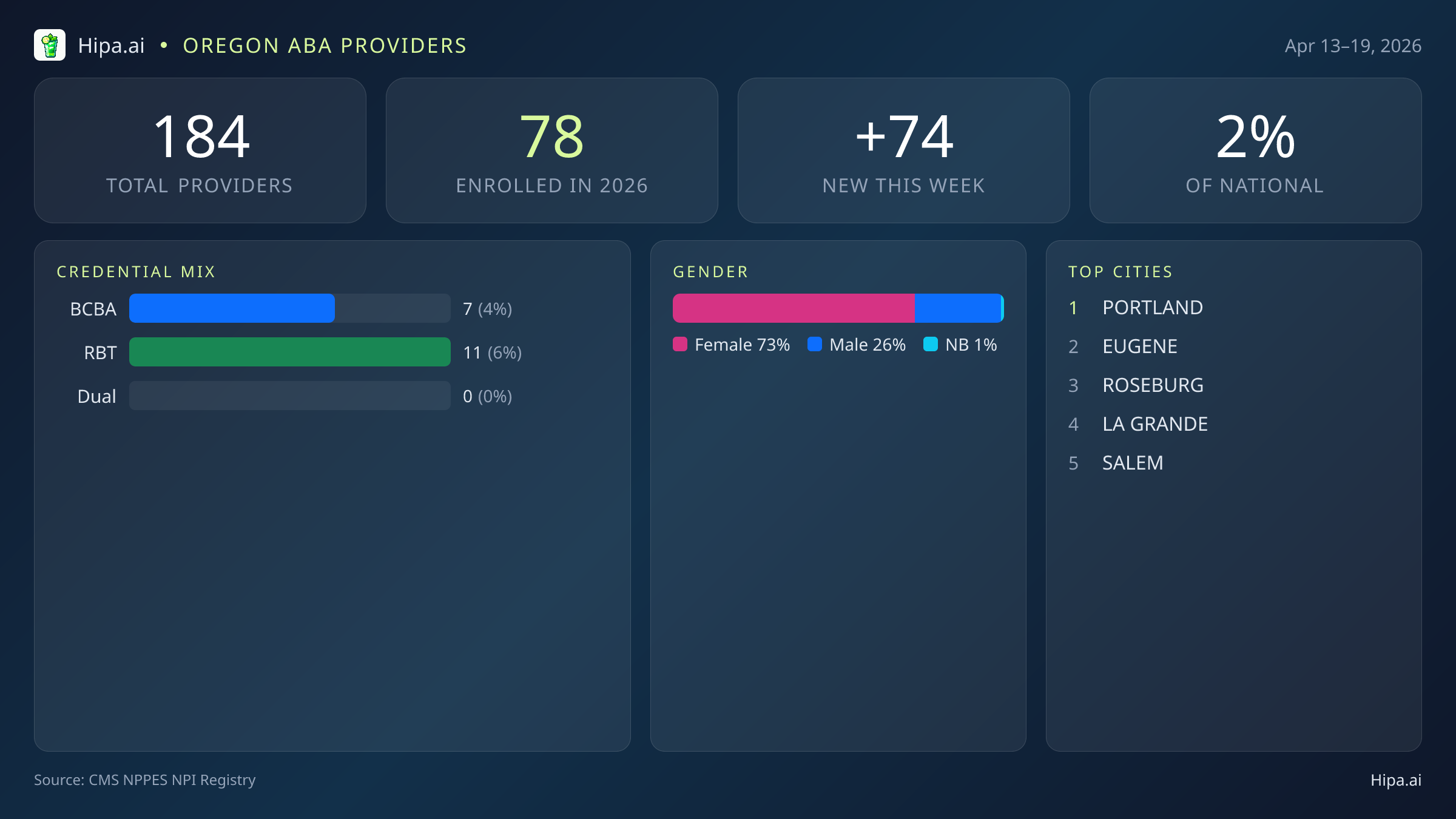
Oregon's behavioral health sector saw 184 providers in the latest CMS NPI registry update, representing 2% of the national weekly total. This moderate concentration indicates a steady, rather than explosive, growth in the state's behavioral health workforce, reflecting ongoing demand for services across various behavioral health disciplines.
Credential Mix and Supervision Capacity
Focusing on the ABA workforce, the data identifies 7 Board Certified Behavior Analysts (BCBAs) and 11 Registered Behavior Technicians (RBTs) by credential. It is important to note that these counts reflect the primary credential listed, and some providers may hold multiple certifications or different taxonomies. There were no providers explicitly listed with dual BCBA and RBT credentials in this update. The ratio of RBTs to BCBAs suggests a relatively tight supervision capacity for ABA services, which could impact the scalability of direct RBT services if not balanced by other LBA-level professionals.
Workforce Demographics and Organizational Presence
Among the 153 individual providers, the workforce is predominantly female, with 112 women comprising 73%. Male providers account for 40 individuals, or 26%, while 1 individual identifies as nonbinary, making up 1%. On the organizational side, "CENTER FOR HUMAN DEVELOPMENT, INC." appeared most frequently, listed 3 times, suggesting a significant regional presence for this entity in Oregon.
This snapshot of Oregon's behavioral health landscape points to a growing but potentially supervision-constrained ABA workforce, with a clear need for more BCBA-level professionals to support RBTs and expand access to care.