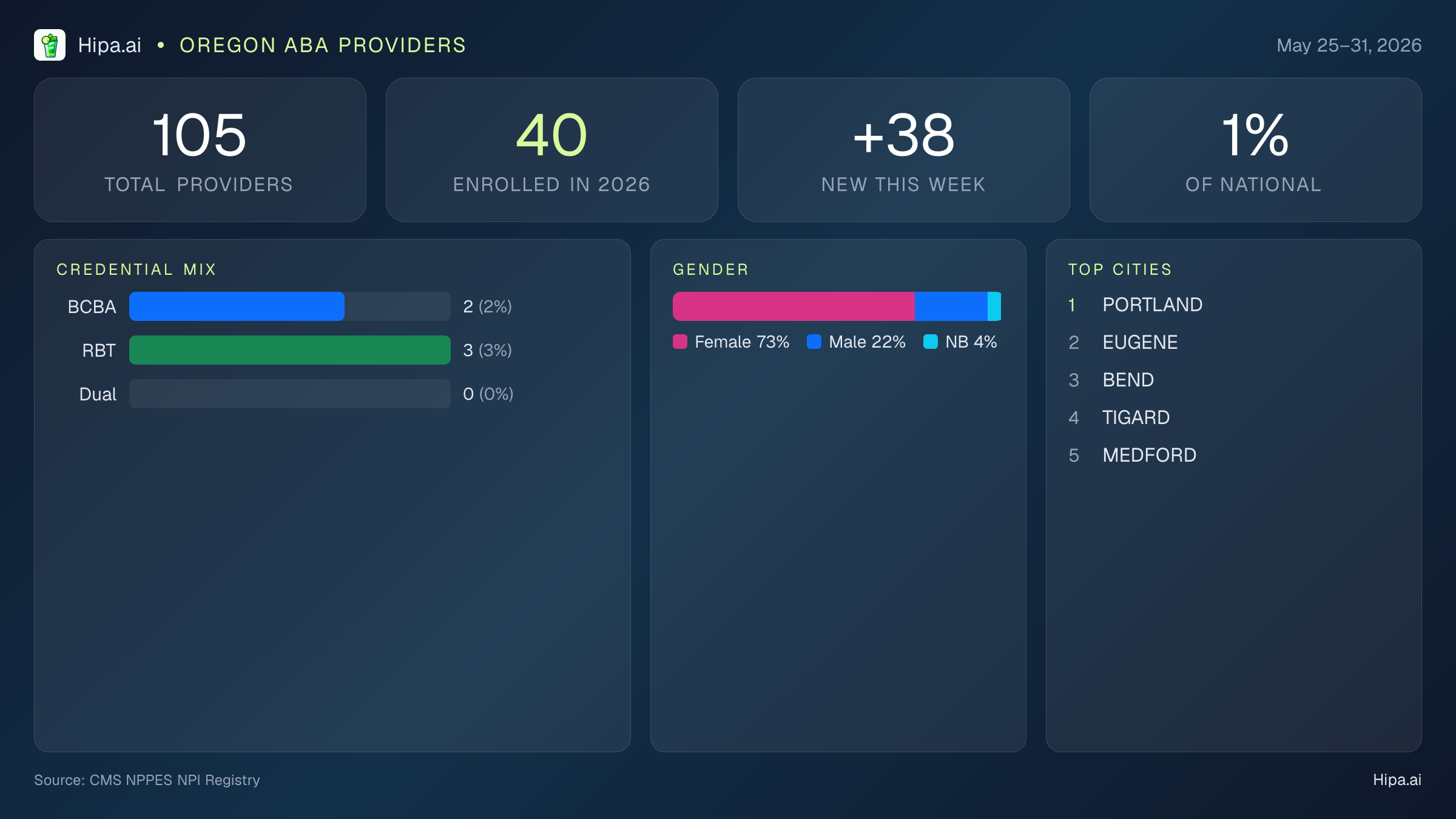
Oregon added 105 behavioral health providers in the latest CMS NPI registry weekly update, accounting for 1% of the national total. This consistent, albeit smaller, influx of new providers signals ongoing demand for mental health and behavioral services across the state, even if not at the scale of larger markets.
ABA Workforce Dynamics
Focusing on the applied behavior analysis (ABA) sector, the data shows 2 BCBA credentials and 3 RBT credentials. It is important to note that these are credential counts and not mutually exclusive categories; no individuals were reported holding both BCBA and RBT credentials in this update. The very low number of BCBAs compared to RBTs points to a significant challenge in supervision capacity. For ABA clinics, this ratio indicates that while there are RBTs available for direct service delivery, the limited number of BCBAs could hinder the ability to expand services, maintain high-quality supervision, and meet the growing need for ABA therapy in Oregon.
Provider Demographics and Organizational Presence
Among the 94 individual providers, the workforce shows a clear gender distribution: 69 (73%) are female, 21 (22%) are male, and 4 (4%) identify as nonbinary. This aligns with broader trends in the behavioral health field, which is predominantly female. No specific organizations were noted as appearing multiple times in this week's registrations, suggesting a diverse range of smaller practices or individual practitioners rather than dominant multi-state chains expanding rapidly.
Overall, while Oregon continues to see new behavioral health professionals, the specific scarcity of BCBAs relative to RBTs suggests that strategic efforts to bolster the supervisory workforce will be crucial for improving ABA access and ensuring sustainable growth in the state.