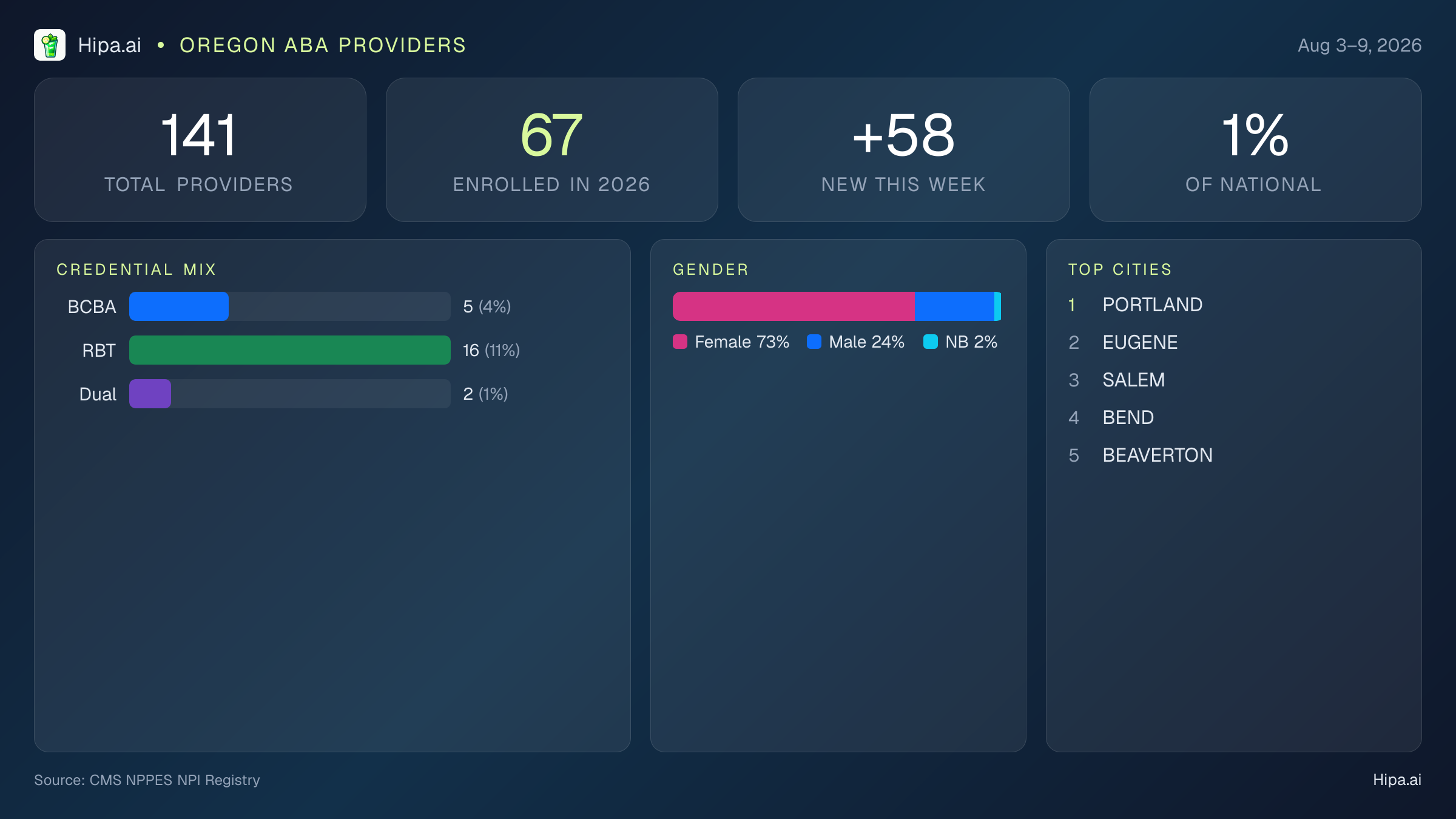
Oregon recorded 141 providers in the latest CMS NPI registry weekly update, equal to 1% of the national weekly total. With 58 new providers added this week and 67 added this year, the state represents a modest portion of national activity but shows meaningful current expansion. The registry includes 124 individuals and 17 organizations, indicating that most new activity is tied to individual practitioners rather than provider entities.
ABA Workforce Mix
The ABA-related data lists 5 BCBA credentials and 16 RBT credentials, along with 2 dual BCBA-RBT credentials. These categories overlap: dual-credentialed providers are included in both the BCBA and RBT counts, so they should not be added as separate people or treated as mutually exclusive shares. The resulting pattern points to a larger direct-service workforce than supervisory workforce. Because BCBAs design treatment plans and supervise RBTs, the relatively small BCBA count may constrain supervision capacity as RBT participation grows.
Demographics and Provider Pattern
Among providers with reported gender data, 91 female providers represented 73%, compared with 30 male providers at 24% and 3 nonbinary providers at 2%. The registry identifies no notable organization appearing multiple times. Activity is concentrated across Portland, Eugene, Salem, Bend and Beaverton, while additional entries span smaller and rural communities.
Oregon’s mix suggests expanding behavioral health capacity, but ABA access may depend on developing more BCBA supervisors to support its RBT workforce across both metropolitan and less-populated areas.