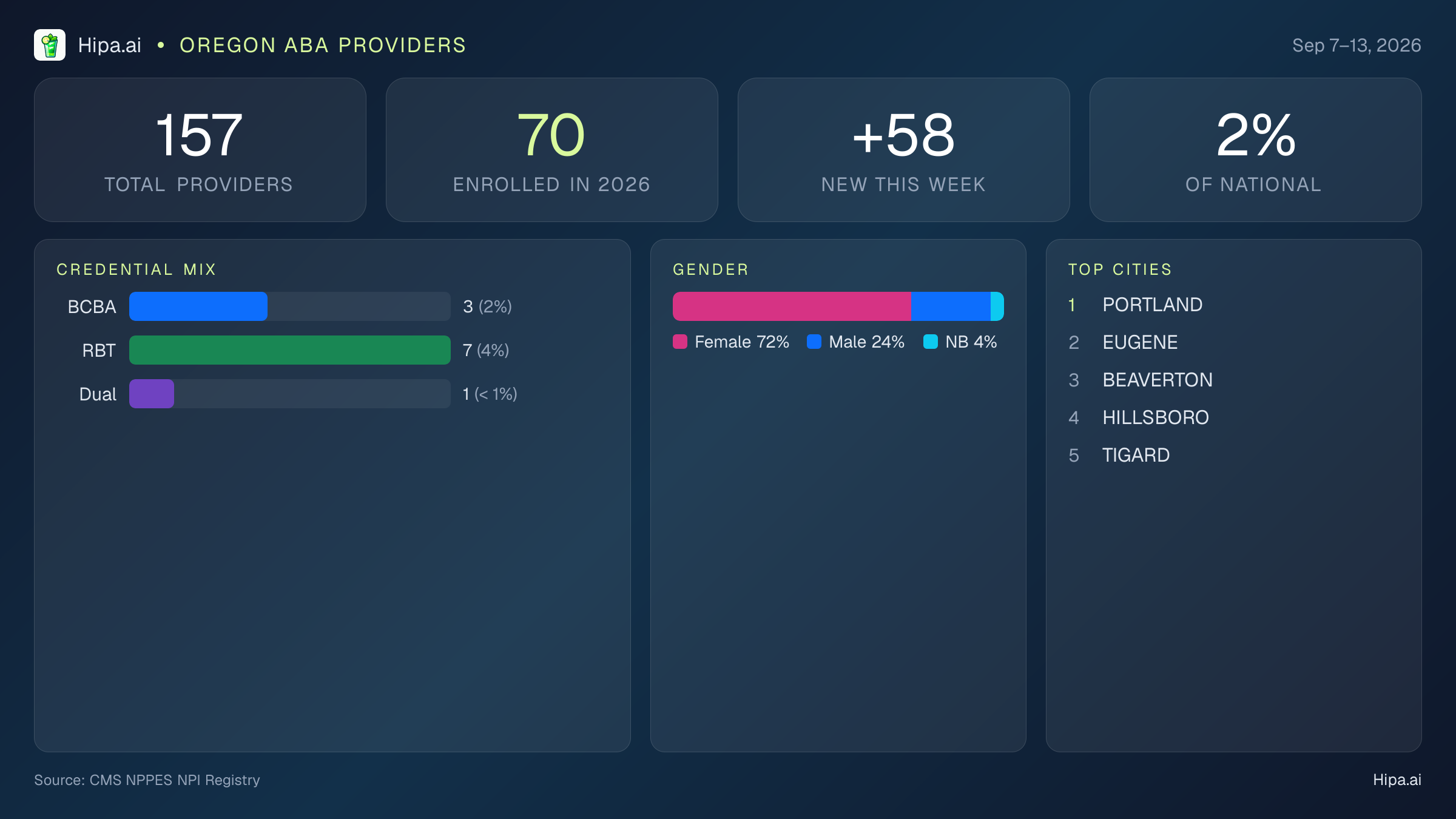
| ABOUSAMRA, ANGELA | BEAVERTON, OR | LMSW, LBS-PA | Counselor | 07/14/2015 |
| ABRAMS, ALEXANDER | EUGENE, OR | - | Mental Health Counselor | 09/09/2026 |
| ACADIA HEALTHCAREORG | TIGARD, OR | - | Addiction (Substance Use Disorder) Counselor | 10/14/2024 |
| ADAMS, JESSICA | MEDFORD, OR | LCPC; LPC | Counselor | 05/27/2014 |
| AKOTH, GRACE | BEAVERTON, OR | - | RBT | 09/10/2026 |
| ALBERTSON, KRISTINE | REDMOND, OR | SLP | Speech-Language Pathologist | 06/15/2009 |
| ANDREWS, ROBIN | THE DALLES, OR | - | Addiction (Substance Use Disorder) Counselor | 01/16/2025 |
| ARMENDARIZ COUNSELING LPC, LLCORG | CLACKAMAS, OR | - | Mental Health Counselor | 09/11/2026 |
| AVELAR, ALYSSA | EUGENE, OR | PSYCHOLOGISTRESIDENT | Mental Health Counselor | 08/29/2025 |
| AYACH, DANIA | PORTLAND, OR | - | Mental Health Counselor | 04/17/2025 |
| BARLOW, HALEY | WOODBURN, OR | - | Case Management Agency | 12/21/2020 |
| BARNES, HUNTER | HILLSBORO, OR | - | Mental Health Counselor | 09/07/2026 |
| BARNETT, CLAIRE | HILLSBORO, OR | - | BCBA | 09/10/2026 |
| BARRAGAN-ISIDORO, LUZ | EUGENE, OR | - | Mental Health Counselor | 04/14/2025 |
| BEARHEART THERAPY LLCORG | LA PINE, OR | - | Community/Behavioral Health Agency | 09/10/2026 |
| BETZ, ANTHONY | TUALATIN, OR | - | Professional Counselor | 08/21/2026 |
| BEVILLE, AMELIA | SALEM, OR | - | Specialist | 09/10/2026 |
| BISQUERA, JAZMYNE | MILWAUKIE, OR | - | Case Manager/Care Coordinator | 09/09/2026 |
| BLACK MEN & WOMEN IN TRAININGORG | PORTLAND, OR | - | Mental Health Counselor | 10/11/2022 |
| BLACKWELL, KAREN | EUGENE, OR | LCSW | Clinical Social Worker | 11/08/2022 |
| BLAIR, PAIGE | KEIZER, OR | - | Case Manager/Care Coordinator | 09/08/2026 |
| BOASE, KATHLEEN | CORVALLIS, OR | LPC | Professional Counselor | 01/15/2024 |
| BOBO, BRITNI | BAKER CITY, OR | - | Case Manager/Care Coordinator | 11/06/2025 |
| BRIDGES TO WELLBEING LLCORG | MEDFORD, OR | - | Mental Health Counselor | 02/19/2021 |
| BRIVIC, NICOLE | LAKE OSWEGO, OR | - | Case Manager/Care Coordinator | 09/10/2026 |
| BROWN, JEFFRY | KEIZER, OR | - | Mental Health Counselor | 09/12/2026 |
| BURNER, PEPPER | PORTLAND, OR | - | Specialist | 09/10/2026 |
| BURNETT, LINNEA | MEDFORD, OR | MS | Mental Health Counselor | 07/15/2025 |
| CALVILLO-MENDOZA, MARTHA | HEPPNER, OR | - | Mental Health Counselor | 09/11/2026 |
| CAMPBELL, CHEYENNE | PORTLAND, OR | CADC | Addiction (Substance Use Disorder) Counselor | 09/10/2026 |
| CAMPBELL, CORI | TIGARD, OR | - | Mental Health Counselor | 09/08/2026 |
| CARTER, BRITNEY | GRANTS PASS, OR | - | Mental Health Counselor | 05/02/2023 |
| CHANCE TO CHANGE SUPPORTIVE SERVICES OF OREGON INCORG | PORTLAND, OR | - | Mental Health Counselor | 09/09/2026 |
| CHANCE, KARA | ALBANY, OR | LCSW | Clinical Social Worker | 08/03/2021 |
| CHAVEZ-AYERS, AMAYA | TIGARD, OR | LPC | Professional Counselor | 12/16/2020 |
| CHAYADI, CAROLINE | TIGARD, OR | - | Addiction (Substance Use Disorder) Counselor | 09/08/2026 |
| CIRILLO, RYAN | PORTLAND, OR | QMHA-R | Case Manager/Care Coordinator | 09/08/2026 |
| CLORE, BRAD | BEND, OR | CADC1, CRM | Addiction (Substance Use Disorder) Counselor | 09/07/2026 |
| COMELLA, STEPHEN | WOODBURN, OR | LPC, MAC, CADC III | Case Manager/Care Coordinator | 06/28/2007 |
| COTE, KRYSTEN | PORTLAND, OR | MA | Case Manager/Care Coordinator | 06/18/2012 |
| CRAIG, AMBER | PORTLAND, OR | PCA, QMHP | Mental Health Counselor | 09/08/2021 |
| CROCKER, ALEXANDRA | BEAVERTON, OR | - | Mental Health Counselor | 09/10/2026 |
| CROWDER, MARIAH | HEPPNER, OR | - | Mental Health Counselor | 09/10/2026 |
| DALTON, ROSEMARY | ASHLAND, OR | M.S.W. | Mental Health Counselor | 11/17/2005 |
| DAVIS, KEN | SAINT HELENS, OR | BSW, CDP | Addiction (Substance Use Disorder) Counselor | 09/11/2017 |
| DAYNA COURY COUNSELING LLCORG | EUGENE, OR | - | Mental Health Counselor | 08/24/2026 |
| DE ARAUJO SANCHEZ, MARIA-ALEJANDRA | HILLSBORO, OR | LCSW | Clinical Social Worker | 02/16/2017 |
| DEHART, MILICENT | PORTLAND, OR | - | Mental Health Counselor | 09/09/2026 |
| DEINA K OLSTAD COUNSELING & PSYCHOTHERAPYORG | PORTLAND, OR | - | Mental Health Counselor | 05/13/2026 |
| DELA ROSA, NOREEN RENAE | GRESHAM, OR | - | Mental Health Counselor | 11/01/2022 |
| DIRKS THERAPY SERVICES LLCORG | MCMINNVILLE, OR | - | Speech-Language Pathologist | 09/08/2026 |
| DIRKS, KYLA | MCMINNVILLE, OR | M.S., CCC-SLP | Speech-Language Pathologist | 07/20/2014 |
| DIRU, IFEANYICHUKWU | SALEM, OR | - | Mental Health Counselor | 09/11/2026 |
| DRWENSKI, ANDREW | BEAVERTON, OR | LCSW | Clinical Social Worker | 02/24/2021 |
| DURAN, ERIN | GRESHAM, OR | QMHA | Specialist | 01/17/2022 |
| ELLIS, EVAN | PORTLAND, OR | PCA | Mental Health Counselor | 09/10/2026 |
| ERICKSON, LINDSEY | SALEM, OR | LCSW | Mental Health Counselor | 09/10/2026 |
| ESTY, JULIE | BEAVERTON, OR | - | Mental Health Counselor | 09/09/2026 |
| FAIRCHILD-MADAR, EMILY | PORTLAND, OR | LPC | Professional Counselor | 07/16/2014 |
| FERGUSON, SHAELI | NEWBERG, OR | M.A., LPC | Mental Health Counselor | 04/22/2020 |
| FRANKE, RANDENA | HAPPY VALLEY, OR | QMHA | Counselor | 12/26/2012 |
| FREEDOM PATH COUNSELING LLCORG | SPRINGFIELD, OR | - | Professional Counselor | 04/27/2023 |
| GALATO, MIMI | GRESHAM, OR | - | Case Manager/Care Coordinator | 09/11/2026 |
| GIDDENS, GLORIA | OREGON CITY, OR | - | Counselor | 01/23/2017 |
| GODSHALL, TIMOTHY | SALEM, OR | M.A., LMHC, LPCA | Mental Health Counselor | 07/01/2024 |
| GONCE, LAURA | PORTLAND, OR | LCSW | Clinical Social Worker | 02/26/2009 |
| GORELIK, VERONIKA | PORTLAND, OR | - | Mental Health Counselor | 09/11/2026 |
| GRACE, JON | BEND, OR | PSS-YS, QMHA-R | Mental Health Counselor | 11/05/2024 |
| GRAMME, HEATHER | LA PINE, OR | MSW, MSG | Clinical Social Worker | 06/03/2014 |
| GRIFFITH, CARMEN | ALBANY, OR | - | Speech-Language Pathologist | 09/09/2026 |
| HALL, CLAUDE | EUGENE, OR | LCSW, CADCIII | Addiction (Substance Use Disorder) Counselor | 04/25/2012 |
| HAMMOND, JESSICA | EUGENE, OR | LCSW, PMH-C | Mental Health Counselor | 08/08/2013 |
| HANSEN, DAWN | EUGENE, OR | - | Professional Counselor | 06/24/2025 |
| HAWKINS, DIANA | EUGENE, OR | QMHP, MASTERS | Mental Health Counselor | 07/07/2015 |
| HILL, LISA | SALEM, OR | - | Case Manager/Care Coordinator | 01/06/2026 |
| JOHNSON, JANAE | TIGARD, OR | QMHA | Mental Health Counselor | 06/25/2019 |
| KEYS, CHARLES | BAKER CITY, OR | - | Mental Health Counselor | 10/08/2025 |
| KINGSTON, ORION | PORTLAND, OR | QMHP-C | Mental Health Counselor | 09/08/2022 |
| KOCHENDORFER, JOSIE | TIGARD, OR | - | Mental Health Counselor | 09/11/2026 |
| KURZENHAUSER, STEPHANIE | PORTLAND, OR | MSW, LCSW | Clinical Social Worker | 07/10/2024 |
| KYLEE M PETERSON LLCORG | BEAVERTON, OR | - | Community/Behavioral Health Agency | 09/10/2026 |
| LEFEVER, CHEYENNE | MCMINNVILLE, OR | - | Mental Health Counselor | 12/29/2025 |
| LEONARDI, KATHRYN | PORTLAND, OR | - | Clinical Social Worker | 04/21/2016 |
| MAGDELAIN, HALEIGH | TUALATIN, OR | - | RBT | 08/20/2026 |
| MARSH, TABITHA | MCMINNVILLE, OR | DACM | Mental Health Counselor | 09/15/2008 |
| MARTEN, KATERINA | BURNS, OR | - | Addiction (Substance Use Disorder) Counselor | 09/10/2026 |
| MARTIN, HOLLY | GEARHART, OR | - | Speech-Language Pathologist | 09/09/2026 |
| MARTIN, KRISTEN | HILLSBORO, OR | R9932 | Mental Health Counselor | 03/18/2026 |
| MARTINEZ, LAURA | PORTLAND, OR | - | RBT | 09/08/2026 |
| MAUGE, JUDE | TUALATIN, OR | - | BCBA | 02/04/2022 |
| MCBRYAN, ALLISON | PHOENIX, OR | - | Counselor | 09/11/2026 |
| MCMILLAN, HANNAH | TIGARD, OR | - | Mental Health Counselor | 09/11/2026 |
| METRO TREATMENT OF OREGON LPORG | GRESHAM, OR | - | Addiction (Substance Use Disorder) Counselor | 01/27/2026 |
| MILLER, SCOTT | PORTLAND, OR | - | Clinical Social Worker | 04/27/2009 |
| MOA-ANDERSON, LEIF | PORTLAND, OR | MA, LMHC | Mental Health Counselor | 01/11/2011 |
| MURPH, WESLEY | PORTLAND, OR | LPC | Mental Health Counselor | 01/26/2021 |
| NELSON, BRYAN | PORTLAND, OR | PSYD | Counselor | 07/25/2012 |
| O'DELL, LISA | PORTLAND, OR | M.S., LMHC, LPC | Mental Health Counselor | 09/06/2016 |
| OGBEAMA, VITALIS | GRESHAM, OR | - | Mental Health Counselor | 06/23/2026 |
| OLSTAD, DEINA | PORTLAND, OR | LPC, LCMHC | Mental Health Counselor | 10/16/2025 |
| OSBORN, LORA | BEAVERTON, OR | - | RBT | 09/08/2026 |
| PACIFIC ADVOCACY CENTER NORTHWESTORG | HILLSBORO, OR | - | Clinical Social Worker | 09/04/2026 |
| PACIFIC UNIVERSITYORG | HILLSBORO, OR | - | Clinic/Center | 08/25/2006 |
| PALOSAARI, TYLER | PORTLAND, OR | - | Addiction (Substance Use Disorder) Counselor | 11/18/2024 |
| PANKEY, BRADLEY | PORTLAND, OR | - | Mental Health Counselor | 10/20/2021 |
| PARKS, RHONDA | EUGENE, OR | - | Addiction (Substance Use Disorder) Counselor | 10/03/2023 |
| PARMER, BRIAN | MEDFORD, OR | BS | Addiction (Substance Use Disorder) Counselor | 05/23/2016 |
| PEDERSON, NAOMI | EUGENE, OR | - | Professional Counselor | 10/06/2022 |
| PETERMAN, BETHANY | GRESHAM, OR | LPC CADCIII | Mental Health Counselor | 03/03/2015 |
| PLESSMAN, SAMANTHA | WILSONVILLE, OR | M.S. CCC-SLP | Speech-Language Pathologist | 01/12/2016 |
| POOLE, DALTON | ROSEBURG, OR | - | Mental Health Counselor | 09/09/2026 |
| PRYCE, VYNCENT | PORTLAND, OR | CADC | Addiction (Substance Use Disorder) Counselor | 01/23/2024 |
| RADIE, LOUIS | PORTLAND, OR | - | Mental Health Counselor | 02/17/2023 |
| RALPH, RUTH | EUGENE, OR | LPC | Professional Counselor | 03/11/2013 |
| REAM, AHNIKA | PORTLAND, OR | MA | Mental Health Counselor | 03/29/2022 |
| REED, CAMEO | TROUTDALE, OR | - | Case Manager/Care Coordinator | 09/10/2026 |
| REEVES, ASHLYN | PORTLAND, OR | - | Addiction (Substance Use Disorder) Counselor | 09/10/2026 |
| RILEY, DEAN | WOODBURN, OR | - | Day Training/Habilitation Specialist | 02/08/2018 |
| RITTER, MEGAN | PORTLAND, OR | QMHA | Mental Health Counselor | 05/24/2011 |
| RODGERS, CHAYLAH | KLAMATH FALLS, OR | - | Case Manager/Care Coordinator | 09/08/2026 |
| ROMERO- ABARCA, JASMINE | OREGON CITY, OR | - | Counselor | 09/10/2026 |
| ROTT, SAMANTHA | PORTLAND, OR | MA, MFTA, PCA, LMHCA | Mental Health Counselor | 04/11/2022 |
| RUIZ CASTRO, MARBELLA | MEDFORD, OR | QMHA | Case Manager/Care Coordinator | 09/11/2026 |
| RUSSELL, CELESTIA | ROSEBURG, OR | - | Case Manager/Care Coordinator | 09/09/2026 |
| SACRED PATH COMPASSION & RECOVERY SERVICES LLCORG | GRANTS PASS, OR | - | Community/Behavioral Health Agency | 09/10/2026 |
| SAFRAN, KAI | ASHLAND, OR | - | Mental Health Counselor | 09/09/2026 |
| SCHILLING, MAGGIE | WOODBURN, OR | CSWA | Clinical Social Worker | 01/23/2023 |
| SEMKE, JACOB | GRANTS PASS, OR | - | Addiction (Substance Use Disorder) Counselor | 09/08/2026 |
| SHARP, CAYDEN | TIGARD, OR | - | Counselor | 04/21/2025 |
| SIAKA, KWABENA | PORTLAND, OR | - | Addiction (Substance Use Disorder) Counselor | 06/03/2015 |
| SIDO, NEJMA | PORTLAND, OR | - | Case Manager/Care Coordinator | 09/11/2026 |
| SMITH, SOPHIE | SAINT HELENS, OR | - | Clinical Social Worker | 09/08/2026 |
| SPELLMAN, MEGAN | GRANTS PASS, OR | M.S. SLP | Speech-Language Pathologist | 09/08/2026 |
| SPRINKLE, AVERY | BROOKINGS, OR | - | Mental Health Counselor | 09/09/2026 |
| STEPHANIE LANGENFELD, LCSW, LLCORG | PORTLAND, OR | - | Mental Health Counselor | 09/11/2026 |
| STEVE COMELLA COUNSELING, LLCORG | WOODBURN, OR | - | Addiction (Substance Use Disorder) Counselor | 09/07/2026 |
| STEWART, CHARLI | HILLSBORO, OR | - | BCBA | 09/10/2026 |
| STONE, SUZANNE | EUGENE, OR | - | Mental Health Counselor | 08/31/2026 |
| SUGUITAN, BREANNA | PORTLAND, OR | - | Mental Health Counselor | 05/31/2025 |
| SUNDBERG, KYLEA | PORTLAND, OR | - | Professional Counselor | 08/11/2023 |
| THAYER, EVAN | BEAVERTON, OR | LCSW | Clinical Social Worker | 10/07/2019 |
| THERAPY PORTLAND CORPORATION PCORG | PORTLAND, OR | - | Clinical Social Worker | 08/06/2024 |
| TRUECARE CONNECTIONS, LLCORG | BEAVERTON, OR | - | Mental Health Counselor | 09/23/2025 |
| UNVERRICH, LAURA | GRESHAM, OR | - | Mental Health Counselor | 10/19/2022 |
| VALUE CREATION EDUCATIONAL AND COUNSELING SERVICES PDX LLCORG | PORTLAND, OR | - | Addiction (Substance Use Disorder) Counselor | 07/08/2026 |
| VAZQUEZ DUQUE, DIANA | PORTLAND, OR | PHD | Mental Health Counselor | 07/03/2019 |
| WALLACE, MAX | ALBANY, OR | LCSW | Clinical Social Worker | 09/20/2023 |
| WARREN, SAMANTHA | SALEM, OR | - | Mental Health Counselor | 09/11/2026 |
| WELCH, APRIL | CORVALLIS, OR | - | Addiction (Substance Use Disorder) Counselor | 11/23/2021 |
| WENZEL, PEPPER | BAKER CITY, OR | - | Mental Health Counselor | 05/16/2024 |
| WEST, MYRANDA | PORTLAND, OR | PWS/ QMHA-R | Addiction (Substance Use Disorder) Counselor | 03/25/2025 |
| WILKINS, TIMOTHY | PORTLAND, OR | QMHP-C | Counselor | 09/04/2017 |
| WOOD, RACHAEL | ALBANY, OR | BS | RBT | 11/05/2019 |
| WRIGHT, JOSIE | PORTLAND, OR | - | RBT | 09/08/2026 |
| YOUNG, ASHLYN | PORTLAND, OR | LPC | Professional Counselor | 09/29/2022 |
| YOUNGREN, TARA | HILLSBORO, OR | - | Speech-Language Pathologist | 09/10/2026 |
| ZAHM, JENNIFER | REDMOND, OR | - | Mental Health Counselor | 09/01/2026 |